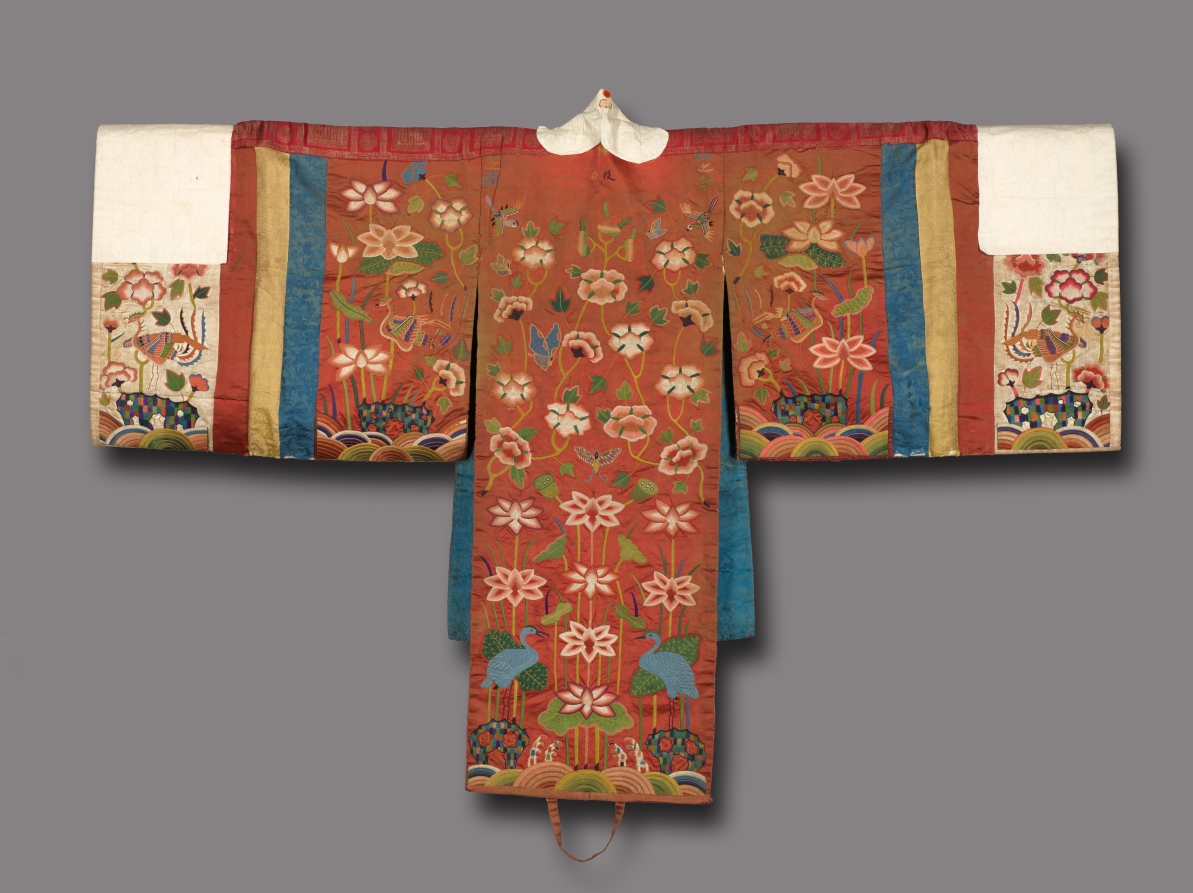
The Hwarot: A Confluence of Imperial Legacy and Artisanal Mastery
In the rarefied echelons of heritage textiles, few artifacts command the reverence afforded to the Hwarot—the Korean bridal robe that transcends mere garment to become a testament to the enduring legacy of imperial silk weaving. As Senior Heritage Specialist for Lauren Fashion Heritage Lab, I have had the privilege of examining this extraordinary piece within the context of its materiality: silk, that most noble of fibers, which has for millennia been the currency of power, ritual, and artistic expression across East Asia. This paper posits that the Hwarot, through its meticulous construction and symbolic lexicon, represents the apogee of a silk-weaving tradition that originated in the imperial courts of China and was refined to exquisite perfection in Joseon Dynasty Korea (1392–1910).
The Hwarot is not merely a garment; it is a narrative woven in silk. Its provenance lies in the royal silkworm farms of the Korean peninsula, where the cultivation of Bombyx mori was elevated to a state-sponsored art. The silk used in these robes was of the highest grade—often sang-ok, a term denoting a lustrous, tightly woven fabric that could support the weight of intricate embroidery without distortion. This silk was the product of a supply chain that mirrored the precision of a Savile Row tailoring house: from the mulberry leaves fed to silkworms in Gyeongsang Province to the dye vats of Hanseong (modern Seoul), every step was governed by protocols that ensured consistency and quality. The resulting fabric possessed a drape and sheen that, even after centuries, retains a luminous depth—a quality that bespeaks the weaver’s mastery of tension and thread count.
Materiality and Construction: The Silk as Structural Foundation
To understand the Hwarot is to appreciate the structural integrity of its silk. Unlike the gossamer silks of European couture, which often prioritize fluidity over form, the Hwarot’s silk was engineered to serve as a canvas for narrative. The fabric was typically woven in a satin weave, which provided a smooth, reflective surface that enhanced the vibrancy of the embroidered motifs. This choice was deliberate: the satin ground, often in shades of crimson, indigo, or emerald, was dyed using natural pigments derived from cochineal, indigo, and gardenia—each color carrying specific symbolic weight. Crimson, for instance, signified prosperity and warding off evil, while indigo represented heaven and eternity. The dyeing process itself was a closely guarded craft, requiring multiple immersions to achieve the depth of hue that would not fade over generations.
The construction of the Hwarot reveals a bespoke approach that would resonate with the ethos of a Savile Row cutter. Each robe was tailored to the bride’s measurements, with seams that were hand-stitched using silk thread of matching color—a technique that ensured the garment’s structural longevity. The sleeves, often exaggeratedly wide, were not merely decorative; they were designed to allow for the layering of ceremonial undergarments, a practical consideration that nonetheless contributed to the robe’s majestic silhouette. The collar, typically a V-neckline, was reinforced with a silk interlining that prevented sagging—a detail that underscores the weaver’s understanding of how fabric behaves under the weight of embroidery. This attention to functional elegance is the hallmark of a tradition that valued both form and utility.
The Legacy of Imperial Silk Weaving: From China to Korea
The Hwarot’s silk heritage cannot be divorced from the broader legacy of imperial silk weaving that originated in China’s Tang and Song dynasties. Korean weavers, however, adapted this tradition with a distinctive restraint. Where Chinese imperial silks often favored opulent gold thread and dense patterns, the Hwarot’s embroidery—executed in flat and couching stitches—maintained a balance between richness and clarity. The motifs—peonies for wealth, bats for happiness, and phoenixes for union—were rendered in silk floss that was untwisted to create a matte finish, contrasting with the lustrous ground. This interplay of textures is a masterclass in tactile storytelling.
The imperial patronage of silk weaving in Korea reached its zenith during the Joseon Dynasty, when the Royal Bureau of Silk was established to oversee production for the court. The Hwarot, though worn by brides of the yangban (aristocratic) class, was a direct beneficiary of this institutional knowledge. The weavers who produced these robes were often hereditary artisans, their skills passed down through generations—a lineage that mirrors the apprenticeship model of London’s tailoring houses. This continuity ensured that the techniques of warp-faced weaving and resist dyeing were preserved with a fidelity that modern industrial processes cannot replicate.
Preservation and Contemporary Relevance
In the context of the Lauren Fashion Heritage Lab, the Hwarot serves as a case study in sustainable luxury. The robe’s construction—using natural dyes, hand-weaving, and embroidery—offers a counterpoint to the disposability of fast fashion. Its preservation requires climate-controlled storage at 18–20°C with 50–55% relative humidity, and handling protocols that include acid-free tissue and UV-filtered lighting. These measures are not merely technical; they are an acknowledgment that the Hwarot’s silk is a living archive of a craft that is now endangered. The Master Weavers of Korea, recognized as Intangible Cultural Heritage, continue to practice these techniques, but their numbers are dwindling.
For the modern fashion scholar, the Hwarot offers lessons in material integrity. Its silk, when examined under magnification, reveals a uniformity of thread diameter that speaks to the weaver’s precision—a quality that contemporary silk producers often sacrifice for speed. The robe’s colorfastness, even after 200 years, is a testament to the chemical mastery of natural dyeing. These attributes challenge the industry to reconsider the value of slowness in production.
In conclusion, the Hwarot is not merely a bridal robe; it is a manifesto of silk’s potential. Its materiality—the silk, the dyes, the embroidery—embodies a dialogue between imperial legacy and artisanal skill. As we at the Lauren Fashion Heritage Lab continue to study such artifacts, we are reminded that true luxury is not in the opulence of the object, but in the knowledge encoded within its threads. The Hwarot, preserved in its silk splendor, invites us to weave that knowledge into the future of fashion.