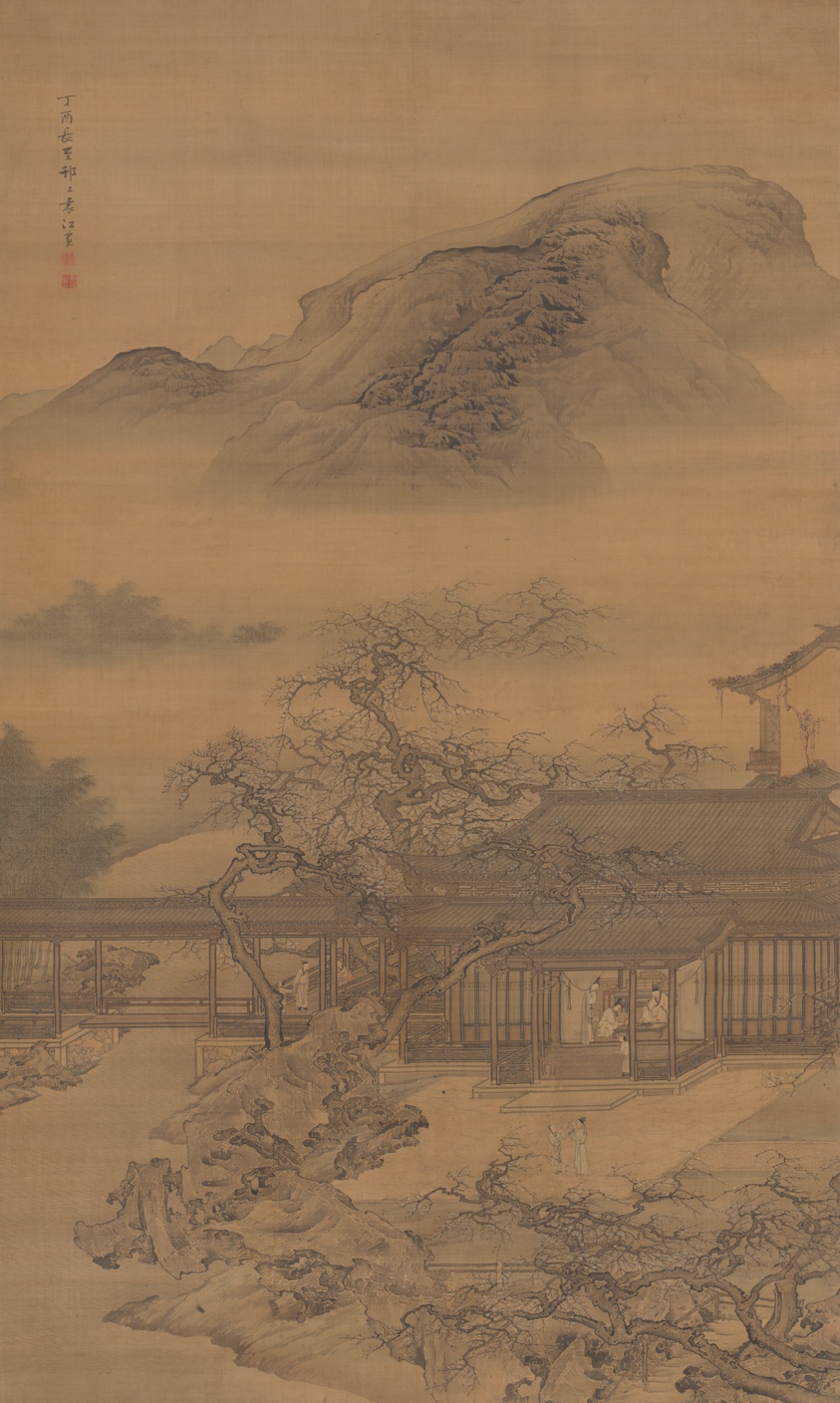
The Materiality of Memory: Deconstructing “Viewing Plum Blossoms with Warm Wine”
In the rarefied atmosphere of a Mayfair atelier, where the cut of a cloth speaks to centuries of unspoken discipline, we encounter an artifact that transcends mere decoration. “Viewing Plum Blossoms with Warm Wine” (溫酒賞梅圖) is not simply a painting; it is a testament to the symbiotic relationship between material and meaning. Hanging scroll, ink and slight color on silk—these are the precise, unadorned facts of its construction. Yet, within this technical specification lies a narrative of profound elegance, a quiet dialogue between the artisan’s hand and the scholar’s soul. This heritage research artifact, therefore, demands a forensic examination of its materiality, for in the weave of the silk and the liquidity of the ink, we find the very essence of its cultural provenance.
The Silk Ground: A Foundation of Refined Discipline
The choice of silk as the support is not arbitrary. In the lexicon of Chinese material culture, silk represents the pinnacle of refined production, a fabric that demands patience, precision, and an intimate understanding of natural processes. The hanging scroll format, with its vertical orientation, imposes a specific rhythm upon the composition. It is a format that invites contemplation, not casual glance. The silk itself, likely a fine, tabby-weave variety, possesses a subtle sheen that interacts with light in a manner that paper cannot replicate. This luminosity is not ostentatious; it is the quiet confidence of a bespoke garment—a whisper, not a shout. The slight color, applied with restraint, further acknowledges the primacy of the silk. The pigments are not meant to overpower the ground but to dance upon it, their translucency revealing the warp and weft beneath. This is the hallmark of a master: the ability to work with the material, not against it.
Consider the preparation. Before a single brushstroke is applied, the silk must be sized with alum and glue, a process that renders it both absorbent and resilient. This is the equivalent of a tailor’s basting—the unseen, unglamorous work that ensures the final garment holds its shape. The silk’s weave, typically between 40 and 60 threads per centimeter, provides a grid, a subtle architecture that guides the ink. The artist, like a Savile Row cutter, must respect this grid. The brushstrokes, whether bold or delicate, are always in dialogue with the silk’s inherent structure. The result is a surface that feels both fluid and controlled, a paradox that defines the highest echelons of craftsmanship.
Ink and Color: The Palette of Restraint
The ink, ground from soot and animal glue, is the soul of the composition. Its application on silk demands a different technique than on paper. The ink does not bleed as readily; it sits on the surface, creating a crisp, almost lacquered quality. This allows for a precision of line that is both rigorous and lyrical. In “Viewing Plum Blossoms with Warm Wine,” the ink is used to delineate the gnarled branches of the plum tree, their angular forms a counterpoint to the soft, rounded blossoms. The slight color—perhaps a wash of pale vermilion for the blossoms, a hint of green for the wine vessel—is applied with a delicacy that borders on the ascetic. It is a palette that eschews vulgar display in favor of understated sophistication. The warm wine, a symbol of conviviality and poetic inspiration, is rendered not through heavy pigment but through the implication of warmth, the suggestion of a shared moment. This is the art of suggestion, a hallmark of classical Chinese aesthetics.
The artist’s hand is evident in the modulation of the ink’s density. The branches are painted with a dry brush, the bristles splayed to create texture, while the blossoms are rendered with a wetter, more fluid stroke. This variation in technique creates a tactile quality, a sense of depth that belies the flatness of the silk. The viewer is invited to trace the line, to feel the resistance of the brush against the fabric. This is not a passive viewing experience; it is an engagement with the materiality of the work itself.
Cultural Provenance: The Scholar’s Aesthetic
To understand this artifact is to understand the cultural milieu from which it emerged. The subject—viewing plum blossoms with warm wine—is a classic trope of the Chinese literati, a celebration of resilience and refined pleasure. The plum blossom, which blooms in the harshness of winter, is a symbol of perseverance, of beauty in adversity. The warm wine, often associated with the poet Li Bai, represents the warmth of human connection, the solace of shared experience. Together, they form a meditation on the transient nature of life and the enduring value of aesthetic contemplation.
The hanging scroll format itself is a product of this scholarly tradition. It was not intended for permanent display but for occasional unrolling, a ritual of appreciation. The scroll would be stored in a wooden box, protected from light and dust, and brought out for specific occasions—a gathering of friends, a moment of personal reflection. This ephemeral quality is central to its charm. It is an object that demands attention, that rewards the patient observer. In this sense, it is the antithesis of the mass-produced, the disposable. It is a bespoke artifact, tailored to the sensibilities of its owner.
Conclusion: A Legacy of Fluid Elegance
“Viewing Plum Blossoms with Warm Wine” is more than a painting; it is a document of a civilization’s highest aspirations. Its materiality—the silk, the ink, the slight color—is not incidental but integral to its meaning. The craftsmanship is not a mere vehicle for the image; it is the image itself. The fluid elegance of the brushwork, the quiet luminosity of the silk, the restrained palette—these elements coalesce into a whole that is greater than the sum of its parts. In the world of heritage, where provenance and materiality are paramount, this artifact stands as a masterclass in the art of the understated. It is a reminder that true luxury lies not in opulence but in precision, not in abundance but in restraint. And in that, it finds its eternal resonance.