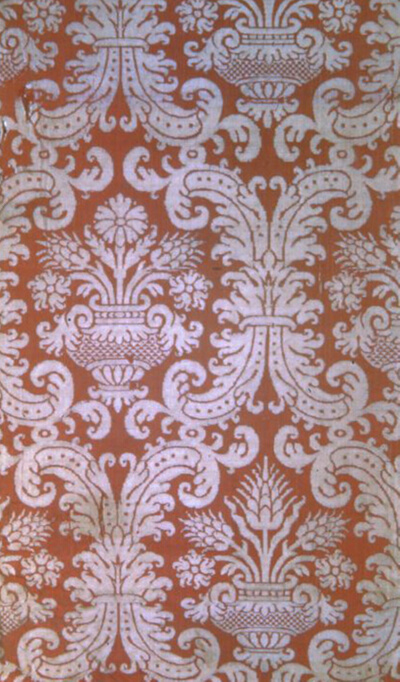
A Consideration of the Fragment
In the rarefied ateliers of our craft, we do not deal in remnants. We traffic in entirety: the complete garment, the perfected silhouette, the resolved vision. Yet, to understand the totality, one must occasionally—and with due reverence—contemplate the part. The fragment, therefore, presents not as a discard, but as a sovereign artefact; a concentrated testament to decisions made, standards upheld, and a dialogue between material and maker that speaks volumes in a square inch. The specimen under consideration: a swatch of pure silk, executed in a fancy simple satin weave. Its context is the dual canon of classic silk craftsmanship and fluid elegance. It is, in its isolated state, a manifesto.
Material Integrity: The Foundation of Fluidity
First, one must address the substance. This is not merely ‘silk’ in the generic sense, as one might find in a commonplace description. This is the pinnacle of Bombyx mori filament, a continuous thread of profound strength and innate luminosity. The choice of this base material is the first and most non-negotiable declaration. It establishes a covenant with the wearer: what follows will possess a specific gravity, a thermal intelligence, and a capacity to interact with light that no inferior fibre can mimic. The fragment, held between thumb and forefinger, communicates this immediately through its cool, dense hand-feel. It has substance without bulk, a paradox that is the very essence of luxury. This is the foundational commitment upon which all else is built; the flawless canvas for the weaver’s art.
The Architecture of Light: The Satin Weave Decoded
Upon this foundation rests the architecture: the fancy simple satin weave. Do not be misled by the modesty implied by ‘simple’. In the lexicon of textile engineering, this denotes a specific, highly disciplined arrangement. The satin weave structure is one of profound strategic cunning. By allowing the warp threads to dominate the surface, floating over multiple wefts before being interlaced, it creates an unbroken, mirror-smooth plane. Each float is a calculated risk—a potential snag point—accepted in pursuit of a higher goal: maximal reflectance.
This fragment, in its stillness, is a study in captured illumination. It does not sparkle; that is the vulgar province of the sequin. It glows. Light does not strike it so much as it is received, embraced, and re-emitted with a softened, internal radiance. The ‘fancy’ element—a subtle deviation in the float pattern—is the discreet signature of the mill, a quiet crest upon the fabric, discernible only upon the most intimate inspection. It is the equivalent of a tailor’s distinctive pick stitching: a mark of identity visible only to those who know where to look. This is not cloth designed to shout; it is cloth designed to compel through silent, sustained excellence.
The Heritage of Drape: From Fragment to Form
Which leads us to the promised fluid elegance. A fragment, by its nature, cannot drape. Yet, to the educated eye, it contains the prophecy of drape within its very structure. The density of the weave, the tensile strength of the filament yarn, the precise degree of twist—all are calibrated to produce a specific behavioural characteristic. One can, with experience, foresee how this silk will abandon the stiff rhetoric of broadcloth and embrace the complex, eloquent grammar of the body. It will not stand away from the form, nor will it cling with indecorous insistence. It will cascade. It will move with a kinetic elegance that is an extension of the wearer’s own motion, a second skin of surpassing sophistication.
This is where classic craftsmanship transcends mere technique and enters the realm of philosophy. The weaver at the loom is not simply producing yardage; he is engineering potential energy. He is pre-determining how this material will behave when entrusted to the cutter’s shears and the tailor’s needle. The fragment is the guarantee of that performance. It is the sworn affidavit that the resulting garment will possess what we term ‘authoritative grace’—a presence that is both commanding and supple.
The Fragment as Permanent Record
Ultimately, this swatch of silk satin is a permanent record. In an age of distressing ephemerality, it stands as an immutable benchmark. It captures a moment where every variable—from the mulberry leaves consumed by the silkworm to the tension on the loom—was brought into perfect alignment. It is a touchstone for quality, a physical reference against which all other claims of ‘luxury’ must be measured and will, almost invariably, be found wanting.
To file such a fragment in the Lauren Fashion Heritage Lab is not an act of archival pedantry. It is an act of preservation for the very language of our craft. When future practitioners examine it, they will not see a scrap. They will read a codex. They will understand the unyielding standards of material integrity, the intellectual rigour of the weave, and the pursuit of an elegance that is fluid not because it is formless, but because it is supremely, confidently fitted to its purpose. The fragment, therefore, is the whole story, distilled. It is the essence, and the essence, as any Savile Row mind will affirm, is everything.