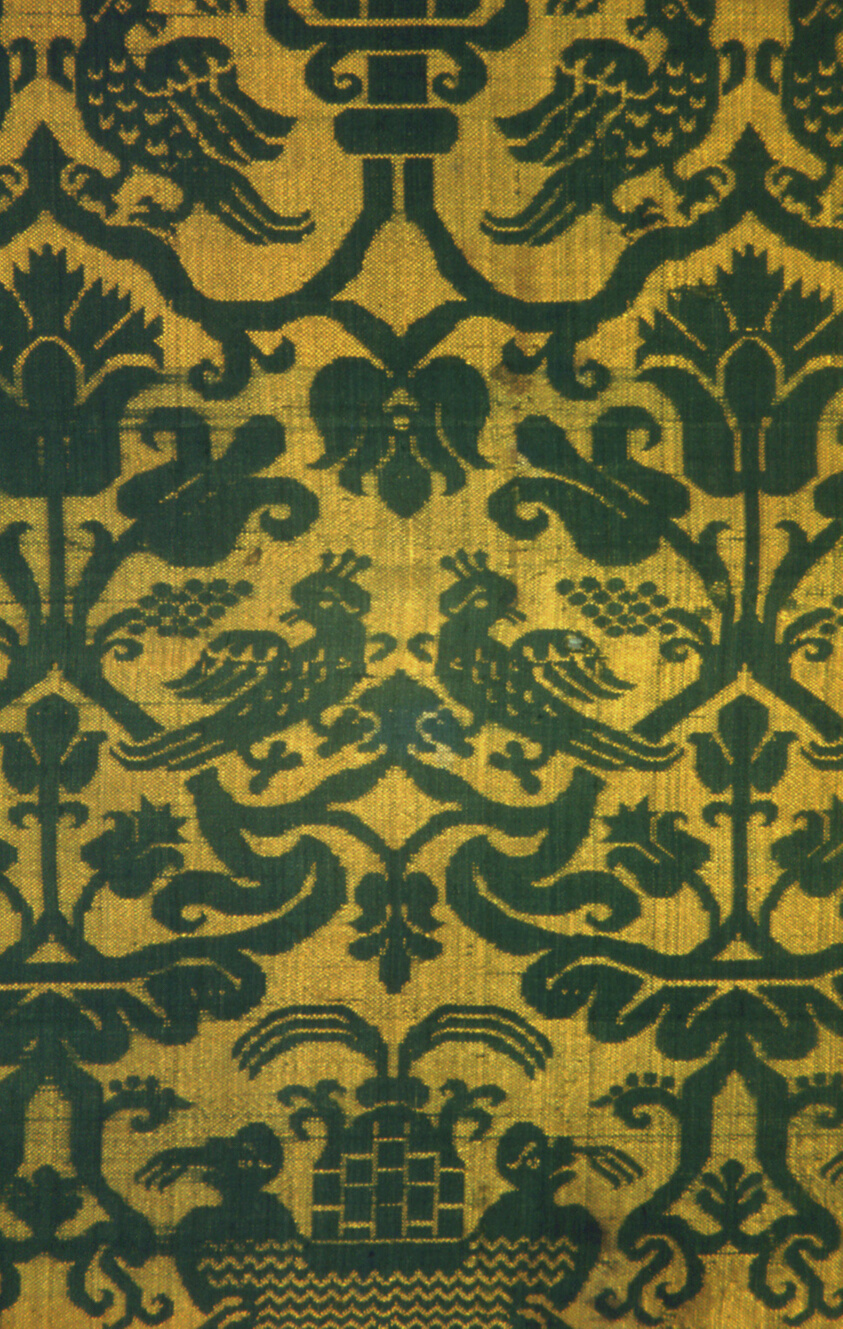
The Fragment as Archive: Deconstructing Materiality in Classic Silk Craftsmanship
In the rarefied atmosphere of London’s Savile Row, where tailoring is not merely a trade but a living archive of sartorial heritage, the fragment holds a singular power. A remnant of silk, measuring perhaps no more than a hand’s span, is never simply a scrap. It is a concentrated document of process, a testament to the interplay between human skill and natural fiber. This paper examines a specific heritage artifact: a fragment of silk, constructed in a plain weave with plain interlacings of secondary binding warps and supplementary patterning wefts. Through the lens of materiality, we decode its technical sophistication and its embodiment of fluid elegance, demonstrating how even a fragment can illuminate the foundational principles of classic silk craftsmanship.
Technical Deconstruction: The Weave as a System of Control
The fragment’s materiality is defined by a deliberate complexity. The plain weave base—the simplest and most ancient of interlacings—provides a stable, neutral ground. Yet, this is not a simple cloth. The introduction of secondary binding warps and supplementary patterning wefts transforms the structure into a controlled system of visual and tactile modulation. The secondary warps, which run parallel to the primary warp but are not part of the ground weave, act as anchors for the supplementary wefts. These wefts, in turn, are not load-bearing in the structural sense; they are purely decorative, floating across the surface to create pattern, texture, or sheen.
This technique, often associated with compound weaves or lampas constructions, requires extraordinary precision. The weaver must manage multiple sets of threads simultaneously, each with a distinct function. The plain weave base ensures the fabric’s integrity, while the secondary binding warps prevent the supplementary wefts from distorting the cloth. The result is a surface that is both disciplined and expressive—a paradox that lies at the heart of classic silk craftsmanship. The fragment, in its small scale, reveals this tension: every thread is accounted for, yet the overall effect is one of effortless fluidity.
Fluid Elegance: The Aesthetic of Controlled Movement
In the lexicon of Savile Row, “fluid elegance” is not a casual descriptor. It denotes a specific quality of drape and movement, achieved through the interplay of fiber, weave, and finish. For silk, this is particularly acute. The natural protein fiber possesses a unique combination of tensile strength and suppleness. When woven with the structural sophistication described above, the fabric does not merely hang; it flows. The supplementary patterning wefts, often in contrasting colors or metallic threads, catch light at varying angles, creating a subtle shimmer that animates the surface.
This fragment, though small, exemplifies this principle. The plain weave base provides a matte, understated backdrop, while the supplementary wefts introduce a discreet luster. The secondary binding warps, by controlling the float lengths of these wefts, ensure that the pattern remains crisp without stiffening the cloth. The result is a fabric that moves with the body, responding to gesture and posture. In a Savile Row context, this is the hallmark of a garment that is not merely worn but inhabited—a suit or gown that becomes an extension of the wearer’s presence.
Heritage and Provenance: The Fragment as Witness
Every fragment carries a provenance, even if unwritten. This particular artifact, with its refined technique and restrained palette, suggests a lineage rooted in the great silk-weaving centers of Europe—Lyons, Como, or Spitalfields. The use of secondary binding warps and supplementary wefts is a hallmark of figured silks, which were historically produced for court dress, ecclesiastical vestments, and luxury furnishings. The fragment’s small size may indicate it was a sample, a trial piece, or a remnant from a larger commission. In the Savile Row tradition, such remnants are often preserved in workrooms as references for future designs, embodying a continuity of knowledge that spans generations.
The materiality itself offers clues to its age and care. The silk’s condition—its suppleness, the clarity of its weave, the absence of significant degradation—suggests it was stored in a controlled environment, perhaps in a tailor’s archive or a textile library. The fragment’s survival is not accidental; it was deemed worthy of preservation. This act of curation elevates it from a mere offcut to a heritage artifact, a tangible link to the hands that wove it and the eyes that selected it.
Implications for Contemporary Practice
For the modern designer or tailor, studying such a fragment is an act of retrieval. It reconnects the practitioner with the haptic knowledge that is increasingly lost in an age of digital design and mass production. The fragment teaches by touch: the resistance of the secondary warps, the slight give of the supplementary wefts, the balance between stiffness and drape. This is knowledge that cannot be fully captured in a specification sheet or a CAD file. It requires the hand to understand the cloth.
Moreover, the fragment challenges the contemporary emphasis on novelty. In its modest scale, it demonstrates that innovation in silk craftsmanship is often a matter of refinement rather than revolution. The plain weave, the secondary binding warps, the supplementary wefts—these are ancient techniques, yet their combination yields a fabric that feels both timeless and contemporary. For Savile Row, this is a crucial lesson: heritage is not a constraint but a resource. The fragment invites the practitioner to ask: How can these principles be reinterpreted for today’s silhouettes and sensibilities? How can fluid elegance be achieved without sacrificing structural integrity?
Conclusion: The Fragment as a Complete Statement
In the end, the fragment is not a fragment at all. It is a complete statement of intent, a microcosm of the weaver’s art. Its plain weave base speaks to discipline; its secondary binding warps speak to control; its supplementary patterning wefts speak to aspiration. Together, they create a fabric that is both grounded and transcendent, a material embodiment of the Savile Row ethos: that true elegance is never ostentatious, but always felt.
As a heritage artifact, this fragment of silk serves as a reminder that the most profound lessons are often found in the smallest details. It is a call to look closely, to touch deliberately, and to honor the hands that came before. In the quiet archive of a Savile Row workroom, such fragments are not relics; they are living texts, waiting to be read anew.