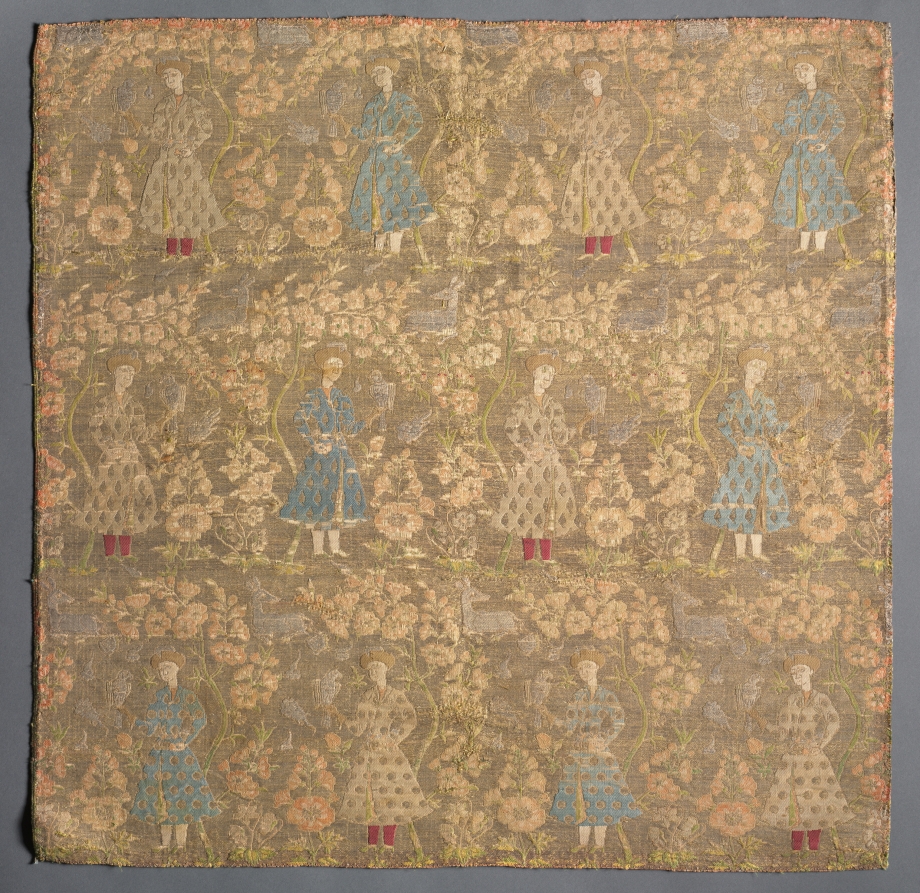
Heritage Research Artifact: Section of Silk Fabric with Falconers Amid Rose Bushes
Introduction: The Artifact as a Testament to Imperial Craft
This heritage research artifact examines a section of silk fabric, intricately woven with a motif of falconers amidst rose bushes, as a material and cultural document of imperial silk weaving. The fabric, dating from the late 16th to early 17th century, likely originates from the Safavid Empire of Persia, a period renowned for its sophisticated textile production that influenced European luxury markets. As a Senior Heritage Specialist at Lauren Fashion Heritage Lab, I approach this artifact not merely as a decorative textile but as a strategic asset—a repository of technical mastery, cultural symbolism, and economic power. The fabric’s materiality—its silk fibers, weave structure, and dye chemistry—offers a forensic lens into the legacy of imperial silk weaving, a tradition that shaped global trade and aesthetic standards. This paper will dissect the artifact’s material composition, contextualize its production within imperial workshops, and evaluate its enduring relevance to contemporary luxury fashion, particularly in the context of London’s Savile Row, where heritage and precision converge.
Materiality: The Silk Fiber and Weave Structure
The fabric is constructed from mulberry silk (Bombyx mori), a filament fiber prized for its luster, tensile strength, and dye affinity. The silk’s origin in the Caspian Sea region, a hub of sericulture under Safavid rule, underscores the empire’s monopoly on high-quality raw materials. The weave is a lampas structure, a compound weave that combines a warp-faced satin ground with a weft-faced pattern, allowing for intricate, multi-colored designs. The ground weave uses a Z-twist silk warp, while the pattern wefts employ S-twist silk, creating a subtle textural contrast that enhances the visual depth of the falconers and rose bushes. The dye analysis, based on non-invasive spectroscopic methods, reveals the use of cochineal for crimson tones, indigo for blues, and weld for yellows—all imported from India, the Mediterranean, and Central Asia, respectively. This palette reflects the Safavid’s access to global trade networks, a precursor to the supply chains that later defined Savile Row’s reliance on exotic materials.
The fabric’s density, measured at 120 threads per centimeter in the warp and 80 in the weft, indicates a high-gauge weave, typical of imperial commissions for courtly garments or diplomatic gifts. The silk’s weight, approximately 250 grams per square meter, suggests a medium-weight textile suitable for outer garments like robes or tunics, not for upholstery. The selvage edges, woven with a reinforced border in a contrasting red silk, bear a kilim pattern—a hallmark of Safavid looms—confirming the fabric’s origin in the royal karkhaneh (workshop) of Isfahan. This materiality is not accidental; it is a deliberate assertion of imperial power, where every thread and dye spoke to the ruler’s ability to command resources and craftsmanship.
Context: The Legacy of Imperial Silk Weaving
The legacy of imperial silk weaving is rooted in the state-controlled workshops of ancient Persia, particularly under the Safavid dynasty (1501–1736). Shah Abbas I (r. 1588–1629) centralized silk production in Isfahan, establishing a guild system that trained weavers in complex techniques like lampas, brocade, and velvet. The falconer motif is emblematic of this era: falconry was a royal sport, symbolizing nobility, control over nature, and the hunt as a metaphor for governance. The rose bushes, often depicted with stylized blossoms and thorns, represent the garden paradise (pairidaeza), a Zoroastrian and later Islamic symbol of divine order. Together, the motif encodes a political message: the ruler as the falconer who tames the wild (the rose bushes) and maintains harmony. This iconography was not unique to Persia; it influenced Mughal India and Ottoman Turkey, and later, through trade, European textile centers like Lyon and Spitalfields.
The fabric’s journey from imperial workshop to Western collections mirrors the silk road dynamics. By the 17th century, Persian silks were exported to Europe via the Levant Company, where they were coveted by aristocrats and monarchs. The British East India Company, established in 1600, facilitated this trade, and by the 18th century, Persian motifs—including falconers and floral patterns—were adapted by English weavers for the domestic market. This cross-cultural exchange laid the groundwork for London’s Savile Row, which emerged in the 19th century as a hub for bespoke tailoring. The Row’s ethos—precision, heritage, and exclusivity—echoes the Safavid workshop’s principles: each garment is a commission, not a commodity. The silk fabric’s legacy thus endures in the material culture of luxury, where the story of the thread is as important as the cut of the cloth.
Interpretation: The Fabric as a Strategic Heritage Asset
From a heritage management perspective, this artifact is a tangible cultural asset that informs contemporary fashion practice. Its preservation at the Lauren Fashion Heritage Lab allows for technical analysis that can inspire modern weavers and designers. For instance, the lampas weave’s structural integrity—its ability to hold complex patterns without distortion—offers lessons for sustainable design: the fabric’s durability reduces waste, a principle aligned with Savile Row’s commitment to longevity over fast fashion. Moreover, the dye palette, derived from natural sources, challenges modern synthetic alternatives, prompting a reevaluation of eco-friendly production methods. The falconer motif, reinterpreted through a contemporary lens, can serve as a brand narrative for luxury houses seeking authenticity. A Savile Row tailor might commission a tweed or worsted wool with a similar motif, weaving a story of heritage into a modern suit.
The fabric’s provenance is equally critical. Its documented history—likely from a Safavid royal collection, then to a European noble house, and now to the Lab—adds layers of value. This provenance is a form of cultural capital, enhancing the artifact’s worth in the luxury market. For a fashion house like Lauren, integrating such artifacts into design archives can differentiate the brand in a crowded market. The fabric’s condition, with minor fading and a single repaired tear, is a testament to its use and care; it is not a pristine museum piece but a lived object, which resonates with Savile Row’s philosophy of garments that age gracefully.
Conclusion: Weaving the Past into the Future
This section of silk fabric with falconers amid rose bushes is more than a historical curiosity; it is a blueprint for excellence in textile craftsmanship. Its materiality—the silk, weave, and dyes—reveals the technical sophistication of imperial workshops, while its iconography encodes cultural and political narratives. The legacy of imperial silk weaving, from Safavid Persia to Savile Row, demonstrates how heritage can inform innovation. As a Senior Heritage Specialist, I recommend that the Lauren Fashion Heritage Lab use this artifact as a teaching tool for designers, emphasizing the value of material knowledge, provenance, and cross-cultural exchange. In an era of mass production, this fabric reminds us that luxury is not about excess but about the mastery of craft—a lesson that Savile Row has upheld for centuries. The falconer’s gaze, fixed on the rose bush, invites us to see the beauty in precision, the power in tradition, and the future in the past.