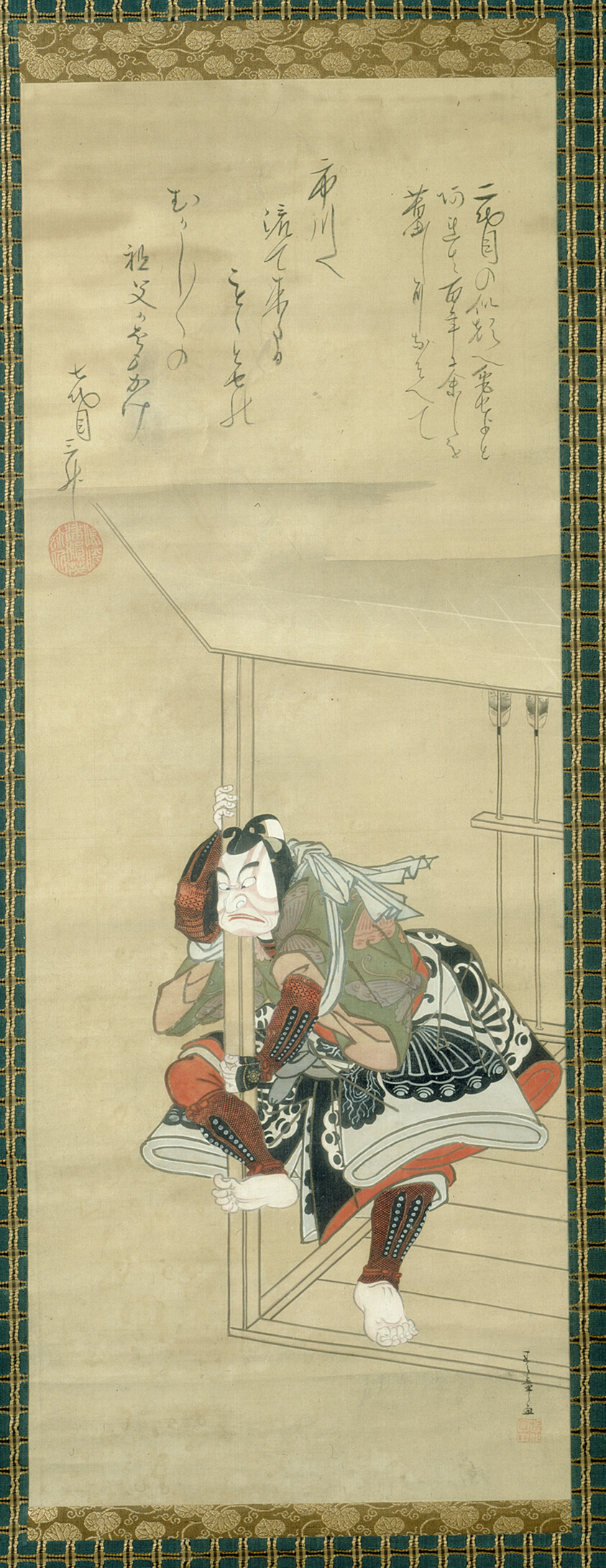
The Kabuki Actor Ichikawa Danjûrô II (1689-1758): A Heritage Artifact of Silk, Stage, and Status
Introduction: The Convergence of Craft and Performance
In the rarefied world of heritage textiles, few artifacts capture the intersection of material mastery and cultural narrative as profoundly as the hanging scroll depicting Ichikawa Danjûrô II (1689-1758). Executed in ink and colors on silk, this work is not merely a portrait of a celebrated kabuki actor; it is a testament to the classic silk craftsmanship that defined Edo-period Japan and a window into the fluid elegance of a theatrical tradition that continues to influence global aesthetics. For the connoisseur of fine materials—whether a Savile Row tailor or a museum curator—this scroll represents a pinnacle of artistic and technical achievement, where the medium itself becomes a protagonist in the narrative of heritage.
Materiality: The Silk as Canvas and Statement
The choice of silk as the substrate for this scroll is no accident. In 18th-century Japan, silk was a material of immense prestige, reserved for the garments of the elite and the most significant works of art. The hanging scroll format (kakemono) demanded a fabric that could endure repeated rolling and unrolling while retaining its chromatic vibrancy and structural integrity. Here, the silk is a finely woven habutae—a plain-weave fabric known for its smooth, lustrous surface—which provides an ideal ground for the application of mineral pigments and sumi ink. The fluid elegance of the brushstrokes, particularly in the rendering of Danjûrô’s dynamic pose and elaborate costume, is amplified by the silk’s natural sheen, which catches light and animates the figure as if he were still performing on the kabuki stage.
The craftsmanship involved in preparing such a scroll was exacting. The silk was first stretched on a frame, then treated with a sizing solution of alum and animal glue to prevent the ink from bleeding. Artisans applied layers of gofun (ground oyster shell) to create a white ground for the colors, a technique that echoes the classic silk craftsmanship of Chinese court painting but was refined in Japanese ateliers. The pigments—cinnabar for red, azurite for blue, and orpiment for yellow—were ground to a fine powder and mixed with a binder of nikawa (animal glue) to ensure adhesion. This meticulous process ensured that the scroll would survive centuries, its colors still vivid, its silk still supple—a testament to the materiality of heritage.
Cultural Context: The Kabuki Actor as Cultural Icon
Ichikawa Danjûrô II was not merely a performer; he was a living embodiment of the aragoto (rough style) acting tradition, a lineage that his father, Danjûrô I, had established. The Danjûrô line was synonymous with heroic roles—warriors, demons, and supernatural beings—whose exaggerated movements and vocal stylizations demanded a physicality that bordered on the sculptural. In this scroll, Danjûrô II is depicted in a mie (a dramatic pose), his eyes wide, his hand gripping a sword, his costume a riot of bold patterns and colors. The silk captures the fluid elegance of his movement, the folds of his kimono rendered with a calligraphic precision that suggests both power and grace.
This artifact also reflects the social status of kabuki actors in Edo-period Japan. Though officially ranked as outcasts, actors like Danjûrô II were adored by the merchant class and even patronized by the shogunate. The commissioning of a silk scroll—an expensive and time-consuming endeavor—was a declaration of cultural capital. It was a way for patrons to align themselves with the glamour of the kabuki world, to own a piece of the heritage that defined urban sophistication. The scroll, therefore, is not just a portrait; it is a status symbol, a material object that bridges the ephemeral art of performance with the permanence of fine craftsmanship.
Aesthetic Analysis: Fluid Elegance in Ink and Color
The aesthetic of this scroll is rooted in the ukiyo-e tradition, though it predates the woodblock prints that would later dominate the genre. Here, the hand-painted quality allows for a fluid elegance that printmaking could not replicate. The artist—likely a member of the Torii school, which specialized in kabuki imagery—uses ink to define the contours of Danjûrô’s face and costume, then fills the spaces with washes of color that seem to breathe on the silk. The red of his under-robe is particularly striking, a hue that symbolizes both heroism and danger, while the black of his outer garment anchors the composition with a sense of gravitas.
The materiality of the silk enhances this aesthetic. Unlike paper, which absorbs ink and creates a matte finish, silk allows the pigments to sit on the surface, creating a luminous quality that shifts with the viewer’s angle. This interplay of light and color is central to the classic silk craftsmanship of the period. The scroll’s mounting—typically a brocade border of silk or gold-threaded fabric—further elevates the piece, framing the image as a precious object to be displayed on special occasions. The fluid elegance of the composition is thus mirrored in the materiality of its support, a harmony of form and function that defines the finest heritage artifacts.
Preservation and Legacy: The Scroll in the Modern Context
Today, this scroll resides in a climate-controlled environment, its silk carefully monitored for humidity and light exposure. The preservation of such artifacts requires a deep understanding of the materials involved—the silk’s sensitivity to UV radiation, the fragility of the mineral pigments, the risk of desiccation. For the heritage specialist, the scroll is a living document, a record of both artistic intent and the passage of time. Its materiality offers clues to the techniques of the Edo period, while its subject matter connects us to a theatrical tradition that still thrives in modern Japan.
The legacy of Ichikawa Danjûrô II extends beyond the stage. His image, captured in silk, has influenced everything from fashion to film. The bold patterns of his costume—checkerboard motifs, stylized waves, and family crests—have inspired designers from Issey Miyake to Alexander McQueen. The fluid elegance of the scroll’s composition has been cited by choreographers and visual artists as a model of dynamic balance. In the context of the Lauren Fashion Heritage Lab, this artifact serves as a research cornerstone, a case study in how material culture can inform contemporary design. The classic silk craftsmanship of the scroll is not a relic; it is a living tradition, a source of inspiration for those who seek to marry heritage with innovation.
Conclusion: A Heritage Artifact of Enduring Value
The hanging scroll of Ichikawa Danjûrô II is more than a historical document; it is a masterclass in the materiality of heritage. From the classic silk craftsmanship that gave it form to the fluid elegance of its aesthetic, this artifact embodies the values of precision, artistry, and cultural significance that define the finest heritage objects. For the scholar, the collector, or the designer, it offers a lesson in how materials can elevate narrative, how craft can preserve performance, and how a single object can bridge centuries. In the world of heritage, where every thread tells a story, this scroll is a narrative of silk, stage, and status—a legacy that endures.