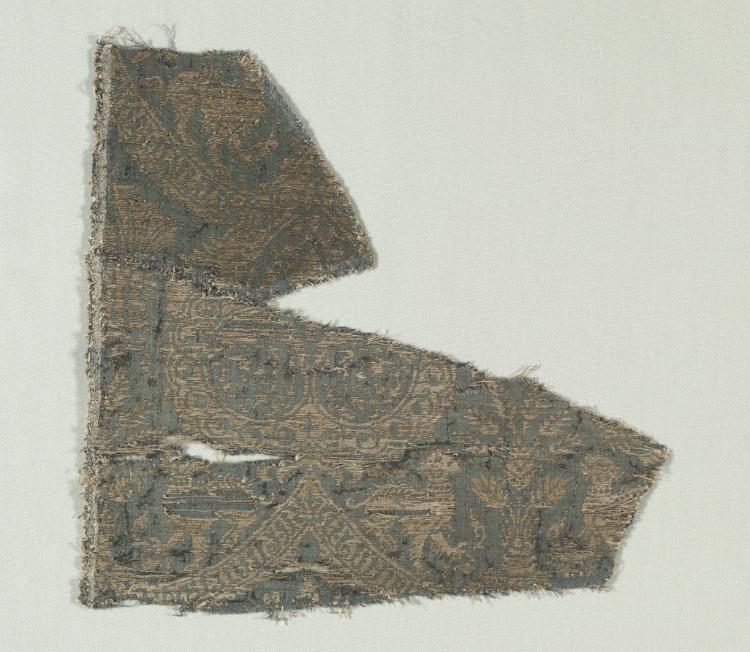
An Examination of A Curious Artefact: Canine Motifs and Kufic Script in Swaying Bands
One encounters, upon occasion, a textile that gives one pause. Not merely for its technical virtuosity—which, in the realm of imperial silk weaving, is a given—but for the quiet, persistent challenge it presents to the conventional narrative. The subject in question, a fragment bearing the curious conjunction of canine figures and Arabic script within a framework of swaying, undulating bands, is precisely such a piece. It is an artefact that refuses to be easily categorized, demanding instead a more nuanced appreciation of the cross-currents of trade, taste, and translation that defined the loftiest echelons of the pre-modern luxury economy. To analyse it is to engage in a form of sartorial archaeology, brushing aside the dust of assumed histories to reveal the vibrant, complex weave beneath.
Materiality as Testament: The Sovereign Foundation
Let us first establish the foundation: the silk itself. This is not a mere substrate; it is a statement of intent. The very employment of silk, particularly of the quality evidenced by the density of the weave and the enduring luminosity of the dyes, immediately places this fragment within a specific milieu—the imperial workshop, or tiraz. Here, the material was not simply processed but commanded. Its production, from sericulture to loom, was often a closely guarded state monopoly, a tangible manifestation of sovereign power. The silk, therefore, is our first clue: this was an object of consequence, born from a system where textile production was inseparable from political authority and economic control. Its handle, its weight, its sheen—these are the silent, tactile testaments to its provenance.
The Grammar of Ornament: Decoding the Motifs
The design, however, is where our narrative becomes intriguingly complex. We must dissect its two primary components: the script and the fauna.
The Arabic script, rendered in a stately, angular Kufic, is the element most readily associated with imperial legacy. It is, typically, the voice of the patron—often bearing benedictions, the ruler’s name, or quotations from the Qur’an. It transforms the garment from a mere covering into a declarative object, a mobile edict. In this fragment, the script is integrated within the swaying bands, a design principle that speaks to a sophisticated understanding of visual rhythm and sacred geometry. The bands themselves, with their fluid, wave-like motion, suggest a familiarity with Hellenistic and Sasanian traditions of ornament, absorbed and refined within the Islamic artistic vocabulary. They provide a dynamic, almost musical framework, a counterpoint to the static authority of the written word.
Then, we confront the dogs. Herein lies the delightful contradiction. Within the predominant cultural context of the early Islamic empires, the dog was often viewed with ambivalence, rarely celebrated in high art. Its presence here, particularly in such a formal, ceremonial context, is arresting. This is not the depiction of a lion, a symbol of royal power, or a hawk, denoting nobility. These canines, rendered with a spirited naturalism, suggest a different influence. One is drawn to look eastwards, along the Silk Roads, to the traditions of Central Asia and China, where dogs—hunting hounds, guardians, companions—featured more prominently in decorative schemes. Their inclusion hints at a clientele or a workshop operating at a cultural crossroads, where motifs travelled alongside merchants and diplomats. It suggests a commission for a patron whose taste or cultural identity accommodated, or even prized, this symbolism. Perhaps a courtier with roots in the steppes, or a gift intended for a foreign dignitary whose heraldic devices included such a creature. The dogs are the anomaly that forces us to widen our lens.
A Synthesis of Legacies: The Imperial Loom as Crucible
The true heritage of this fragment lies not in isolating its elements, but in appreciating their synthesis. The imperial silk workshop was not an island of pure, unchanging style; it was a crucible. It absorbed technical influences from Byzantium, aesthetic motifs from Persia and beyond, and catered to a diverse, international elite. The weaver who executed this design was a master of this cosmopolitan language. The disciplined, mathematically precise bands and script coexist with the lively, naturalistic canine figures. This is not a dissonance, but a dialogue.
The legacy of imperial silk weaving, therefore, as exemplified by this singular artefact, is one of authoritative synthesis. It is the legacy of taking the sovereign material—silk—and upon it, weaving a visual language capable of expressing both universal power (the script, the geometric order) and particular identity (the anomalous motifs). It speaks to an era where luxury was deeply intelligent, where every thread and every symbol was laden with meaning, accessible to the initiated viewer. The object served as a badge of inclusion within a trans-regional elite, a man or woman who could appreciate the quality of the weave, decipher the script, and understand the nuanced statement being made by the unusual iconography.
Conclusion: A Fragment of a Larger Conversation
In the final analysis, this fragment of silk with its dogs and Kufic script is more than a textile; it is a fragment of a conversation. A conversation conducted across continents, between cultures, and through the medium of the loom. It reminds us that the history of luxury is rarely linear or pure. It is a history of encounter, adaptation, and, at times, deliberate and learned eccentricity. To study it is to understand that the most enduring legacies are those woven with the confidence to incorporate the unexpected, binding it with threads of gold and expertise into a new, and compelling, whole. The piece does not merely hang in silence; it continues to speak, if one is schooled enough to listen.