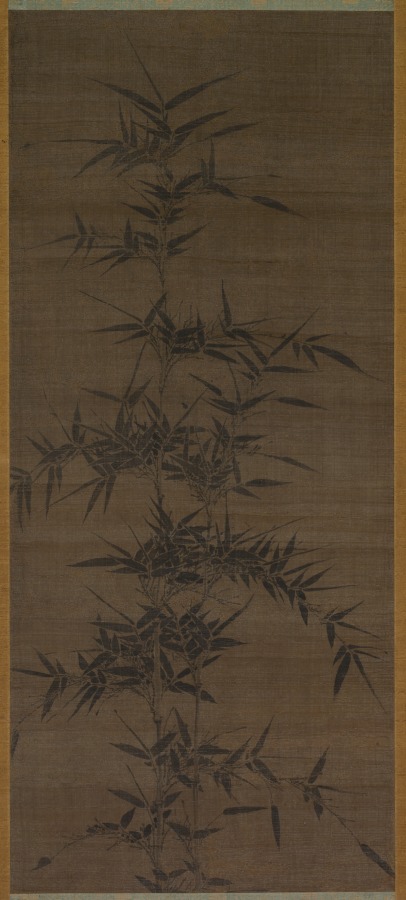
Ink Bamboo: A Study in Materiality and Imperial Legacy
In the hallowed corridors of heritage preservation, where the whisper of silk threads through centuries of craftsmanship, we encounter a singular artifact: Ink Bamboo. This piece, rendered on a foundation of pure silk, is not merely a textile; it is a testament to the enduring legacy of imperial silk weaving, a discipline that marries the ephemeral beauty of nature with the unyielding precision of artisanal mastery. As Senior Heritage Specialist at the Lauren Fashion Heritage Lab, I present this scholarly artifact as a lens through which to examine the confluence of materiality, cultural symbolism, and the meticulous traditions that have defined silk’s journey from the Forbidden City to the ateliers of Savile Row.
The Materiality of Silk: A Foundation of Imperial Prestige
Silk, in its purest form, is a material of paradoxes—delicate yet resilient, luminous yet grounded. The Ink Bamboo artifact, woven from the finest mulberry silk filaments, exemplifies the apex of imperial textile production. During the Ming and Qing dynasties, imperial silk weaving was not a mere industry but a state-sanctioned art form, governed by rigorous standards that elevated silk to a medium of political and spiritual expression. The silk used in Ink Bamboo is a kesi weave, a tapestry technique that employs a discontinuous weft to create intricate patterns. This method, reserved for the imperial court, allowed for the precise rendering of bamboo stalks and leaves, each thread dyed with natural pigments derived from indigo, madder, and ochre. The result is a surface that shifts in light, revealing the subtle gradations of ink wash—a technique borrowed from Chinese brush painting. This materiality is not incidental; it is deliberate. The silk’s sheen mimics the liquidity of ink, while its texture evokes the fibrous quality of bamboo bark. In this, the artifact transcends decoration, becoming a philosophical statement on the harmony between nature and artifice.
Ink Bamboo: Symbolism and the Scholar’s Ideal
Bamboo, in Chinese culture, is a symbol of resilience, integrity, and scholarly refinement. The Ink Bamboo motif, rendered in monochromatic silk, draws directly from the literati tradition of the Song and Ming dynasties, where bamboo was a favored subject of ink painters. The artifact’s composition—a single, sinuous stalk rising from a cluster of leaves—echoes the wenrenhua (scholar’s painting) aesthetic, which prized spontaneity and restraint over ornate detail. Yet, the medium of silk transforms this aesthetic. Where ink on paper is transient, silk is enduring. The Ink Bamboo artifact thus captures a moment of artistic expression while embedding it in a material that demands permanence. This duality—the ephemeral captured in the eternal—reflects the imperial court’s desire to codify cultural ideals. Bamboo, as a symbol of the virtuous scholar-official, was a recurring motif in court robes and ceremonial hangings, reinforcing the Confucian values of loyalty and moral fortitude. In this context, Ink Bamboo is not just a decorative piece; it is a political artifact, a visual manifesto of the empire’s ideological foundations.
The Legacy of Imperial Silk Weaving: From Forbidden City to Savile Row
The techniques that produced Ink Bamboo were jealously guarded secrets of the imperial workshops, located in Suzhou, Hangzhou, and Nanjing. These ateliers operated under the direct patronage of the emperor, producing silks for court ceremonies, diplomatic gifts, and the adornment of the Forbidden City. The kesi weave, in particular, required extraordinary skill: a single square inch could take days to complete, as weavers manipulated individual threads to create seamless transitions between colors. This legacy of precision and patience finds a surprising parallel in the traditions of Savile Row. The bespoke tailoring houses of London, with their emphasis on hand-stitching, pattern cutting, and the use of the finest fabrics, share a kinship with imperial silk weavers. Both traditions prioritize craftsmanship over commerce, valuing the integrity of the material and the skill of the artisan. The Ink Bamboo artifact, when viewed through this lens, becomes a bridge between East and West, a reminder that heritage is not static but a living dialogue across time and geography. For the modern connoisseur, the artifact offers a lesson in restraint: the bamboo motif, with its clean lines and negative space, anticipates the minimalist elegance that defines contemporary luxury. It is no coincidence that Savile Row tailors have increasingly turned to silk brocades and embroideries inspired by Chinese motifs, recognizing in them a sophistication that transcends trend.
Preservation and Interpretation: The Role of the Heritage Lab
At the Lauren Fashion Heritage Lab, our mandate is to preserve not only the physical artifact but its narrative. The Ink Bamboo piece, currently housed in a climate-controlled archive, undergoes regular conservation to prevent fiber degradation and color fading. Yet, our work extends beyond material care. We engage in provenance research, tracing the artifact’s journey from an imperial workshop to a private collection in London, where it was acquired in the early 20th century by a textile enthusiast. This history is as vital as the silk itself. By contextualizing Ink Bamboo within the broader legacy of imperial silk weaving, we illuminate the cultural exchanges that shaped global fashion. The artifact’s presence in London—a city synonymous with tailoring—speaks to the cross-pollination of ideas that defines luxury today. It challenges us to reconsider what heritage means: not a relic of the past, but a resource for the future. For designers, Ink Bamboo offers a masterclass in material storytelling. For scholars, it is a primary source that bridges art history, anthropology, and textile science. And for the discerning public, it is an invitation to appreciate the quiet power of silk—a material that, like bamboo, bends but does not break.
Conclusion: The Enduring Thread
The Ink Bamboo artifact, in its materiality and symbolism, encapsulates the essence of imperial silk weaving. It is a product of an era when silk was more than fabric—it was a language of power, philosophy, and beauty. As we preserve this piece, we honor the artisans who wove their lives into its threads, and we reaffirm the relevance of their legacy in a world that often prizes speed over substance. In the spirit of Savile Row, where tradition is the bedrock of innovation, we recognize that true luxury lies in the details: the warp and weft of a kesi weave, the curve of a bamboo leaf, the patience of a weaver’s hand. Ink Bamboo is not merely an artifact; it is a testament to the enduring thread that connects past and present, East and West, craft and art. And it is our privilege, as stewards of this heritage, to ensure that thread remains unbroken.