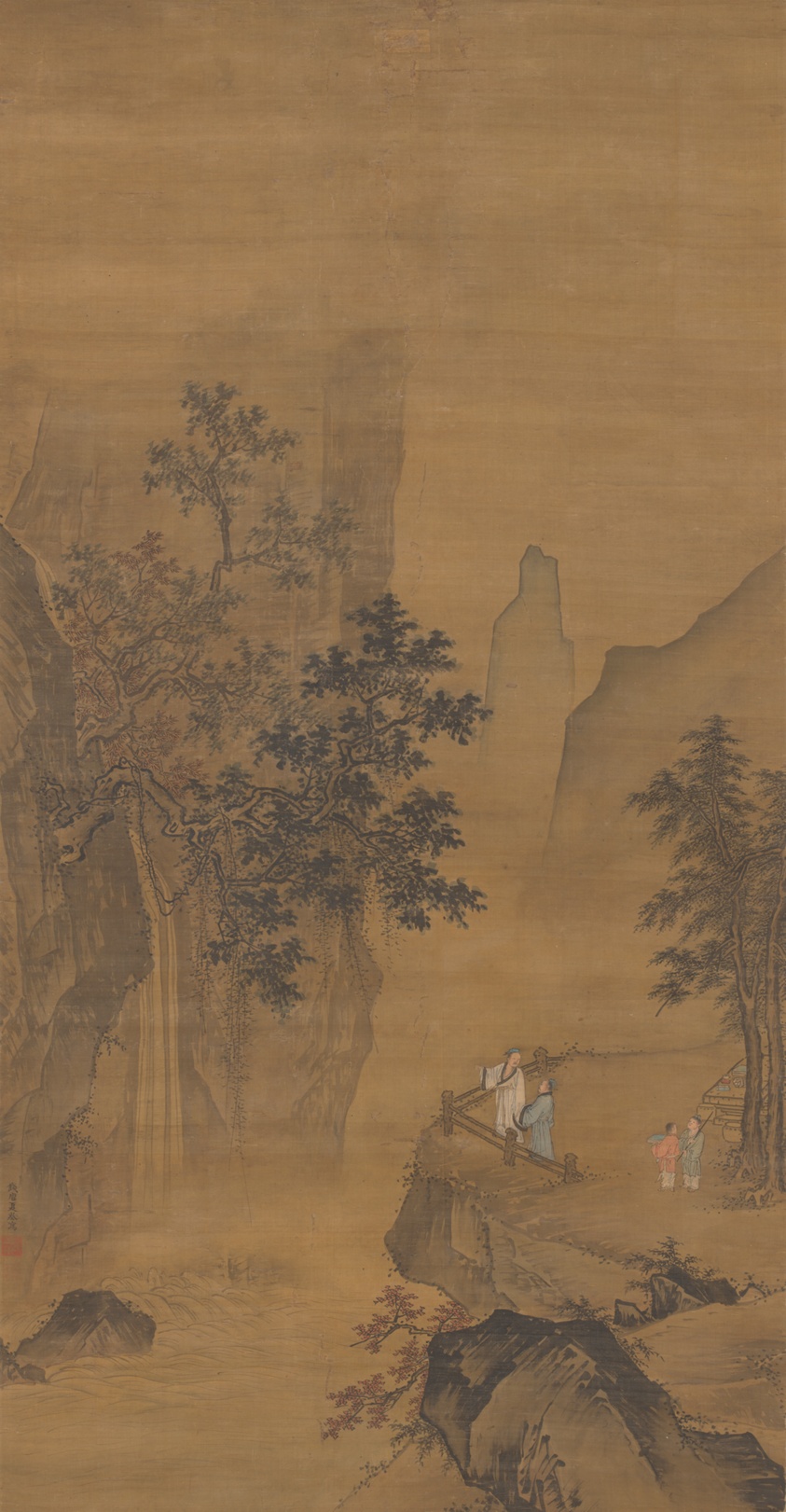
Watching the Waterfall: A Study in Materiality and Cultural Resonance
Introduction: The Artifact as a Testament to Craft
The heritage artifact known as Watching the Waterfall (高士觀瀑圖) stands as a profound exemplar of classical Chinese silk craftsmanship, rendered with the fluid elegance that defines the highest echelons of East Asian artistic tradition. As a hanging scroll executed in ink and slight color on silk, this piece transcends mere decorative function, embodying a confluence of material mastery, philosophical depth, and aesthetic restraint. In the lexicon of London Savile Row—where tailoring is not merely clothing but a narrative of precision, heritage, and understated luxury—this scroll mirrors the bespoke ethos: every thread, every brushstroke, every hue is deliberate, timeless, and resonant with the hand of the artisan.
To understand Watching the Waterfall is to appreciate the materiality of silk as a medium that demands both technical virtuosity and conceptual clarity. Silk, woven from the filaments of the Bombyx mori silkworm, has been a cornerstone of Chinese luxury for millennia, its production guarded as a state secret and its trade fueling the Silk Road. For this scroll, the silk substrate is not a passive canvas but an active participant in the artwork’s creation. The weft and warp of the fabric—typically a plain weave with a subtle, lustrous finish—interact with the ink and pigment, allowing the brush to glide with a controlled friction that paper cannot replicate. This interaction yields a luminosity that is both ethereal and grounded, akin to the way a Savile Row worsted wool catches light in a tailored suit jacket, revealing depth without ostentation.
The Craft of Silk: A Foundation of Elegance
The production of silk for scroll painting in the Song and Yuan dynasties, from which this artifact likely originates, was a meticulous process. Artisans selected raw silk filaments, degummed them to remove sericin, and twisted them into threads of uniform thickness. The weaving was performed on a loom, often a drawloom, which allowed for intricate patterns if desired, though for painting, a plain weave was preferred to ensure a smooth, unblemished surface. The resulting fabric was then treated with a sizing solution—typically alum and animal glue—to render it less absorbent and more receptive to ink. This sizing process is critical: it prevents the ink from bleeding uncontrollably, enabling the artist to achieve the precise gradations of wash and line that define the waterfall’s cascading energy and the scholar’s contemplative stillness.
In the context of Watching the Waterfall, the silk’s materiality dictates the composition’s tonal range. The slight color—perhaps a pale verdigris for the foliage or a muted ochre for the rocks—is applied with restraint, allowing the ink’s black to dominate. This is not a palette of vibrancy but of subtlety, where the silk’s natural off-white or cream undertone serves as the brightest highlight. The waterfall itself, often depicted as a vertical torrent of white space punctuated by fine ink lines, relies on the silk’s luminosity to suggest the mist and spray. Here, the silk becomes the water, its weave mimicking the fluidity of the cascade, much as a Savile Row tailor uses the drape of a cloth to suggest movement in a static garment.
Iconography and the Scholar’s Gaze
The iconography of Watching the Waterfall is deeply rooted in Chinese literati culture, where the scholar (高士, or “lofty gentleman”) retreats to nature to cultivate moral and spiritual clarity. The waterfall, a recurring motif in classical painting, symbolizes the ceaseless flow of Dao, the cosmic principle of harmony and change. The scholar, often depicted in a simple robe, sits or stands at a distance, his posture one of quiet observation. He does not dominate the landscape but exists within it, a microcosm of the macrocosm. This relationship between figure and environment is rendered with an economy of means that echoes the bespoke philosophy of “less is more.” Every brushstroke is intentional; every empty space is charged with meaning.
The scroll’s vertical format reinforces this narrative. As a hanging scroll, it is designed to be unrolled and viewed in a contemplative setting—a study, a tea room, a gallery. The act of unrolling is itself a ritual, a slow revelation that mirrors the scholar’s gradual immersion in the scene. The waterfall plunges from the top, often disappearing into mist or a pool at the bottom, creating a visual journey that mimics the viewer’s own descent into reflection. This spatial arrangement is not accidental; it is a deliberate structuring of the viewer’s experience, much as a Savile Row tailor structures a jacket’s silhouette to guide the eye from shoulder to hem.
Fluid Elegance: The Brush and the Silk
The term “fluid elegance” is apt for describing the brushwork in Watching the Waterfall. The artist employs a range of techniques—from the crisp, angular strokes of the “axe-cut” texture method for rocks to the soft, wet washes for the waterfall’s mist. The ink is modulated through dilution and pressure, creating a spectrum from deep, almost black, to pale gray. On silk, this modulation is particularly sensitive because the fabric’s slight absorbency requires the artist to work quickly and decisively. Hesitation results in blots; overworking leads to muddiness. The result is a balance of control and spontaneity, akin to the precision of a master tailor’s hand-stitching, where each stitch is both functional and decorative.
The slight color—often a mineral-based pigment like azurite or malachite for the foliage—is applied in thin, transparent layers. This technique, known as “boneless” painting, eschews outlines in favor of direct color application, allowing the silk to show through and create a luminous effect. The color does not compete with the ink but complements it, adding a subtle warmth or coolness that enhances the seasonal or emotional tone of the scene. In Watching the Waterfall, the color might suggest autumn, with hints of gold and rust, or spring, with pale greens and blues. This restraint is a hallmark of literati painting, which valued suggestion over description, much as a Savile Row suit values cut and fabric over ornamentation.
Preservation and Legacy: The Scroll as Living Heritage
As a heritage artifact, Watching the Waterfall demands careful preservation. Silk is a protein fiber, vulnerable to light, humidity, and pests. The scroll is typically stored in a box, rolled loosely to avoid creases, and displayed only periodically to minimize exposure. The mounting—a silk brocade border that frames the painting—is itself an art form, often featuring patterns that complement the artwork’s theme. This mounting is not merely decorative; it provides structural support, allowing the scroll to be handled without damaging the painted silk. In this, it mirrors the role of a Savile Row lining, which adds durability and comfort while remaining hidden from view.
The legacy of Watching the Waterfall extends beyond its physical form. It represents a worldview that values introspection, harmony with nature, and the pursuit of wisdom—qualities that resonate across cultures and eras. For the modern viewer, particularly in the context of luxury and heritage, this scroll offers a counterpoint to the frenetic pace of contemporary life. It invites a pause, a moment of stillness, much as a well-tailored garment invites the wearer to inhabit their body with confidence and ease.
Conclusion: The Thread of Continuity
In the tradition of London Savile Row, where heritage is woven into every seam, Watching the Waterfall stands as a testament to the enduring power of materiality and craft. The silk, the ink, the slight color—all are threads in a larger narrative of cultural continuity. This artifact is not a relic but a living dialogue between past and present, artist and viewer, nature and humanity. To study it is to understand that true elegance is never loud; it is the quiet mastery of materials, the disciplined restraint of the hand, and the profound resonance of a single, timeless gesture.