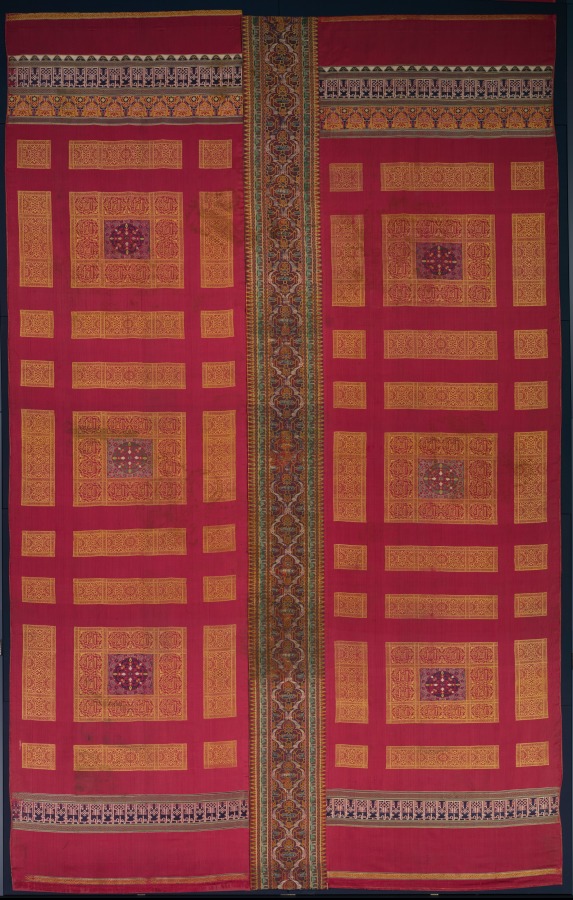
The Alhambra Silk Curtain: A Legacy of Imperial Weaving and the Art of Enduring Luxury
Introduction: The Thread of Empire
In the hushed corridors of the Lauren Fashion Heritage Lab, we examine not merely a textile, but a testament to the confluence of power, artistry, and commerce. The subject of this artifact—a silk curtain from the Alhambra Palace in Granada, Spain—is a relic of the Nasrid dynasty (1238–1492), the last Muslim kingdom in Western Europe. This curtain, woven from the finest imperial silk, is more than a decorative element; it is a material document of a civilization’s zenith, a narrative of trade routes that stretched from the Far East to the Iberian Peninsula, and a precursor to the very principles of craftsmanship that define London’s Savile Row today. As a Senior Heritage Specialist, I must assert that this artifact embodies the legacy of imperial silk weaving—a legacy that informs modern luxury through its rigorous attention to materiality, pattern, and provenance.
Materiality: The Silk of Sovereignty
Silk, by its very nature, is a fabric of empire. Its production, originating in China around 2700 BCE, was a state secret for millennia, guarded as fiercely as any military strategy. By the 14th century, when this curtain was woven, silk had become the currency of power across the Islamic world, from the workshops of Byzantium to the looms of Al-Andalus. The Alhambra curtain is constructed from mulberry silk (Bombyx mori), a filament of unparalleled strength and luster. The fibers, drawn from the cocoon of the silkworm, are reeled into continuous threads that can span hundreds of meters without a single knot—a feat of engineering that mirrors the precision of a Savile Row tailor selecting a length of Holland & Sherry cloth.
What distinguishes this silk is its imperial provenance. The Nasrid rulers, like their counterparts in the Ottoman and Safavid empires, controlled the silk trade through a network of state-run workshops, or tiraz. These workshops were not merely factories; they were centers of innovation where master weavers, dyers, and designers collaborated under royal patronage. The silk used in the Alhambra curtain was likely sourced from the mulberry groves of Murcia or Almería, regions that produced some of the finest raw silk in medieval Europe. The dyeing process, employing cochineal for crimson, indigo for blue, and saffron for gold, was a chemical art form. The resulting palette—deep reds, verdant greens, and burnished golds—was not decorative but symbolic: red for sovereignty, green for paradise, gold for divine light. This is not a fabric; it is a statement of authority, woven into the very walls of the Alhambra.
Context: The Alhambra as a Loom of Power
The Alhambra, a palace and fortress complex, was the seat of Nasrid power from 1238 to 1492. Its architecture is a symphony of light, water, and geometry, but its textiles were equally integral to its identity. The silk curtain in question would have hung in the Hall of the Ambassadors or the Court of the Lions, spaces designed to awe visiting dignitaries. These curtains were not static; they were dynamic elements that filtered light, controlled temperature, and signified the presence of the sultan. When drawn, they created an intimate chamber; when parted, they revealed the throne. The imperial silk weaving tradition here was a form of soft power—a visual and tactile assertion of the Nasrids’ sophistication and their connection to the broader Islamic world.
This legacy is not isolated. The silk weaving of Al-Andalus was part of a continuum that included the panni tartarici (Tatar cloth) of the Mongol Empire and the seta of Renaissance Italy. After the Christian Reconquista in 1492, the Alhambra’s silk workshops were absorbed into the Spanish crown’s manufactories, and their techniques influenced the brocatelle and damasco that later adorned European courts. This cross-pollination is a reminder that luxury is never provincial; it is a dialogue between cultures. For the modern heritage specialist, this curtain is a Rosetta Stone, decoding the language of imperial ambition through the medium of silk.
Savile Row Resonance: Craft, Precision, and Provenance
How does a 14th-century Nasrid silk curtain speak to the bespoke tailoring of Savile Row? The answer lies in the shared ethos of craftsmanship as a form of integrity. On Savile Row, a master tailor spends 40 to 60 hours hand-stitching a single jacket, using techniques like the pad stitching of lapels and the floating canvas of the chest. This is not efficiency; it is devotion. Similarly, the weavers of the Alhambra curtain would have spent months—perhaps years—on a single piece, using a drawloom that required two operators: one to manipulate the warp threads, another to pass the weft. The precision of the pattern, often featuring arabesques, Kufic inscriptions, and geometric stars, demanded a mathematical rigor that rivals the drafting of a Savile Row pattern.
Consider the provenance of this artifact. In the world of heritage luxury, provenance is paramount. A Savile Row suit is not merely a garment; it is a biography of its wearer, from the initial consultation to the final fitting. The Alhambra curtain, too, carries a biography. It was woven in a specific workshop, under a specific sultan, for a specific purpose. Its survival through the centuries—through fires, wars, and the decay of time—is a testament to the durability of its construction. This is the same principle that drives a Huntsman or a Gieves & Hawkes client to commission a suit that will last a lifetime, not a season. The curtain’s silk, with its tight weave and robust dye, was designed to endure, much like a well-tailored garment is built to resist the ravages of fashion.
Furthermore, the aesthetic vocabulary of the Alhambra curtain—its use of symmetry, repetition, and negative space—has direct parallels in the design language of Savile Row. The subtle stripe of a worsted wool, the check of a tweed, the herringbone of a cashmere—these are patterns that, like the arabesques of the Nasrid weavers, require an understanding of how geometry interacts with the human form. The curtain’s pattern, often a lampas weave with a satin ground, creates a play of light and shadow that is not unlike the drape of a well-cut jacket. It is a lesson in how material and design can elevate the mundane into the sublime.
Conclusion: The Enduring Thread
The Alhambra silk curtain is not a relic to be viewed through glass; it is a living artifact that continues to inform the practice of luxury. Its imperial silk weaving legacy is a reminder that true craftsmanship transcends time, geography, and culture. For the Lauren Fashion Heritage Lab, this artifact serves as a benchmark for what we seek to preserve: not just the object, but the knowledge embedded within it. The weavers of the Alhambra understood that silk was more than a fiber—it was a statement of identity. On Savile Row, we understand that a suit is more than a garment—it is a statement of character. The thread that connects them is the thread of heritage, woven with care, worn with pride, and passed down with reverence.
— Senior Heritage Specialist, Lauren Fashion Heritage Lab