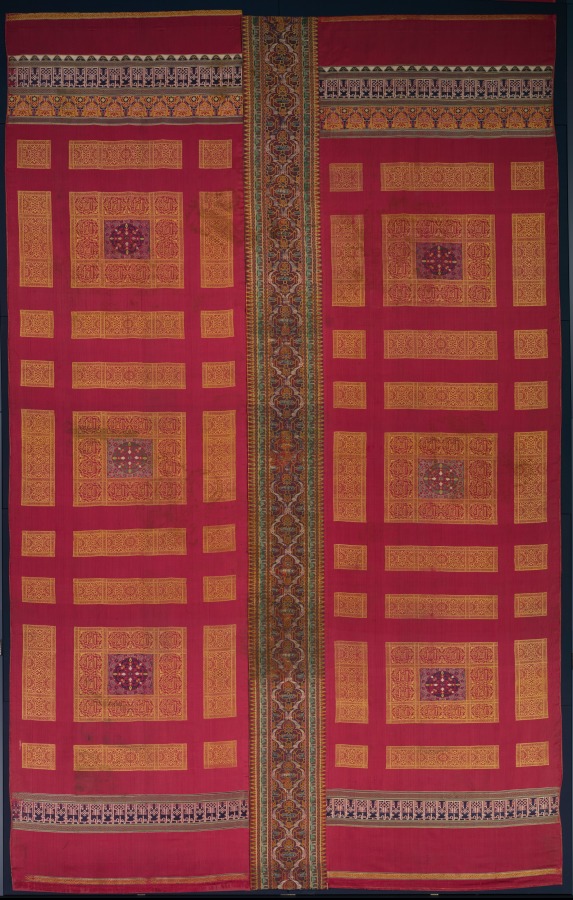
An Examination of a Specimen: The Alhambra Silk Curtain
One must approach this artefact not as a mere decorative textile, but as a definitive statement of power, articulated through the most sophisticated medium of its age. The subject is a silk curtain, or fragment thereof, attributed to the palatial workshops of the Alhambra during the Nasrid dynasty’s zenith. Its materiality—pure silk—is the foundational datum from which all further analysis proceeds. This is not simply fabric; it is the physical manifestation of an imperial supply chain, a testament to a legacy of weaving that functioned as the period’s equivalent of a bespoke atelier for sovereigns. To comprehend its stature, one must appreciate silk not as a commodity, but as the paramount currency of prestige, its very threads imbued with dynastic ambition.
The Weave as Writ of Authority
The legacy of imperial silk weaving, from Byzantium to Baghdad and thence to Al-Andalus, represents a continuum of controlled expertise. The production of such cloth was, by deliberate design, a state secret and a state monopoly. The looms required were complex, capital-intensive machinery; the dyers’ recipes, guarded formulae; the weavers themselves, highly disciplined artisans operating within a rigid, palace-supervised hierarchy. To drape a chamber in this material was to perform a silent, continuous declaration of reach. It announced that the ruler commanded not only the armies and the treasury, but also the most advanced technological and artistic consortium of the era. The curtain, therefore, was less an interior furnishing and more a component of the architectural authority, a soft yet impermeable boundary between the sovereign’s private counsel and the outer world.
Deciphering the Code: Pattern and Palimpsest
Upon the lustrous ground of the silk, one encounters the intellectual rigour of the pattern. In the Savile Row tradition, we speak of a ‘bespoke canvas’—the worsted cloth upon which the cutter’s art is rendered. Here, the silk is that canvas, and the woven pattern is its precise, immutable tailoring. One typically observes the ‘ataurique’—the intricate, scrolling vegetal arabesque—interlocking with precise geometric strapwork and, with profound significance, interlaced Arabic calligraphy. This is not ornament for ornament’s sake. It is a deliberate, hierarchical visual language.
The botanical motifs suggest a paradisiacal garden, a timeless symbol of sovereignty and divine favour. The geometry speaks of an immutable cosmic order, reflecting the mathematical prowess of the court. Most critically, the woven inscriptions—often poetic verses praising the Sultan, or quotations from the Quran—transform the textile from a patterned object into a legible document. The curtain literally clothes the space in text, wrapping the occupant in a cocoon of legitimising rhetoric. The silk, in its capacity to hold such fine, shimmering detail, was the only medium capable of bearing this complex weight of meaning without sacrificing refinement.
Materiality and the Tactile Diplomacy
The hand, as any connoisseur of cloth will affirm, is paramount. The handle of this silk—its weight, its drape, its characteristic rustle—was an integral part of its message. In an age of coarse woollens and linens, the sensation of such a textile was profoundly other. It spoke of a rarefied environment. Furthermore, silk possessed an acoustic property; the movement of such curtains in a breezy courtyard or behind a figure of state would create a distinctive, whispering susurration—an auditory signal of presence and transition. This was theatre, meticulously crafted. The material’s inherent luminosity, catching the calibrated light of sun and candle, would have animated those intricate patterns, causing the calligraphy to gleam and the arabesques to shimmer with a life of their own. It was, in effect, a dynamic, interactive surface.
Enduring Legacy: From Palace to Archive
The journey of such a curtain from its original telar (loom) in the Alhambra to a modern conservation mount is a narrative of shifting value. Its original value was immediate, political, and spatial. It defined a room and the status of those permitted within it. As a fragment preserved behind glass, its value transmutes into the historical and the symbolic. It becomes a key specimen for understanding the aesthetic and administrative sophistication of the last Islamic kingdom in Iberia. The precision of its weave finds echoes in the exacting standards of a modern bespoke garment: both are the result of countless hours of skilled labour, a profound understanding of material, and an unwavering commitment to an ideal form.
In conclusion, this Alhambra silk curtain stands as a peerless exemplar of material culture deployed at the highest level. It demonstrates that true heritage in textiles resides not solely in beauty, but in the confluence of material excellence, technological mastery, and symbolic depth. Its silk is the common thread in a global legacy of imperial weaving—a legacy where cloth was never merely cloth, but the very fabric of power itself. To study it is to acknowledge that the most enduring statements of authority are often those woven with the finest of threads.