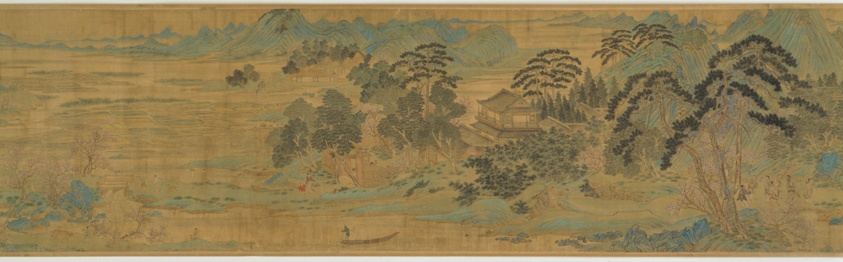
The Peach Blossom Spring 桃花源圖: A Study in Silk, Craft, and the Poetics of Escape
Introduction: The Handscroll as a Testament to Heritage
In the rarefied world of heritage textiles, few materials command the reverence of silk. Its lustrous surface, tensile strength, and capacity for absorbing pigment have rendered it a medium of choice for centuries of Chinese artistry. At the Lauren Fashion Heritage Lab, we examine not merely the artifact but the narrative it weaves—a narrative of craftsmanship, cultural memory, and the enduring human desire for transcendence. The Peach Blossom Spring 桃花源圖, a handscroll executed in ink and color on silk, stands as a singular exemplar of this tradition. It is not a garment, yet its materiality speaks to the same principles that define the finest tailoring on London’s Savile Row: precision, restraint, and an almost obsessive attention to the interplay of texture and form.
This artifact, dating from the Ming dynasty (1368–1644), depicts the legendary utopia described by poet Tao Yuanming in his fourth-century prose poem. The handscroll format—unfurled horizontally, section by section—invites a sequential, almost cinematic experience. The viewer is not a passive observer but a participant in a journey, much like the fisherman who stumbles upon the hidden valley. The silk support, with its subtle sheen and tactile warmth, transforms this narrative into a sensory encounter. It is a material that breathes, that yields to the brush yet retains its structural integrity—a quality that resonates with the bespoke ethos of Savile Row, where fabric is chosen not merely for appearance but for its ability to hold a line and endure.
Materiality and Craft: The Silk as a Living Archive
The handscroll’s silk is a testament to centuries of Chinese sericulture, a practice that elevated silk from a commodity to an art form. The warp and weft of the fabric are not merely structural; they are a dialogue between artisan and material. In The Peach Blossom Spring, the silk is woven with a fine, even gauge, allowing the ink and mineral pigments to settle without bleeding. The result is a surface that glows with a muted luminosity, as if the silk itself were a source of light. This is no accident. The Ming dynasty saw a refinement of silk-weaving techniques, with workshops in Suzhou and Hangzhou producing textiles of unparalleled delicacy. The handscroll’s silk, likely a plain-weave variety known as *juan*, was chosen for its ability to absorb pigment while preserving the brushstroke’s vitality.
Consider the parallel to Savile Row’s reverence for cloth. A master tailor does not simply cut fabric; he reads its grain, its weight, its drape. Similarly, the Chinese painter approached silk as a collaborator. The handscroll’s composition—a winding river, mist-shrouded peaks, a hidden grove of peach blossoms—is rendered with a fluidity that mirrors the silk’s own pliancy. The ink washes are applied with a controlled spontaneity, allowing the silk’s texture to soften edges and create atmospheric depth. This is not a static image but a living archive of touch—the painter’s hand, the brush’s hair, the silk’s response. It is a material memory that speaks to the heritage of craftsmanship, a lineage that the Lauren Fashion Heritage Lab seeks to preserve and interpret.
Narrative and the Poetics of Escape
The story of the Peach Blossom Spring is one of discovery and loss. A fisherman, following a stream, enters a cave and emerges into a paradise where people live in harmony, untouched by the chaos of the outside world. He leaves, marking his path, but the spring is never found again. This narrative of elusive utopia resonates deeply with the human condition—a longing for a place that exists only in the imagination. The handscroll captures this tension through its materiality. The silk, with its delicate surface, suggests fragility; the paradise is as ephemeral as the fabric that depicts it.
The handscroll’s format reinforces this theme. Unlike a framed painting, which presents a fixed view, the handscroll demands a temporal engagement. The viewer unrolls it from right to left, revealing the landscape in stages. The peach blossoms appear first, then the cave, then the hidden valley. This sequential revelation mirrors the fisherman’s journey, but it also enacts the process of memory—fragmented, partial, and ultimately unrecoverable. The silk, as a medium, enhances this effect. Its surface is not neutral; it carries the patina of age, the subtle discoloration of centuries. This is not a flaw but a feature, a testament to the artifact’s journey through time. The handscroll is not merely a representation of the Peach Blossom Spring; it is a relic of the longing it describes.
Heritage and the Savile Row Ethos
In the context of the Lauren Fashion Heritage Lab, The Peach Blossom Spring offers a profound lesson in the value of material heritage. Savile Row is built on the principle that a garment is not a disposable commodity but an heirloom—a piece of craftsmanship that improves with age. The handscroll embodies this ethos. Its silk, carefully preserved, has outlasted the dynasty that produced it. Its pigments, though faded, retain their chromatic integrity. The handscroll is a reminder that heritage is not static; it is a living practice, a conversation between past and present.
For the modern designer, this artifact challenges the fast-fashion paradigm. It asks: What does it mean to create something that endures? The answer lies in the material. Silk, like a fine wool or cashmere, demands respect. It cannot be rushed. The handscroll’s creation required not only technical skill but a philosophical commitment to the material’s potential. This is the same commitment that defines Savile Row’s bespoke tradition—a rejection of mass production in favor of the singular, the handcrafted, the enduring.
Conclusion: The Artifact as a Mirror
The Peach Blossom Spring 桃花源圖 is more than a painting; it is a material meditation on escape, memory, and the fragility of perfection. Its silk support, woven with the precision of a master tailor, elevates the narrative from mere illustration to tactile poetry. At the Lauren Fashion Heritage Lab, we study such artifacts not as relics but as living texts—documents that speak to the enduring power of craft. In a world increasingly defined by the ephemeral, the handscroll reminds us that true heritage is not found in the new but in the careful preservation of the old. It is a utopia we may never fully reach, but one we must continue to seek—in silk, in story, and in the quiet discipline of the hand.