← BACK TO ARCHIVES
Silk
Heritage Synthesis: Silk curtain from the Alhambra palace
Curated on Jul 07, 2026 // Node: LDN-01
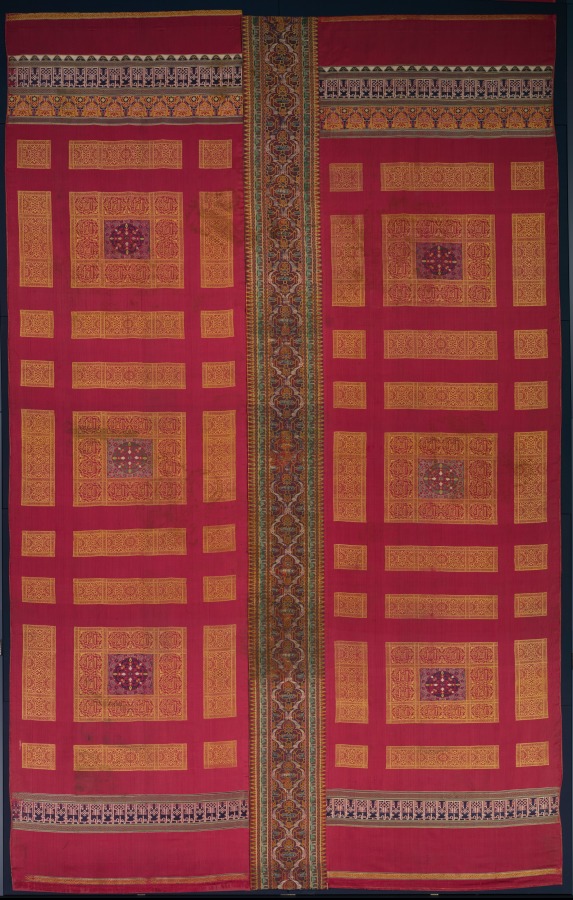
The Alhambra Silk Curtain: A Testament to Imperial Weaving and the Legacy of Craft
In the hallowed corridors of the Lauren Fashion Heritage Lab, we often find ourselves drawn to artifacts that transcend mere utility, becoming instead silent narrators of history, power, and artistry. The silk curtain from the Alhambra palace is one such piece—a fragment of the Nasrid dynasty’s opulent world, woven with threads that speak of empires, trade routes, and the enduring mastery of silk. As a Senior Heritage Specialist, I invite you to consider this artifact not merely as a decorative textile, but as a profound legacy of imperial silk weaving, a discipline that shaped economies, cultures, and the very fabric of luxury.
Materiality and Craft: The Silk of the Alhambra
The curtain’s materiality is its first and most compelling narrative. Silk, the filament of the silkworm, was a commodity of unparalleled value in the medieval world. The Alhambra, perched on the Sabika hill in Granada, was the last stronghold of Islamic rule in Iberia, and its silk industry was a jewel in the Nasrid crown. The curtain, likely woven in the 14th or 15th century, exemplifies the technical virtuosity of Andalusian weavers. Its threads are not merely spun; they are imbued with a lustrous depth that catches light like water, a quality achieved through meticulous sericulture and dyeing techniques. The use of natural dyes—madder for crimson, indigo for blue, and saffron for gold—reflects a sophisticated understanding of chemistry and aesthetics. The weave itself, often a compound structure like lampas or brocade, allowed for intricate patterns that mimicked the palace’s own stucco and tilework, creating a dialogue between architecture and textile.
The legacy of imperial silk weaving is etched into every fiber. The Alhambra’s silk workshops, or *tiraz*, were state-run institutions that produced textiles for the court, diplomatic gifts, and religious vestments. This curtain, with its geometric motifs and Kufic inscriptions, likely served as a partition in the Palace of the Lions or the Hall of the Ambassadors, filtering light and sound while asserting the ruler’s authority. The silk’s materiality—its fragility and resilience—mirrors the Nasrid dynasty itself: a civilization that flourished in the shadow of Christian conquest, weaving beauty as a form of defiance.
Context: The Imperial Silk Weaving Legacy
To understand the Alhambra curtain, one must situate it within the broader tapestry of imperial silk weaving. From the Byzantine workshops of Constantinople to the Safavid looms of Isfahan, silk was a medium of power. The Nasrids inherited this tradition from the Umayyad Caliphate of Córdoba, which had established silk production as a cornerstone of Iberian luxury. The Alhambra’s silk was not isolated; it was part of a network that stretched from China’s Silk Road to the Mediterranean’s trading ports. The curtain’s patterns—stars, interlocking polygons, and stylized foliage—echo the mathematical precision of Islamic art, a visual language that celebrated unity and infinity. This was not mere decoration; it was a cosmological statement, woven into the very fabric of the palace.
The legacy of imperial silk weaving also carries a narrative of exchange and adaptation. When the Catholic Monarchs conquered Granada in 1492, they recognized the value of Nasrid silk. The Alhambra’s workshops were repurposed, and the curtain’s descendants—Mudejar textiles—blended Islamic motifs with Christian iconography. This curtain, then, is a bridge between worlds. It survived the Reconquista, the Inquisition, and centuries of neglect, emerging as a relic of a lost empire. Its silk threads hold the memory of a time when Granada was a beacon of cultural synthesis, where Jewish, Christian, and Muslim artisans collaborated in the pursuit of beauty.
Preservation and Interpretation: A Heritage Responsibility
In the Lauren Fashion Heritage Lab, we approach such artifacts with reverence and rigor. The Alhambra silk curtain is not a static object; it is a living document. Its preservation requires controlled humidity, minimal light exposure, and careful handling—a testament to the fragility of silk. Yet, its interpretation demands more than conservation. We must ask: What does this curtain tell us about the role of textiles in imperial identity? How did its production reflect the economic and social hierarchies of Nasrid society? And, crucially, how can we honor its legacy in a world where fast fashion has eroded the value of craftsmanship?
The answer lies in the ethos of Savile Row. Just as a bespoke suit is a collaboration between tailor and client, the Alhambra curtain was a dialogue between weaver and patron. Each thread was chosen with intention, each pattern imbued with meaning. This is the antithesis of disposable fashion. The curtain’s legacy challenges us to reconsider our relationship with clothing and textiles—to see them as investments in heritage, not mere commodities. For the Lauren Fashion Heritage Lab, this artifact is a touchstone. It informs our research into sustainable luxury, the revival of artisanal techniques, and the preservation of cultural narratives. We study its weave to understand the physics of drape; we analyze its dyes to recreate historical palettes; we document its history to inspire contemporary designers.
Conclusion: The Curtain’s Enduring Thread
The Alhambra silk curtain is more than a relic; it is a masterclass in the art of weaving empires. Its materiality—the silk, the dyes, the weave—speaks of a world where craft was synonymous with power. Its context—the legacy of imperial silk weaving—reminds us that textiles are never neutral; they carry the weight of conquest, trade, and cultural exchange. As we preserve and interpret this artifact, we honor the weavers who labored in the *tiraz*, the merchants who traded along the Silk Road, and the Nasrid rulers who understood that a curtain could be a statement of sovereignty.
In the Lauren Fashion Heritage Lab, we believe that heritage is not a static past but a living dialogue. The Alhambra curtain invites us to participate in that dialogue—to touch the silk, to trace the patterns, and to imagine the hands that wove it. It is a call to uphold the standards of imperial craftsmanship in an age of mass production. And it is a reminder that, in the world of luxury, the thread that connects us to history is the most precious of all.
Heritage Lab Insight
Lab Insight: CMA Silk Archive Node integration.