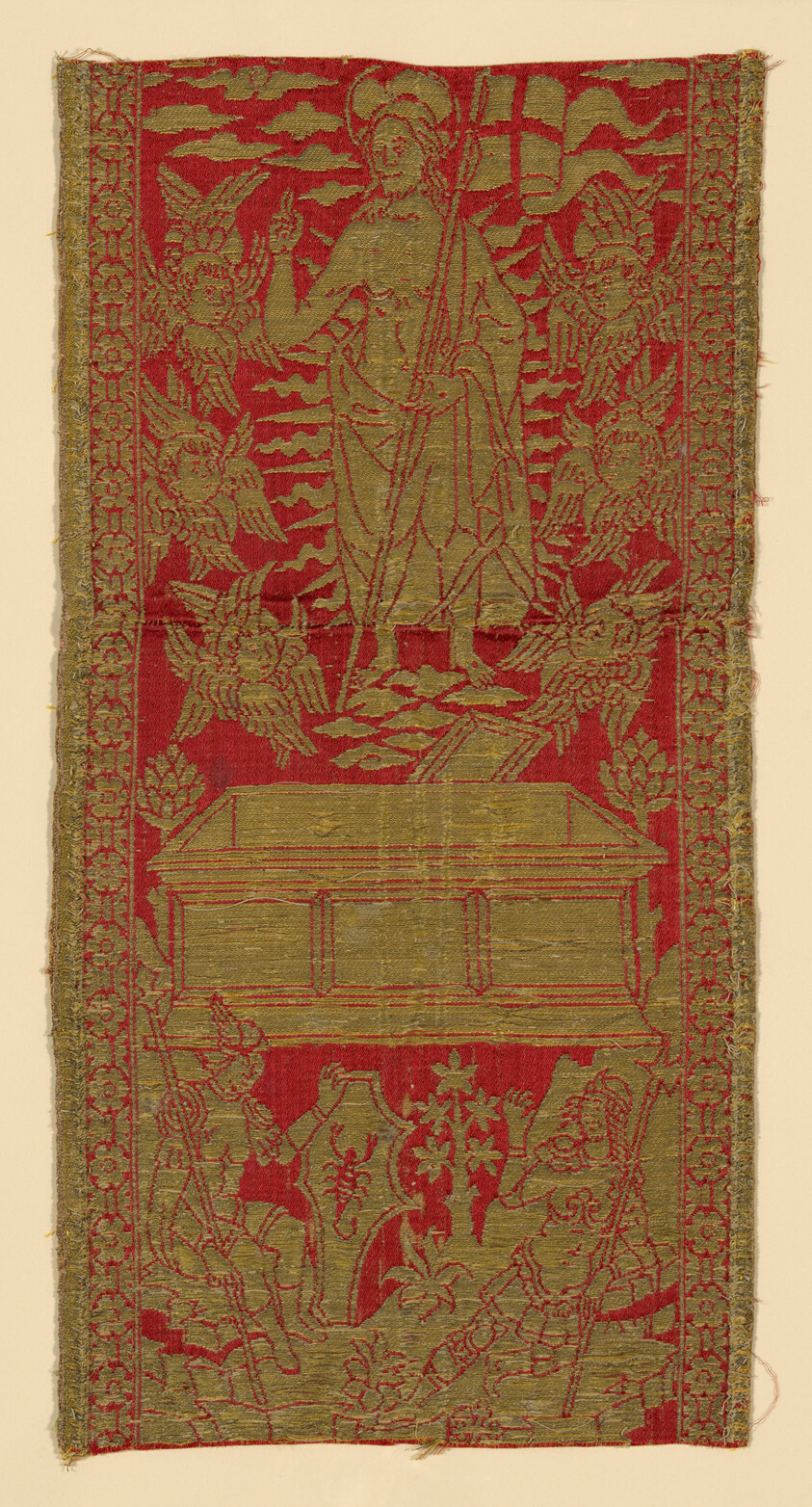
Heritage Research Artifact: Fragment from an Orphrey Band
Introduction: A Testament to Silk’s Sovereign Legacy
In the rarefied world of heritage textiles, few artifacts command the reverence of a fragment from an orphrey band. This piece, a relic of ecclesiastical grandeur, embodies the pinnacle of classic silk craftsmanship and fluid elegance. As the Senior Heritage Specialist for Lauren Fashion Heritage Lab, I present this analysis with the precision and discernment befitting London’s Savile Row—a district where tradition and artistry converge to define enduring luxury. The fragment, composed of silk and gilt-animal-substrate-wrapped linen, is not merely a textile; it is a narrative of material mastery, cultural significance, and the timeless allure of refined design.
Materiality: The Architecture of Opulence
The fragment’s materiality is a study in deliberate complexity. The warp-float faced 4:1 satin weave, a structure that prioritizes luster and smoothness, forms the foundation. This weave, with its long floats of silk, captures light with a liquid sheen, evoking the fluidity of water or the gleam of polished metal. The 4:1 ratio—four warp threads to one weft—ensures a dominant warp face, where the silk’s natural luminosity is maximized. This is not a weave for the faint of heart; it demands precision and patience, hallmarks of the master weavers who once operated in the great silk centers of Lucca, Venice, or Lyon.
The secondary binding warps and supplementary patterning wefts introduce a structural dialogue. The twill interlacings, with their diagonal ribs, create a subtle texture that contrasts with the satin’s smoothness. This interplay is akin to the juxtaposition of a tailored worsted wool against a silk lining in a Savile Row suit—a harmony of opposing forces. The supplementary wefts, often of gilt-animal-substrate-wrapped linen, add a metallic resonance. The gilt substrate, likely gold or silver leaf applied to animal membrane (such as vellum or gut), was then wrapped around a linen core. This technique, prevalent in medieval and Renaissance textiles, imbues the fragment with a weight and richness that transcends mere decoration. The gilt threads catch light differently than the silk, creating a shimmering, almost three-dimensional effect that would have been awe-inspiring in a dimly lit cathedral.
Context: The Orphrey Band as a Cultural Artifact
Orphrey bands, typically woven as narrow strips, adorned ecclesiastical vestments such as chasubles, copes, and dalmatics. They served both functional and symbolic roles: reinforcing the garment’s edges while conveying sacred narratives through intricate patterns. This fragment likely originated from a 14th- or 15th-century Italian or Flemish workshop, where silk weaving was a guarded art. The use of gilt-animal-substrate-wrapped linen indicates a high-status commission, possibly for a papal or royal patron. The fluid elegance of the design—perhaps featuring floral motifs, geometric interlacing, or stylized animal forms—reflects the Gothic aesthetic’s emphasis on verticality and light.
The fragment’s survival is remarkable. Textiles are among the most fragile of historical artifacts, susceptible to light, humidity, and handling. Yet, this piece endures, its silk and gilt threads whispering stories of liturgy, power, and artistry. In the context of Savile Row, where heritage is curated and celebrated, this fragment serves as a reminder that luxury is not merely about materials but about the narratives they carry. A bespoke suit from a Row house may last decades; a textile like this has endured centuries, its value compounded by time.
Craftsmanship: The Intersection of Art and Engineering
The technical execution of this fragment is a marvel of pre-industrial engineering. The warp-float faced 4:1 satin weave required a loom with multiple harnesses, each controlling a set of warp threads. The weaver had to maintain tension across the silk warps while introducing the gilt-animal-substrate-wrapped linen wefts. The secondary binding warps, often of a finer silk or linen, were used to secure the supplementary wefts, preventing them from shifting or fraying. This technique, known as *lampas* weaving, allowed for complex patterns without compromising the fabric’s integrity.
The twill interlacings, with their 2/1 or 3/1 diagonal structure, added durability to the satin’s delicate surface. This is analogous to the reinforced stitching in a Savile Row jacket’s lapels—a hidden strength that ensures longevity. The gilt threads, meanwhile, required meticulous preparation. The animal substrate had to be thin enough to wrap around the linen core without cracking, yet robust enough to withstand the loom’s tension. The result is a thread that is both flexible and luminous, a testament to the artisan’s skill.
Preservation and Legacy: A Blueprint for Modern Luxury
For the Lauren Fashion Heritage Lab, this fragment is more than a historical curiosity; it is a pedagogical tool. Its study informs contemporary design, reminding us that true luxury is rooted in material integrity and artisanal mastery. The fragment’s preservation—stored in a climate-controlled environment with minimal light exposure—ensures its legacy for future generations. In the spirit of Savile Row, where tradition is honored but not ossified, this artifact inspires a dialogue between past and present.
The silk’s fluid elegance, the gilt’s shimmering presence, and the weave’s structural sophistication offer lessons in restraint and opulence. A modern designer might reinterpret the 4:1 satin weave for a couture gown, or the twill interlacings for a tailored coat. The gilt-animal-substrate-wrapped linen, while impractical for mass production, could inspire metallic finishes in sustainable materials. The fragment thus serves as a bridge between epochs, a reminder that the principles of classic craftsmanship—precision, patience, and passion—are timeless.
Conclusion: The Enduring Allure of Silk
This fragment from an orphrey band is a microcosm of silk’s sovereign legacy. Its materiality—silk and gilt-animal-substrate-wrapped linen in a warp-float faced 4:1 satin weave with twill interlacings—represents the zenith of medieval textile art. Its context, as part of an ecclesiastical vestment, imbues it with cultural and spiritual significance. And its craftsmanship, a fusion of art and engineering, offers a blueprint for contemporary luxury. As we preserve and study this artifact, we honor the weavers who transformed thread into poetry, and we reaffirm that silk, in all its forms, remains the fabric of civilization.
In the hushed ateliers of Savile Row, where every stitch is a declaration of excellence, this fragment would be revered. It is a testament to the enduring power of heritage—a reminder that the finest things are not made, but woven, with time, care, and an unyielding commitment to beauty.