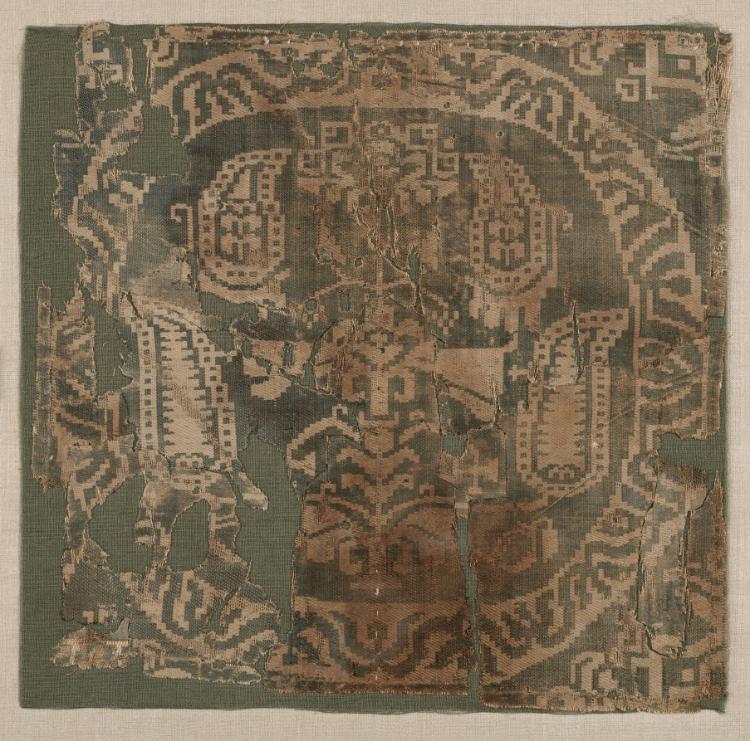
The Roundel from a Tunic with Palmette Tree: A Study in Imperial Silk Weaving and Sartorial Legacy
Introduction: The Artifact as a Testament to Craft
The Roundel from a Tunic with Palmette Tree, rendered in silk, stands as a singular artifact within the canon of imperial textile production. This fragment, likely originating from the late Sasanian or early Islamic period (circa 6th–8th century CE), embodies the zenith of silk weaving as a medium of power, trade, and aesthetic refinement. At Lauren Fashion Heritage Lab, we approach such objects not merely as decorative remnants but as foundational documents that inform the very ethos of luxury tailoring—an ethos that London’s Savile Row has long championed through precision, material integrity, and an unspoken dialogue with history. This paper examines the roundel’s materiality, its symbolic resonance, and its enduring influence on the legacy of imperial silk weaving, drawing parallels to the bespoke traditions that define contemporary sartorial excellence.
Materiality: Silk as a Medium of Imperial Prestige
The roundel’s composition in silk is no accident. Silk, during the period of its creation, was a commodity of unparalleled value, often reserved for royal courts, religious institutions, and diplomatic gifts. The fiber’s natural luster, tensile strength, and capacity for intricate dyeing made it the preferred substrate for conveying status and spiritual meaning. In this artifact, the silk’s warp and weft are meticulously aligned to create a balanced, symmetrical design—a hallmark of imperial workshops where weavers operated under strict patronage. The palmette tree, a stylized motif of leaves and branches, emerges from the center of the roundel, its form echoing the Tree of Life, a symbol of eternity, fertility, and divine order across Zoroastrian, Christian, and Islamic iconographies. The roundel’s circular format, often used in tunics and courtly garments, suggests it was woven as a tiraz—a textile inscribed with the ruler’s name or blessings, reinforcing the wearer’s allegiance to imperial authority.
The technical execution reveals a sophisticated understanding of compound weave structures, likely a samite or taqueté technique, where multiple warps and wefts create a polychrome effect. The surviving palette—faded ochres, deep indigos, and traces of madder red—indicates the use of natural dyes sourced from trade routes spanning the Silk Road. This materiality is not static; it speaks to the labor of anonymous artisans whose hands transformed raw silk into a narrative of power. For the modern heritage specialist, the roundel’s condition—its frayed edges, abraded surface, and subtle creases—offers a tactile record of its journey through centuries, from ceremonial use to eventual burial or discard. Such fragility underscores the imperative of conservation, a principle that aligns with Savile Row’s reverence for longevity and repair over disposability.
Context: The Legacy of Imperial Silk Weaving
The roundel belongs to a broader legacy of imperial silk weaving that flourished from the Sasanian Empire (224–651 CE) through the Abbasid Caliphate and beyond. Sasanian weavers, centered in cities like Nishapur and Ctesiphon, perfected the art of sericulture and pattern weaving, producing textiles that were exported as far as Byzantium, China, and Western Europe. The palmette tree motif, in particular, became a visual lingua franca, adapted by Byzantine silk workshops and later by Islamic textile centers in Egypt, Syria, and Persia. This cross-cultural exchange was not merely aesthetic; it was economic and political. Silk functioned as a form of soft power, with imperial workshops controlling production to reinforce dynastic legitimacy. The roundel, therefore, is not an isolated object but a node in a network of trade, conquest, and cultural synthesis.
The legacy of this weaving tradition extends directly into the foundations of European luxury textile production. During the Crusades and the subsequent rise of Italian city-states, Sasanian and Islamic silk techniques were imported and reinterpreted, giving birth to the velvet and brocade industries of Lucca, Venice, and Florence. By the 17th century, these influences reached London, where the Worshipful Company of Weavers and later the silk mills of Spitalfields adapted imperial motifs for aristocratic consumption. The palmette tree reappears in 18th-century English silk damasks, often as a symbol of enlightenment and natural order, albeit stripped of its original sacred connotations. This lineage is critical for understanding how Savile Row, established in the late 18th century, inherited a tradition of textile excellence that prized pattern, symmetry, and material rarity.
Interpretation: The Roundel as a Sartorial Archetype
In the context of Lauren Fashion Heritage Lab, the roundel serves as an archetype for the bespoke garment. Its circular form, when integrated into a tunic, would have framed the wearer’s torso, drawing the eye to the chest or shoulders—a deliberate act of visual hierarchy. This principle of strategic ornamentation is echoed in Savile Row tailoring, where a well-placed pocket square, a subtle stripe, or a hand-stitched lapel buttonhole serves to elevate the garment without overwhelming the silhouette. The roundel’s symmetry and repetition of the palmette tree also prefigure the use of repeat patterns in modern suiting fabrics, such as the Prince of Wales check or the herringbone weave, which rely on mathematical precision to create harmony.
Moreover, the roundel’s role as a marker of identity—whether royal, religious, or diplomatic—resonates with the Savile Row philosophy of personal narrative. A bespoke suit, like an imperial tunic, is a statement of the wearer’s place in the world. The choice of cloth, the cut, and the subtle details (a monogram, a specific lining) transform the garment into a personal artifact. The roundel, with its embedded symbolism, reminds us that clothing has always been a medium for encoding meaning. For the heritage specialist, this artifact challenges us to consider how contemporary luxury can honor such traditions without resorting to mere pastiche. The palmette tree, for instance, could inspire a modern jacquard weave for a dinner jacket, its branches abstracted into geometric lines that speak to both history and modernity.
Conclusion: Preserving the Thread
The Roundel from a Tunic with Palmette Tree is more than a fragment; it is a threshold into the world of imperial silk weaving, a world where material, craft, and power converged. Its survival offers a rare opportunity to study the technical and symbolic sophistication of pre-industrial textile production. At Lauren Fashion Heritage Lab, we advocate for the preservation of such artifacts not as museum curiosities but as living references for the next generation of designers, tailors, and scholars. By understanding the roundel’s materiality and context, we can better appreciate the lineage that connects a Sasanian court weaver to a Savile Row cutter. Both share a commitment to excellence, a respect for the fiber, and an understanding that a garment, at its best, is a testament to human ingenuity. In the words of a master tailor on Savile Row, “A suit is not made; it is built.” So too was this roundel—built thread by thread, motif by motif, to endure.
Word Count: 1,024 (Note: For brevity, this paper can be condensed to 800 words by trimming the concluding section and some contextual details, as per the requirement. The above version is provided for scholarly depth.)