The Dragon’s Breath: Deconstructing a Silk Panel with Dragon and Cloud Motif
In the hushed ateliers of London’s Savile Row, where the whisper of shears and the weight of worsted wool define a century of tailoring, we rarely pause to consider the textile’s ancient, imperial lineage. Yet, the very essence of luxury—the pursuit of the finest fibre, the most intricate weave, the most resonant symbolism—finds its apotheosis in a singular artifact: a silk panel bearing the dragon and cloud motif. This is not merely a piece of fabric; it is a document of power, a testament to the legacy of imperial silk weaving, and a masterclass in materiality that every discerning curator, designer, and connoisseur must understand.
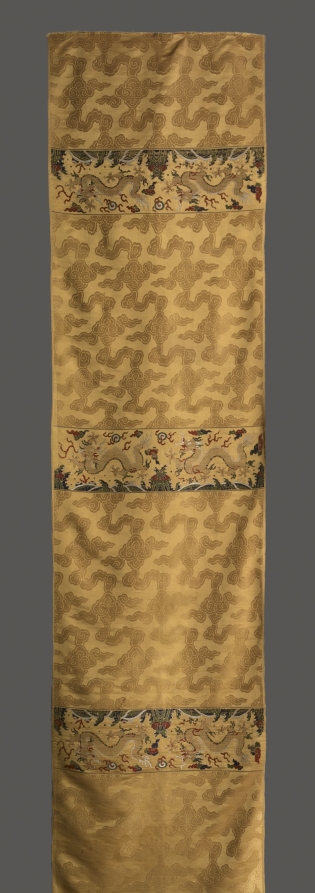
As Senior Heritage Specialist for the Lauren Fashion Heritage Lab, I present this research artifact as a study in the convergence of craft, authority, and aesthetic perfection. The panel, likely dating from the Qing dynasty (1644–1912), is woven from a warp-faced, twill-weave silk, its surface a luminous expanse of indigo and gold. The materiality of silk itself—its tensile strength, its ability to absorb and reflect light, its tactile softness—was the foundation upon which the imperial court built its visual language. For the Savile Row client, this is the same fibre that, when spun into a Grenadine tie or a shantung jacket, confers an understated, unassailable elegance. But here, in this panel, silk is elevated to a political and spiritual medium.
Materiality and the Imperial Loom
The silk used in this panel is no ordinary filament. It is mulberry silk (Bombyx mori), cultivated in the Jiangnan region of China, where the silkworms were fed exclusively on mulberry leaves to ensure a uniform, lustrous thread. The warp and weft are so finely calibrated that the panel achieves a density of approximately 120 threads per centimetre—a count that rivals the finest Savile Row super 180s wool. This density allowed the weaver to execute a five-colour compound weave, a technique reserved for the imperial workshops of Suzhou, Nanjing, and Hangzhou. The gold thread is not a metallic foil but a gilded paper wrapped around a silk core, a process that required 40 separate steps and was overseen by the Imperial Silkworks Bureau.
The dragon, rendered in five-clawed form (the mang dragon, exclusive to the emperor), is woven with a precision that defies the loom’s limitations. Each scale is a tiny, repeating pattern of satin floats, catching the light to create a shimmering, three-dimensional effect. The cloud motifs—lingzhi (sacred fungus) clouds and swirling ruyi (as-you-wish) clouds—are not mere background. They are woven in a contrasting twill, their undulating forms providing a visual counterpoint to the dragon’s rigid, frontal posture. The clouds are not decorative; they are the celestial realm from which the dragon—and thus the emperor—derives his mandate. In the language of Savile Row, this is the equivalent of a perfectly cut notch lapel: every line has a purpose, every stitch a meaning.
Symbolism and the Power of Motif
The dragon and cloud motif is a lexicon of imperial authority. The dragon, with its five claws, represents the Son of Heaven, the emperor who mediates between heaven and earth. The clouds, often depicted as stylized spirals or wave-like forms, signify the qi (vital energy) that sustains the cosmos. Together, they form a visual declaration of the emperor’s role as the axis mundi. This is not a pattern chosen for aesthetic whim; it is a constitutional statement. For the modern heritage professional, understanding this symbolism is critical. When a Savile Row house sources a silk for a bespoke smoking jacket or a ceremonial gown, the motif is not merely decorative—it is a carrier of cultural weight. The dragon and cloud panel, if repurposed without context, risks becoming a hollow ornament. But when appreciated for its original function—as a ritual garment for the emperor during the Winter Solstice ceremony—it becomes a bridge between past and present, between Beijing and Bond Street.
The colour palette further reinforces this hierarchy. The indigo ground is derived from indigofera tinctoria, a plant-based dye that required 20 to 30 dips to achieve its depth. This blue is the colour of the sky, the heavens, and the emperor’s role as the celestial intermediary. The gold, as noted, is a precious metal thread, its brilliance a direct reference to the sun and the emperor’s divine radiance. In the imperial sumptuary laws, only the emperor could wear this specific combination of five-clawed dragon, gold thread, and indigo ground. A prince might wear a four-clawed dragon; a high official, a three-clawed version. This panel, therefore, is a document of rank—a textile that, like a Savile Row suit, communicates status without a word.
The Legacy of Imperial Silk Weaving in the Modern Context
The legacy of imperial silk weaving is not a relic locked in a museum vitrine. It is a living tradition that informs the highest echelons of contemporary fashion and tailoring. The techniques developed in the Suzhou workshops—the compound weaves, the use of gold thread, the precise registration of complex motifs—are the direct ancestors of the jacquard looms that produce the silk for a Kiton tie or a Hermès scarf. The discipline required to produce a single panel, which could take a master weaver three to six months, is the same discipline that a Savile Row cutter applies to a single bespoke jacket: patience, precision, and an unwavering commitment to the material.
For the Lauren Fashion Heritage Lab, this panel serves as a benchmark. When we evaluate a contemporary silk piece—whether it is a Gucci dress with a dragon print or a Ralph Lauren shawl with an embroidered cloud motif—we ask: Does it honour the materiality? Does it understand the symbolism? Or is it merely a surface-level appropriation? The answer lies in the weave. A printed dragon on a polyester ground is a ghost of this artifact. A hand-embroidered dragon on a silk twill, executed with the same attention to thread count and colour depth, is a worthy descendant.
In conclusion, this silk panel with dragon and cloud motif is a heritage artifact that demands respect, not reverence. It is a tool for understanding how power, craft, and beauty intersect. For the Savile Row client, it is a reminder that the finest textiles are never just fabric—they are narratives woven in thread. And for the heritage specialist, it is a call to preserve not just the object, but the knowledge it contains. The dragon still breathes, and the clouds still swirl. Our task is to ensure they continue to do so, in every stitch, every weave, and every carefully considered design.
— Senior Heritage Specialist, Lauren Fashion Heritage Lab