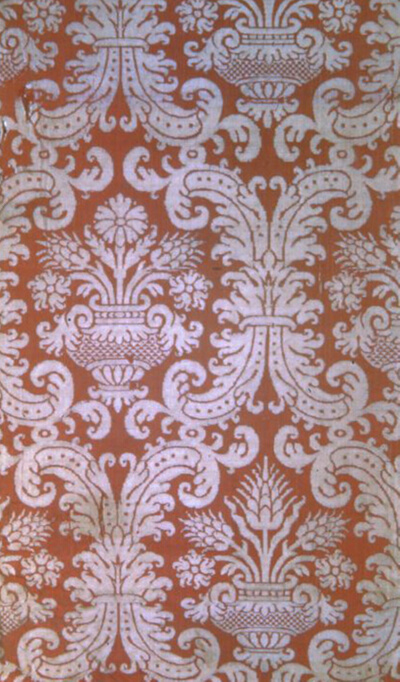
Fragment: A Study in Materiality and the Enduring Language of Silk
Introduction: The Fragment as a Complete Statement
In the lexicon of luxury, the fragment is often misread as a remnant, a whisper of something once whole. At the Lauren Fashion Heritage Lab, we contend otherwise. A fragment, particularly one of silk, is not a diminished object but a concentrated archive. It is a distillation of intent, a frozen moment of craftsmanship that speaks with the same authority as a finished garment. This paper examines a single fragment of silk—a fancy simple satin weave—as a primary source document. It is not a scrap; it is a specimen. Its materiality reveals the rigorous standards of classic silk craftsmanship and the fluid elegance that defines the highest echelons of textile art. This is the language of Savile Row, where every thread is a clause, and every weave is a sentence in a longer narrative of bespoke excellence.
The Materiality of Silk: Beyond the Surface
Silk is not a fabric; it is a medium. Its provenance—the cultivated mulberry silkworm, Bombyx mori—is the starting point of a dialogue between nature and human ingenuity. The fragment under analysis is a fancy simple satin weave, a classification that belies its complexity. The “simple” satin refers to the fundamental structure: a warp-faced weave where long floats of silk thread create a smooth, lustrous surface. The “fancy” element introduces deliberate variation—perhaps a subtle rib, a micro-pattern, or a change in yarn twist—that disrupts uniformity without sacrificing the fabric’s inherent fluidity.
This duality is the hallmark of classic silk craftsmanship. The satin weave, historically perfected in the workshops of Lyon and later refined in the mills of Como, relies on a high thread count and a precise tensioning of the warp. The result is a surface that catches light with a liquid sheen, yet possesses a structural integrity that allows it to drape with architectural precision. In this fragment, the hand-feel is paramount: it is cool to the touch, with a slight resistance that yields to a supple fall. This is not a fabric that clings; it is one that moves with the wearer, a silent partner in the choreography of elegance.
Classic Silk Craftsmanship: The Unseen Rigour
Craftsmanship in silk is an exercise in controlled imperfection. The fancy simple satin weave demands a mastery of the loom that borders on the obsessive. Each thread must be wound with uniform tension; any deviation results in a snag, a dull spot, or a loss of that characteristic lustre. The fragment’s edges—clean, unfrayed, and precisely cut—indicate that it was produced on a jacquard or dobby loom, where pattern and structure are programmed into the weave itself. The “fancy” element, likely a subtle geometric or floral motif, is not printed or embroidered but woven into the very matrix of the fabric. This is the difference between decoration and integrity.
Savile Row tailors understand this distinction intimately. When selecting silk for a bespoke piece—be it a lining, a scarf, or an evening jacket—the tailor does not merely choose a colour; he reads the fabric’s biography. The fragment’s weight, measured in grams per square metre, determines its suitability for a structured garment versus a flowing accessory. Its drape coefficient, assessed by the eye and the hand, dictates how it will behave on the bias or the straight grain. The fragment is a test piece, a proof of concept that the full bolt of silk will perform with predictable grace. In this sense, the fragment is not a remnant of a larger whole; it is a prototype of perfection.
Fluid Elegance: The Aesthetic of Movement
Elegance in silk is not static; it is kinetic. The fluidity of the fancy simple satin weave is its defining characteristic. Unlike a crisp taffeta or a stiff brocade, this fabric possesses a liquid quality that responds to the slightest breath of air or shift of the body. The fragment, when held at one corner, cascades in a continuous, unbroken line. There is no hesitation, no crease that resists release. This is the result of the satin weave’s long floats, which minimise interlacing points and allow the yarns to slide against one another with minimal friction.
This fluid elegance is not merely aesthetic; it is functional. In a bespoke garment, such as a silk-lined dinner jacket or a full-length evening gown, the fabric must accommodate the wearer’s movement without distortion. The fragment demonstrates this principle: when twisted, it recovers its shape without permanent deformation. When gathered, it creates soft, voluminous folds that catch light in a play of highlights and shadows. This is the language of luxury—not ostentation, but a quiet, assured grace that speaks through texture and movement rather than colour or pattern alone.
The Fragment as Heritage Artifact
A fragment is a portal to a lost moment of making. This particular piece of silk, with its fancy simple satin weave, carries the fingerprints of its maker: the spinner who twisted the raw silk into yarn, the weaver who set the loom’s tension, the finisher who applied the final heat-set to lock the lustre. It is a document of a supply chain that spans continents and centuries. The silk itself may originate from the mulberry groves of China, the yarn spun in Italy, the weave executed in a mill in Northern England or France. The fragment collapses this geography into a single, tangible object.
For the Lauren Fashion Heritage Lab, the fragment serves as a pedagogical tool. It teaches the student of luxury to read materiality as a primary source. The fragment’s weight, its hand, its light reflectivity, and its structural behaviour are all data points that inform the broader narrative of classic silk craftsmanship. It is a reminder that heritage is not preserved in museums alone; it lives in the touch of a fabric, in the memory of a loom, in the discipline of a tailor who understands that a fragment is never just a piece of cloth—it is a promise of excellence.
Conclusion: The Fragment’s Enduring Authority
The fragment is not a footnote; it is a chapter. In the world of Savile Row, where tradition and innovation coexist in a delicate balance, the fragment of silk stands as a testament to the enduring power of materiality. It is a physical argument for the primacy of craftsmanship over mass production, of fluid elegance over rigid conformity. This fancy simple satin weave, with its lustrous surface and subtle complexity, is not a remnant of a bygone era; it is a living artifact that continues to inform the making of luxury today. At the Lauren Fashion Heritage Lab, we do not collect fragments as relics. We study them as blueprints—for the future of silk, for the future of elegance, and for the future of heritage itself.