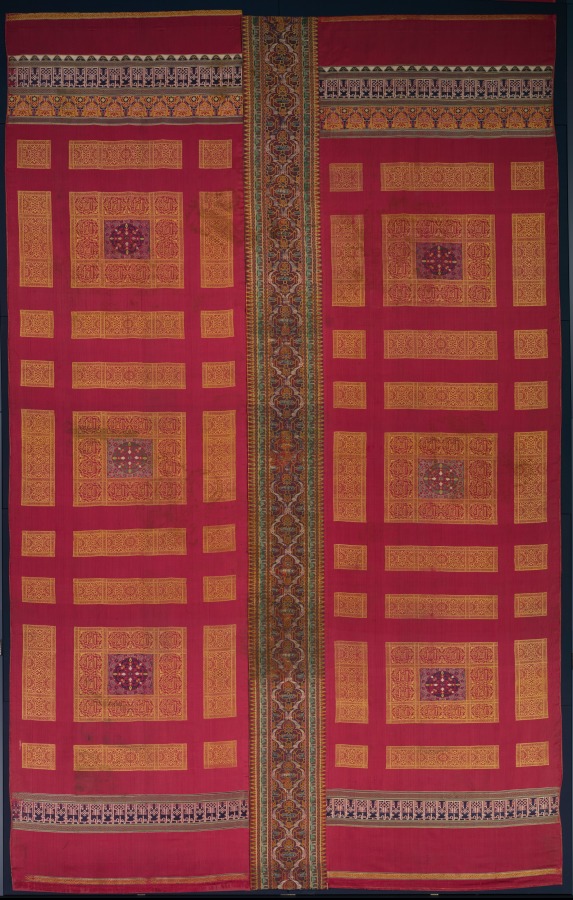
The Alhambra Silk Curtain: A Tapestry of Imperial Legacy and Material Mastery
In the hushed corridors of the Lauren Fashion Heritage Lab, we often speak of fabric as narrative. Yet, few artifacts articulate this truth with the quiet authority of a silk curtain from the Alhambra palace. This is not merely a textile; it is a document of empire, a testament to the confluence of art, power, and trade that defined the medieval Mediterranean. As a Senior Heritage Specialist, I invite you to consider this piece through the lens of its materiality—silk—and its context: the enduring legacy of imperial silk weaving. The Alhambra curtain, preserved in fragments yet resonant in its entirety, offers a profound lesson in how heritage informs the very fabric of luxury and craftsmanship we uphold on Savile Row today.
Materiality: The Silk Thread of Sovereignty
Silk is the protagonist here. Its production, a closely guarded secret originating in China, traversed the Silk Road to become the currency of courts across Europe, Asia, and North Africa. By the 14th century, when the Nasrid dynasty embellished the Alhambra with such textiles, silk weaving had evolved into a sophisticated imperial industry. The curtain’s silk—likely a blend of wild and cultivated varieties—exhibits a lustrous, almost liquid quality, a hallmark of high-grade mulberry silk. This material was not chosen for mere aesthetics; it was a declaration of sovereignty. Silk’s rarity, its labor-intensive production, and its ability to absorb vibrant dyes made it a medium for political messaging. In the Alhambra, silk curtains served as both functional barriers and symbolic thresholds, demarcating spaces of power—the throne room, the private quarters of the sultan—from the mundane world. The weave itself, often a lampas or a compound twill, allowed for intricate patterns that mimicked the palace’s own stucco and tilework, creating a seamless dialogue between architecture and textile.
The physical properties of this silk are instructive. Under magnification, one observes the fine, even twist of the threads, indicative of a skilled hand and a standardized production process. The warp and weft are not merely structural; they are carriers of color—crimson, gold, and indigo—derived from natural sources like cochineal, saffron, and woad. These hues were not arbitrary; they signified wealth, divinity, and authority. The crimson, for instance, was a color reserved for royalty in many Islamic and Christian courts, a chromatic assertion of power that transcended religious boundaries. The curtain’s weight, too, is telling. It drapes with a deliberate gravity, suggesting it was designed to hang in stillness, to command attention through its sheer presence. This is not a fabric for movement; it is a fabric for permanence, for the eternal gaze of the palace.
Context: The Legacy of Imperial Silk Weaving
The legacy of imperial silk weaving is a story of cross-cultural pollination. The Nasrids, rulers of the Emirate of Granada, inherited a tradition of silk production from the Umayyad Caliphate and earlier Persian and Byzantine models. Al-Andalus became a nexus of innovation, where Islamic geometric patterns merged with classical motifs, creating a visual language that would later influence Renaissance Italy. The Alhambra curtain is a product of this synthesis. Its design—likely featuring interlacing stars, arabesques, and Kufic inscriptions—echoes the palace’s famed muqarnas and zillij tilework. Yet, the silk medium introduces a tactile dimension that stone cannot replicate. It is a textile that breathes, that catches light, that whispers of the hands that wove it. This legacy extends beyond the Nasrids. When the Catholic Monarchs conquered Granada in 1492, they did not destroy the Alhambra’s silk workshops; they co-opted them. The same looms that produced curtains for the sultan now wove vestments for the Spanish crown, a testament to silk’s enduring imperial utility.
For the Lauren Fashion Heritage Lab, this curtain is a touchstone for understanding how imperial systems of production—often exploitative, always hierarchical—shaped the material world. The silk trade relied on networks of sericulture, dyeing, and weaving that spanned continents, from the mulberry groves of China to the bazaars of Granada. This globalism, while not modern in the corporate sense, prefigures the supply chains that define luxury fashion today. The curtain’s survival—fragile, yet preserved in museum collections—reminds us that heritage is not static. It is a living dialogue between past and present, between the artisan and the archivist. On Savile Row, we honor this dialogue by insisting on provenance, on the story behind the stitch. The Alhambra silk curtain is the ultimate provenance: a textile that has witnessed the rise and fall of empires, yet retains its capacity to inspire.
Implications for Contemporary Craft and Heritage
What, then, does this artifact mean for the modern practitioner of luxury? First, it underscores the primacy of materiality. In an age of synthetic fibers and fast fashion, the Alhambra curtain is a rebuke. Its silk demands patience, skill, and an understanding of nature’s rhythms—qualities that cannot be algorithmically optimized. Second, it challenges us to reconsider the role of ornament. The curtain’s intricate patterns are not decorative excess; they are a language of power, faith, and identity. For the Savile Row tailor, this translates into a respect for detail, for the lapel that is not merely functional but emblematic of a house’s ethos. Finally, the curtain teaches us about endurance. Silk, despite its delicacy, has survived centuries because it was cared for, repaired, and valued. This is a lesson in stewardship—a reminder that heritage is not a commodity to be exploited but a trust to be maintained.
In conclusion, the Alhambra silk curtain is more than a heritage artifact; it is a masterclass in the intersection of material, craft, and context. Its silk threads carry the weight of imperial ambition, the artistry of Andalusian weavers, and the enduring legacy of a global trade. For the Lauren Fashion Heritage Lab, it stands as a benchmark for what luxury should aspire to be: not transient, but timeless; not superficial, but substantive. As we continue to explore the archives of fashion history, let us remember that every fabric has a story, and every story, if we listen closely, can guide our hands toward a more meaningful craft.