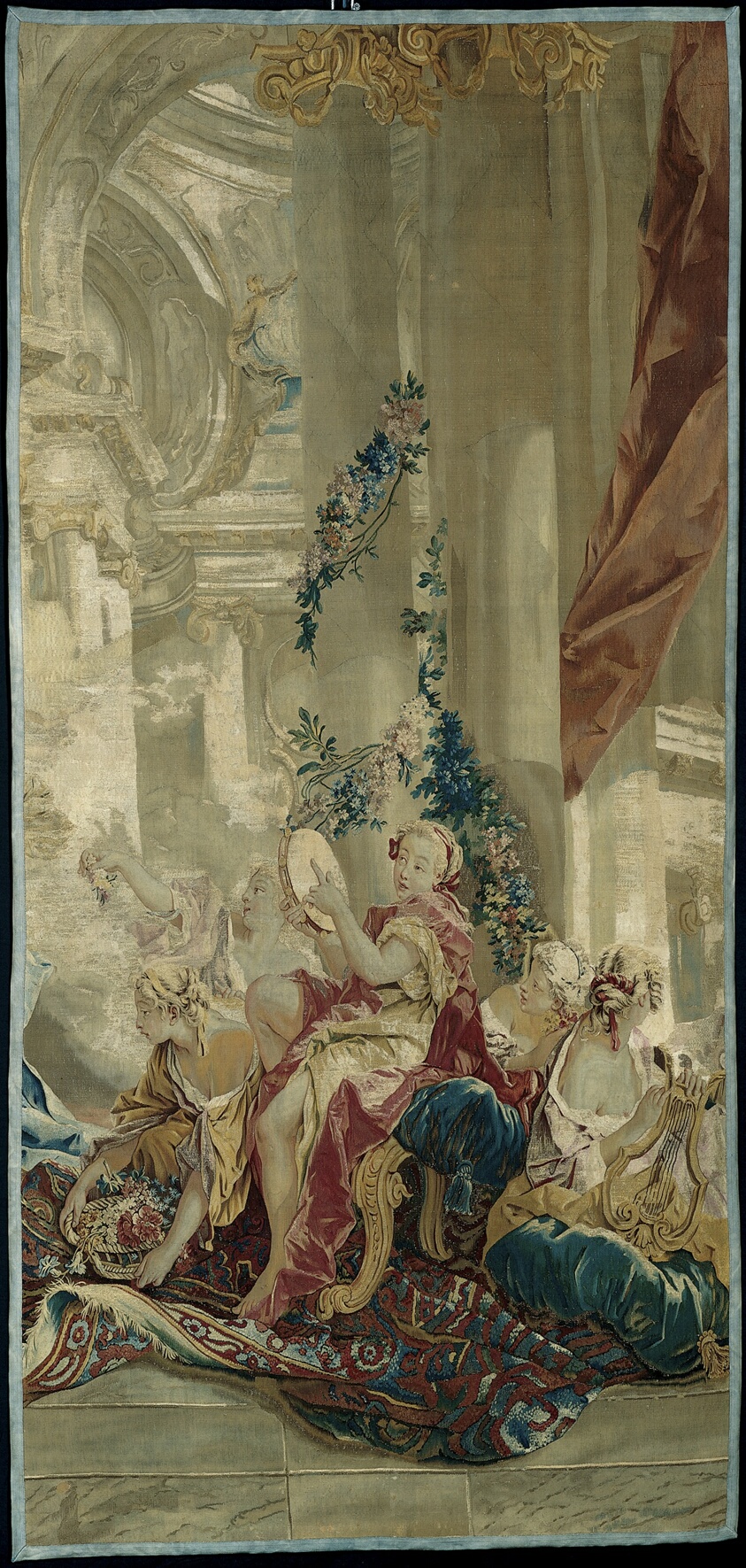
Heritage Artifact Analysis: Psyche’s Entrance into Cupid’s Palace [Right Fragment]
Provenance and Material Significance
This fragment, a surviving segment of the larger Story of Psyche tapestry series, represents a pinnacle of Renaissance textile artistry. Woven in wool and silk using the tapestry weave technique, it captures the moment Psyche approaches the divine threshold of Cupid’s palace. The materiality—specifically the interplay of silk and wool—speaks to a deliberate hierarchy of value. Silk, with its natural luster and ability to absorb vibrant dyes, was reserved for the most luminous elements: Psyche’s flowing gown, the marble columns, and the ethereal light emanating from the palace interior. Wool, by contrast, provides the structural ground and matte backdrop, grounding the scene in tactile reality. This duality mirrors the narrative tension between mortal fragility and immortal splendor.
From a heritage perspective, the fragment’s survival is itself a testament to the durability of silk craftsmanship. The warp threads, likely linen or wool, have held the weft in place for centuries, while the silk wefts retain their chromatic intensity—a deep crimson, a pale gold, a verdant green—that would have dazzled 16th-century viewers. The tapestry weave, with its discontinuous wefts and hatching techniques, allowed the weaver to achieve gradations of light and shadow, rendering Psyche’s hesitant step as a study in chiaroscuro. This is not merely decorative; it is a technical feat that elevates the artifact from craft to high art.
Narrative Context and Compositional Dynamics
The right fragment focuses on Psyche’s entrance—a moment of transition. She stands at the palace gates, one foot poised on the threshold, her body half-turned as if caught between awe and apprehension. The composition draws the eye along a diagonal axis: from the lower left, where her hand brushes the gilded doorframe, to the upper right, where a celestial light spills from within. This diagonal is reinforced by the silk threads, which catch the light differently depending on the viewing angle, creating a sense of movement.
Architectural elements frame Psyche’s figure: a Corinthian column on the left, its capital rendered in silk with meticulous detail; a lintel above, inscribed with a Latin motto (now partially lost to wear). The column symbolizes strength and permanence, contrasting with Psyche’s vulnerability. Yet the silk threads soften the stone—the column appears almost fluid, as if the palace itself is alive. This is characteristic of the Story of Psyche series, which often blurs the boundary between the human and the divine, the material and the immaterial.
The fragment’s right edge cuts off abruptly, suggesting that the original tapestry extended further—perhaps into a garden or a celestial vista. This truncation invites speculation: what lies beyond? The weaver’s choice to focus on Psyche’s entrance, rather than the palace interior, emphasizes the liminality of her journey. She is neither fully mortal nor yet divine; she stands at the cusp of transformation. The silk threads, with their inherent sheen, mirror this liminal state—they are neither opaque nor transparent, but luminous.
Craftsmanship and Savile Row Parallels
In the lexicon of London’s Savile Row, where tailoring is elevated to an art form, the Psyche’s Entrance fragment resonates deeply. The tapestry’s construction mirrors the bespoke process: a warp (the foundational structure) is laid, and the weft (the decorative narrative) is woven with precision. Similarly, a Savile Row suit begins with a canvas (the warp) and is built layer by layer with silk linings, wool flannels, and hand-stitched details. Both require an understanding of material behavior—how silk drapes, how wool holds shape, how light interacts with texture.
The fragment’s palette—crimson, gold, ivory, and verdigris—echoes the color schemes favored by Savile Row houses for evening wear and ceremonial garments. The crimson of Psyche’s gown is not unlike the deep burgundy of a smoking jacket; the gold of the palace columns recalls the silk embroidery on a military tunic. This is no coincidence. The Renaissance tapestry weavers and Savile Row tailors share a lineage: both are custodians of heritage craft, both prioritize fit and finish over fleeting trends.
Moreover, the fragment’s condition—the slight fading of the wool, the crispness of the silk—offers lessons in conservation. Just as a bespoke suit requires careful storage and periodic restoration, so too does this textile artifact. The silk threads, though resilient, are vulnerable to light and humidity. The wool, though sturdy, can become brittle. Preserving the fragment demands a balance between accessibility and protection—a principle that Savile Row applies to its archives, where vintage patterns and sample books are kept under controlled conditions.
Symbolism and the Role of Silk in Narrative
Silk in this fragment is not merely a material; it is a narrative device. The palace’s interior is rendered in silk threads of varying thickness, creating a shimmering effect that suggests otherworldliness. Psyche’s gown, woven with a higher density of silk, appears to glow, marking her as the focal point. The wool background, by contrast, recedes into shadow, emphasizing the isolation of her figure. This technique—using material to guide the viewer’s eye—is a hallmark of master weavers.
The fragment also carries symbolic weight. Silk, historically associated with luxury and divinity, underscores Psyche’s ascent from mortal to goddess. Her entrance into Cupid’s palace is a rite of passage, and the silk threads that define her form are a metaphor for transformation. In the context of heritage, silk represents continuity—a thread that connects past and present, artisan and audience. The fragment, though incomplete, retains this connective power.
Conclusion: A Legacy of Craft and Narrative
Psyche’s Entrance into Cupid’s Palace [Right Fragment] is more than a decorative artifact; it is a testament to the enduring dialogue between material and meaning. Its wool and silk construction, its narrative focus on liminality, and its resonance with Savile Row’s ethos of bespoke craftsmanship elevate it to a position of cultural significance. As a heritage specialist, I recommend that this fragment be studied not only for its aesthetic merits but also for its technical innovations—the hatching, the color gradations, the interplay of light and texture. It is a masterclass in how materiality can tell a story, and how a single fragment can hold the weight of an entire myth.
In preserving and interpreting this artifact, we honor the weavers who, like Savile Row tailors, understood that true elegance lies in the details. The silk threads, though centuries old, still speak—of Psyche’s courage, of Cupid’s palace, of the eternal human quest for the divine. And in that speaking, they remind us that heritage is not static; it is a living weave, continuously reinterpreted by those who care to look.