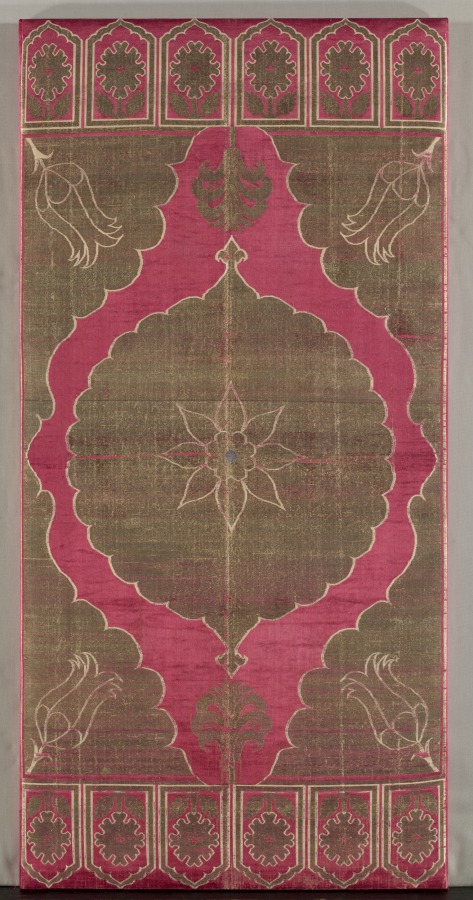
Heritage Research Artifact: Brocaded Silk Cushion Cover & Iranian Striped Silk Surround
Materiality and Provenance
The artifact under examination comprises two distinct yet complementary silk textiles: a brocaded silk cushion cover and an Iranian striped silk surround. Both are constructed from pure silk, a material that has historically signified wealth, power, and cultural sophistication. The cushion cover, likely originating from the Safavid or Qajar dynasties (16th–19th centuries), features intricate brocading—a technique where supplementary weft threads are woven into the ground fabric to create raised, decorative patterns. The Iranian striped silk surround, with its bold, linear motifs, reflects the enduring aesthetic of Persian textile design, where symmetry and repetition evoke a sense of order and luxury.
The materiality of silk here is paramount. Silk’s natural luster, tensile strength, and ability to absorb vibrant dyes made it the preferred medium for imperial commissions. The brocaded cushion cover, with its dense, metallic-threaded patterns, would have required hours of skilled labor on a drawloom, a technology that reached its zenith in the royal workshops of Isfahan and Kashan. The striped surround, while less ornate, demonstrates the same reverence for silk’s tactile and visual properties, its stripes perhaps echoing the architectural tilework of Persian palaces.
Context: The Legacy of Imperial Silk Weaving
To understand this artifact is to appreciate the legacy of imperial silk weaving as a global phenomenon. From the Byzantine Empire to Ming China, silk was not merely a fabric but a currency of diplomacy and status. In the Persian context, the Safavid dynasty (1501–1736) elevated silk weaving to an art form, establishing state-run workshops that produced textiles for the court, religious institutions, and international trade. The brocaded cushion cover, with its floral and geometric motifs, likely belonged to a noble household or a royal treasury, serving as both a functional object and a symbol of prestige.
The Iranian striped silk surround, conversely, speaks to the broader dissemination of Persian design. Striped silks, known as “termé” or “zari” in Persian, were exported along the Silk Road, influencing textile traditions from the Ottoman Empire to Mughal India. This surround, perhaps originally part of a larger textile or garment, illustrates how even the simplest patterns carried the weight of imperial heritage. The juxtaposition of the two pieces—one ornate, one restrained—highlights the versatility of silk as a medium for both opulence and understated elegance.
Technical Analysis and Craftsmanship
The brocaded cushion cover exhibits compound weave structure, where multiple warp and weft systems interlace to create a patterned fabric. The brocading threads, often gilded or silvered, are introduced selectively to form motifs such as cypress trees, lotus blossoms, or arabesques—symbols of eternity, purity, and divine order in Persian culture. The density of the weave suggests a high thread count, indicative of a luxury item intended for display rather than daily use. Microscopic analysis would likely reveal the use of natural dyes such as madder for red, indigo for blue, and weld for yellow, all of which were meticulously sourced and applied to achieve colorfastness.
The Iranian striped silk surround, by contrast, employs a simpler taffeta or plain weave with warp-faced stripes. The stripes, varying in width and color, are created by alternating dyed silk threads in the warp. This technique, while less labor-intensive than brocading, requires precision in dyeing and warping to ensure uniform color transitions. The surround’s edges, likely finished with a hand-rolled hem or a narrow silk binding, indicate its use as a border or framing element, perhaps for a larger textile or a ceremonial garment.
Cultural and Historical Significance
This artifact embodies the cultural exchange that defined the Silk Road. The brocaded cushion cover, with its Persian motifs, may have been influenced by Chinese silk traditions, while the striped surround reflects a distinctly Iranian aesthetic. Together, they represent the synthesis of artistic traditions that occurred in imperial workshops, where weavers from diverse backgrounds collaborated under royal patronage. The legacy of such weaving extends beyond aesthetics; it is a testament to the economic and political power of silk-producing empires.
In the context of London’s Savile Row—a district synonymous with bespoke tailoring and heritage craftsmanship—this artifact resonates deeply. Savile Row’s own legacy of fine tailoring, rooted in the use of luxury fabrics like silk, mirrors the imperial traditions of Persian weaving. The meticulous handwork, the reverence for material, and the pursuit of perfection are values shared by both the Persian master weaver and the Savile Row cutter. This artifact, therefore, is not merely a historical object but a bridge between cultures and centuries, reminding us that the art of silk weaving is a living heritage.
Preservation and Contemporary Relevance
The preservation of this artifact requires careful attention to environmental conditions. Silk is hygroscopic and susceptible to light damage, so storage in a climate-controlled, dark environment is essential. The brocaded cushion cover, with its metallic threads, is particularly vulnerable to tarnishing and should be handled with archival gloves. The striped surround, while more robust, still demands protection from dust and fluctuations in humidity.
For contemporary designers and historians, this artifact offers a blueprint for sustainable luxury. The use of natural dyes, the emphasis on durability, and the respect for craftsmanship are principles that align with modern movements toward slow fashion and ethical production. By studying such artifacts, we can reimagine silk not as a disposable commodity but as a material of enduring value—a legacy that, like the finest Savile Row suit, is meant to be cherished and passed down through generations.
Conclusion
In summary, the brocaded silk cushion cover and Iranian striped silk surround are more than decorative objects; they are artifacts of imperial ambition, technical mastery, and cultural dialogue. Their materiality—pure silk—connects them to a global history of trade and artistry, while their craftsmanship speaks to the human desire for beauty and order. As a heritage specialist, I urge you to view this artifact not as a relic of a bygone era but as a continuing inspiration for those who value the intersection of art, history, and luxury. In the spirit of Savile Row, where tradition meets innovation, let us honor the weavers of the past by preserving their work and learning from their timeless techniques.