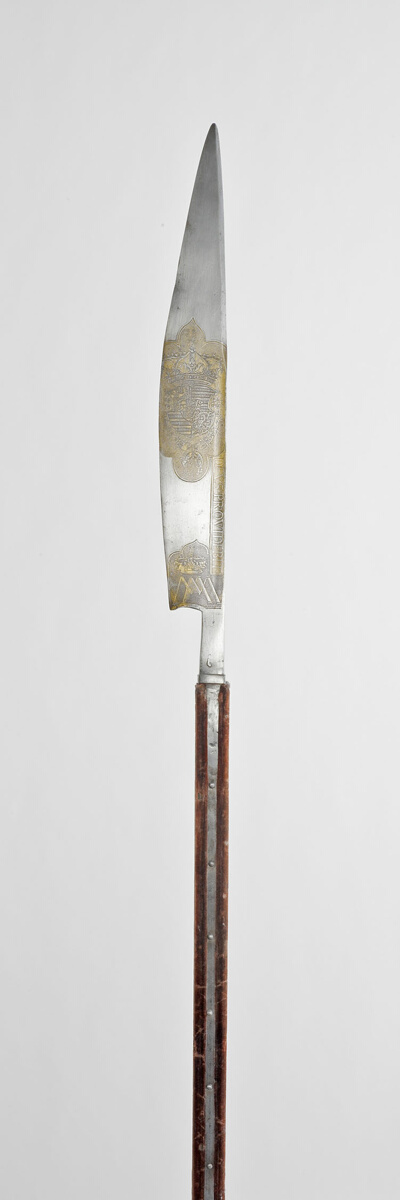
An Armoured Proposition: The Glaive as Sartorial Statement
To consider the glaive—a weapon of undoubted martial purpose—through the lens of heritage is to engage in a most refined exercise in contextual tailoring. It demands we look beyond the mere object, to the ensemble of which it formed a part, and to the individual it was designed to protect. The subject in question, a glaive commissioned for the bodyguard of His Majesty Maximilian II, King of Hungary and Bohemia, later Holy Roman Emperor, is not merely a polearm. It is, we propose, a definitive expression of authority, a piece of ceremonial armoury cut from a cloth of steel and ambition, and finished with the most deliberate and eloquent of details: silk.
The Client: A Monarch Between Worlds
Understanding the commission requires an understanding of the man. Maximilian II was, by all accounts, a figure of profound contradiction and consummate political tailoring. Ascending to the Hungarian and Bohemian thrones in 1562, and later the Imperial dignity in 1564, his court was a pivot between the militant Catholicism of his Habsburg lineage and a personal, often dangerously open, curiosity towards the Protestant Reformation. His was a reign stitched together from disparate fabrics—dogma and humanist inquiry, martial tradition and diplomatic finesse. The men who guarded his person, therefore, were more than mere sentinels; they were a living, breathing extension of his sovereign image. Their appointment, their livery, and their armaments required a narrative, a visual rhetoric that spoke of unwavering power, cosmopolitan sophistication, and legitimate, ancient authority.
Materiality: The Fabric of Power
The construction of the glaive itself follows a pattern as rigorous as any bespoke garment. The core—the blade and socket—is of steel, the foundational wool broadcloth of warfare, hammered and tempered to a lethal sharpness and resilience. This is supported by the iron of the haft, the sturdy internal canvas, providing structure and reach. The oak, carefully selected and seasoned, forms the substantial core of the shaft, offering both strength and a certain dignified weight—the mahogany of the armoury, if you will.
Yet it is in the finishing where the statement is made. Gilding is applied, not lavishly, but with precise intention to the steel. This is not vulgar ostentation; it is the equivalent of a perfectly placed button on a frock coat, or a discreet silk-faced lapel. It catches the light during a procession, denoting a weapon not merely for use, but for show—a symbol of office. And finally, the silk. A velvet, no less, of a deep, likely imperial, hue. This textile sheathes a portion of the oak haft, providing a grip. But its function is overwhelmingly tactile and visual. Velvet, the most sumptuous of the silk weaves, speaks of a courtly world, of palaces and ceremonies. It introduces a note of civil elegance into the martial form, a literal and figurative grasp of soft power upon a instrument of hard power.
Context: The Ceremonial Cut and the Fluid Line
The classic silk craftsmanship referenced here finds its parallel not in the forge, but in the draping of a doublet or the fall of a cloak. The fluid elegance is in the line of the glaive itself—the graceful, elongated curve of the blade flowing into the socket, a single, sweeping silhouette designed for visual impact as much as for functionality. In the hands of a guardsman standing vigil at a coronation or lining a processional route, this glaive becomes part of a uniform. The blade’s curve echoes the slashed silks of Renaissance attire; its poised verticality mirrors the erect, disciplined bearing of the man who holds it.
This artifact exists at the intersection of the workshop and the court. The smith’s mastery provided the form and function, but the final appointment—the gilding, the velvet wrap—was dictated by the court’s masters of ceremony, the arbiters of visual prestige. It transforms the guardsman from a simple soldier into a component of a living tableau, a piece of moving heraldry. The silk velvet grip ensures his hand does not merely hold a weapon; it presents one.
Legacy: A Pattern Preserved
For the modern connoisseur of heritage, this glaive offers a masterclass in integrated design philosophy. It demonstrates that true authority is a composite construction. The steel asserts an uncompromising capability for force. The oak and iron provide the enduring, reliable foundation. The gilding communicates status and legitimacy, a gleam of divine right. And the silk—the silk is the crucial final fitting. It is the element that connects the object, and by extension the sovereign it protects, to the cultivated world of the Renaissance court, to trade, to luxury, and to an elegance that transcends brute strength.
In the archives of Lauren Fashion Heritage Lab, we perceive such an object not as a relic of warfare, but as a precursor to the philosophy of the uniform. It is a study in how materials converse—steel with silk, oak with velvet—to create a singular, powerful impression. The bodyguard of Maximilian II was, in effect, wearing this glaive as the ultimate accessory; a sharply tailored, impeccably finished statement of his master’s sovereign identity, cut from the very fabric of power and trimmed with the finest silk of authority. It remains, centuries later, a perfectly balanced proposition.