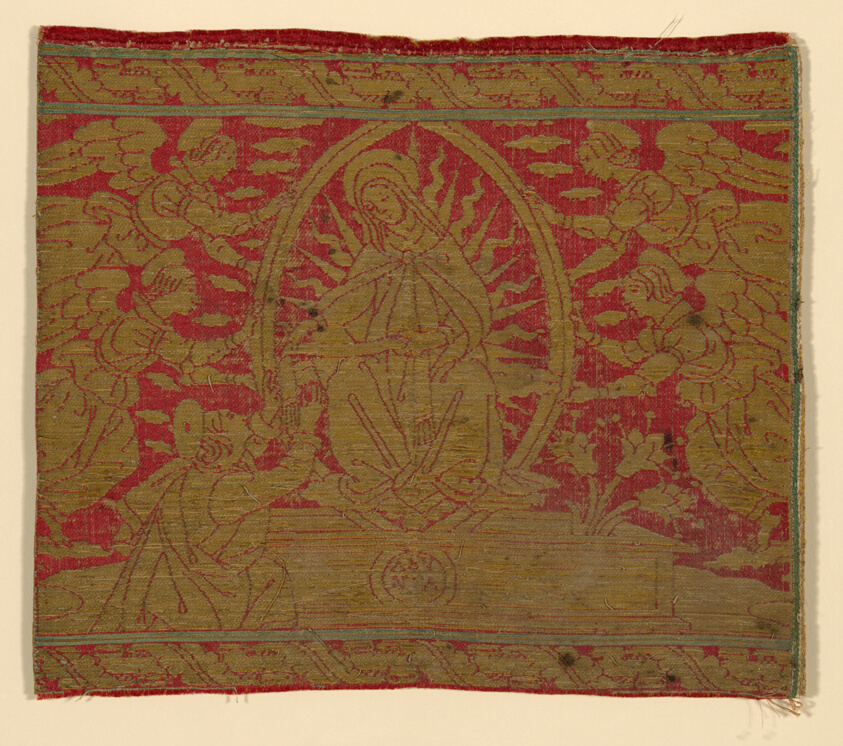
Heritage Research Artifact: Fragment from an Orphrey Band
Introduction: The Legacy of Silk in Ecclesiastical and Sartorial Contexts
In the annals of textile history, few materials command the reverence and technical admiration afforded to silk. The fragment under examination—a remnant from an orphrey band—embodies the pinnacle of medieval and Renaissance craftsmanship, where materiality and symbolism converge. As a Senior Heritage Specialist at the Lauren Fashion Heritage Lab, I approach this artifact not merely as a decorative strip but as a testament to the enduring dialogue between ecclesiastical opulence and the secular elegance later codified on London’s Savile Row. This fragment, with its intricate weave structure and precious materials, speaks to a lineage of luxury that transcends centuries, informing the very principles of bespoke tailoring and textile innovation that define modern heritage fashion.
Materiality: The Anatomy of Silk and Gilt-Animal-Substrate-Wrapped Linen
Silk as the Foundation
The primary material of this fragment is silk, a fiber historically synonymous with status, trade, and artistic mastery. Silk’s natural luster, tensile strength, and dye affinity made it the preferred medium for ecclesiastical vestments, where light and movement were integral to liturgical drama. In this orphrey band, the silk is employed in a warp-float faced satin weave—a structure that maximizes the fiber’s reflective properties, creating a surface of fluid elegance. The satin weave, with its long floats, minimizes interlacings, allowing the silk to lie flat and catch light with a subtle, shifting sheen. This technique, perfected in Byzantine and Italian workshops, required meticulous tension control and a deep understanding of yarn behavior, qualities that resonate with the precision of a Savile Row cutter selecting a worsted wool for a dinner jacket.
Gilt-Animal-Substrate-Wrapped Linen: The Gilded Thread
The secondary material—gilt-animal-substrate-wrapped linen—represents a pinnacle of medieval textile engineering. Here, a linen core is wrapped with a thin strip of animal membrane (often vellum or goldbeater’s skin) that has been gilded with gold leaf. This technique, known as “gold thread” in historical texts, was labor-intensive and costly, reserved for the most prestigious commissions. The linen base provided tensile strength, while the gilt animal substrate offered a malleable, luminous surface that could be woven without cracking. In this fragment, these threads function as supplementary patterning wefts, interlacing with the silk warp to create intricate motifs. The twill interlacings of secondary binding warps further stabilize the structure, ensuring that the gilded elements remain secure despite the wear of liturgical use. This marriage of silk and gilt thread mirrors the Savile Row ethos of combining rare materials with structural integrity—where a silk lining complements a hand-stitched canvas, each element serving both beauty and durability.
Weave Structure: Warp-Float Faced Satin with Twill Interlacings
The weave structure of this fragment is a masterclass in complexity. The warp-float faced satin weave, with its five-harness or eight-harness configuration, creates a smooth, lustrous ground. The secondary binding warps, interlaced in a twill pattern, serve a dual purpose: they anchor the supplementary wefts without disrupting the satin’s surface, and they add a subtle texture that contrasts with the gilt threads. This interplay of satin and twill is analogous to the juxtaposition of a smooth worsted flannel with a herringbone tweed in a tailored garment—a deliberate tension that elevates the design from mere decoration to architectural expression. The supplementary patterning wefts, woven in a discontinuous manner, allow for precise control of the gilded motifs, which in orphrey bands often depicted saints, floral scrolls, or geometric patterns. The result is a fabric that is both structurally robust and visually dynamic, a quality that would later influence the development of brocades and damasks in European fashion.
Context: From Ecclesiastical Opulence to Savile Row Elegance
The Orphrey Band as a Status Marker
Orphrey bands were integral to liturgical vestments such as chasubles and copes, serving as decorative borders that framed the sacred narrative. Their production was concentrated in centers like Venice, Lucca, and later Lyon, where silk weaving flourished under guild regulations. The use of gilt thread and complex weaves signified not only the wealth of the church but also the technical prowess of the weaver. This fragment, with its refined satin and twill interlacings, would have been part of a larger ensemble, perhaps adorning a bishop’s cope. The fluid elegance of the silk, combined with the rigidity of the gilt threads, created a visual rhythm that guided the eye during processions—a precursor to the way a well-tailored suit’s lapel or pocket square directs attention.
Parallels with Savile Row Craftsmanship
The principles embodied in this fragment—precision, material integrity, and a reverence for tradition—are the very tenets of Savile Row tailoring. The bespoke process, from the initial consultation to the final fitting, mirrors the weaver’s journey from raw silk to finished fabric. Both require an intimate knowledge of materials: the tailor’s hand-stitching of a canvas to a woolen cloth echoes the weaver’s interlacing of warp and weft. The gilt-animal-substrate-wrapped linen, with its labor-intensive preparation, finds a parallel in the hand-felled seams and mother-of-pearl buttons of a Huntsman jacket. Moreover, the orphrey band’s role as a marker of status and identity—whether religious or social—is reflected in the Savile Row suit’s ability to confer authority and elegance upon its wearer. The fragment’s fluid elegance, achieved through satin weave, is akin to the drape of a lightweight cashmere overcoat, designed to move with the body while maintaining its form.
Conservation and Interpretation: A Living Legacy
As a heritage artifact, this fragment requires careful conservation to preserve its material and historical integrity. The silk fibers are susceptible to light degradation, while the gilt threads may tarnish or detach if handled improperly. At the Lauren Fashion Heritage Lab, we employ climate-controlled storage and minimal handling protocols, ensuring that future generations can study this masterpiece. Beyond conservation, the fragment serves as a pedagogical tool for understanding the evolution of textile technology. Its weave structure informs modern digital jacquard design, while its use of gilt threads inspires contemporary explorations in metallic yarns. For students of fashion and tailoring, this fragment offers a tangible link to the past—a reminder that the pursuit of elegance is a continuous thread, woven through centuries of human ingenuity.
Conclusion: The Enduring Thread
This fragment from an orphrey band is more than a relic; it is a dialogue between the sacred and the secular, the medieval and the modern. Its silk and gilt-animal-substrate-wrapped linen, its warp-float faced satin with twill interlacings, and its supplementary patterning wefts all speak to a tradition of craftsmanship that finds its echo in the bespoke suits of Savile Row. As we study this artifact, we are reminded that heritage is not static—it is a living practice, refined and reinterpreted by each generation. The fluid elegance of this fragment continues to inspire, proving that the finest textiles, like the finest tailoring, are timeless.