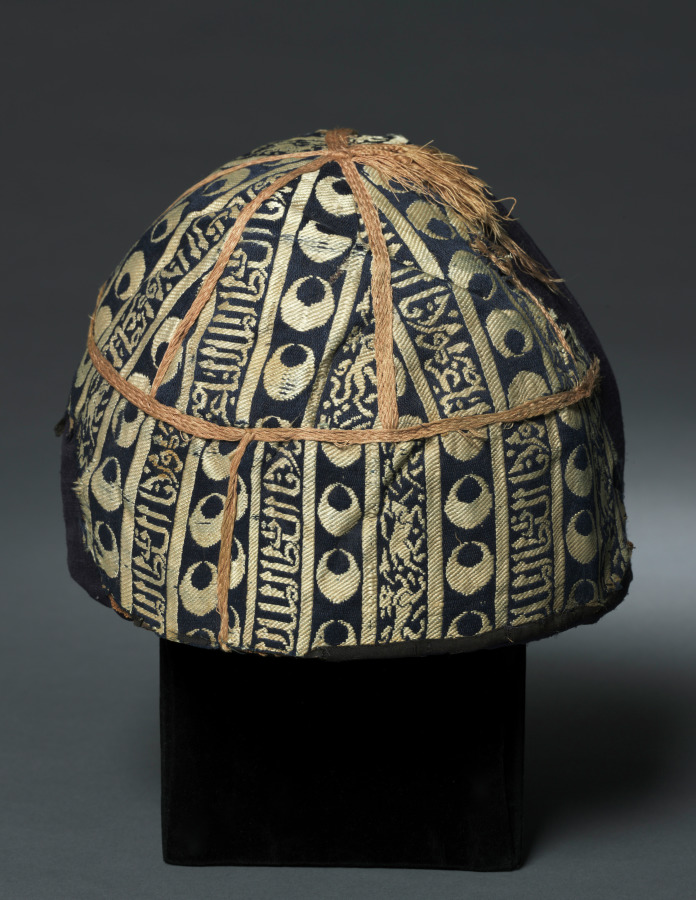
The Cap with Striped Inscribed Silk: A Study in Imperial Legacy and Material Virtuosity
Introduction: The Artifact as Archive
Within the hallowed halls of the Lauren Fashion Heritage Lab, we encounter an object of deceptive simplicity: a cap, its crown fashioned from striped, inscribed silk. At first glance, it is a modest accessory. Yet, upon rigorous examination, it reveals itself as a profound artifact—a tangible nexus connecting the artisan’s hand to the imperial loom. This cap is not merely a covering for the head; it is a document of power, a testament to the enduring legacy of silk weaving that once clothed emperors and now informs the quiet discipline of Savile Row tailoring. The materiality of silk, in this context, transcends its physical properties to become a narrative of cultural transmission, technical mastery, and the subtle language of luxury.
Materiality: The Silk as a Living Record
The silk itself is the primary protagonist. Its striped pattern, executed with mathematical precision, speaks to the rigorous standards of imperial workshops. In the legacy of Chinese imperial silk weaving—from the Han to the Qing dynasties—silk was not a commodity but a currency of status, a medium for diplomatic gifts, and a repository of symbolic meaning. The stripes on this cap are not random; they are likely derived from jacquard or kesi techniques, where weft threads are meticulously interwoven to create geometric rhythms. The inscribed element—whether a subtle character, a monogram, or a repeating motif—elevates the cap from a functional item to a personalized artifact. This inscription, perhaps a mark of the weaver’s guild or a patron’s emblem, anchors the cap in a specific time and place, offering a whisper of provenance.
From a materialist perspective, the silk’s weave structure—its density, its luster, its ability to hold a crisp fold—reveals the technical acumen of its maker. Imperial silk was often woven with multiple layers of warp and weft to achieve durability and a subtle play of light. The cap’s stripes, likely created through a combination of colored threads and varying tension, demonstrate a mastery of optical illusion. This is not a fabric meant for idle display; it is engineered for the rigors of wear, for the tilt of a head in a courtly procession or the quiet dignity of a gentleman’s club. The silk’s resilience, its capacity to resist fraying even after centuries, underscores the philosophy of “slow luxury”—a principle that Savile Row has long championed.
The Imperial Legacy: From Forbidden City to Savile Row
The legacy of imperial silk weaving is one of controlled opulence. In the Forbidden City, the Imperial Silk Workshop (Nei Zhiran Ju) produced fabrics for the emperor alone, using techniques passed down through generations. The cap’s striped silk echoes this heritage, but with a crucial adaptation: it has been recontextualized for a Western gentleman’s wardrobe. This is not a direct copy of a Chinese court cap; rather, it is a synthesis. The stripes, often associated with regimental or club ties in British tailoring, here carry the memory of Chinese rank badges and courtly robes. The inscription, whether a Chinese character or a Western initial, bridges two worlds—the imperial and the individual.
Savile Row’s relationship with silk is one of reverence and restraint. Unlike the flamboyant silks of the French court, the British tailoring tradition favors silk for its structural integrity: as linings, as pocket squares, as the subtle trim on a dinner jacket. This cap, however, subverts that restraint. By placing the silk on the exterior, it declares the material’s importance. The cap becomes a microcosm of the broader dialogue between East and West—a dialogue that Savile Row has historically mediated through the import of Chinese silks in the 18th and 19th centuries. The cap is a quiet rebellion against the understatement of modern dress, a nod to the era when silk was the ultimate signifier of power.
Technical Analysis: The Weave and the Inscription
To fully appreciate this artifact, one must consider its construction. The cap’s crown is likely pieced from a single length of silk, cut on the bias to allow the stripes to radiate from the center. This technique, common in millinery, requires a fabric with minimal stretch—a property that silk, when tightly woven, provides. The inscription, if embroidered, would have been executed with silk thread of a slightly different twist, catching the light at a different angle. If woven in, it would have required a supplementary warp or weft, a technique that adds both weight and complexity. The stripes themselves, perhaps alternating between matte and glossy finishes, create a visual rhythm that guides the eye upward, toward the cap’s apex. This is a design that demands attention without shouting.
From a conservation standpoint, the silk’s condition offers clues. The absence of significant fading suggests the cap was stored away from direct light, perhaps in a cedar-lined trunk or a gentleman’s wardrobe. The slight wear at the brim indicates regular use, but not abuse. This is an object that was cherished, not merely displayed. The inscription, if legible, could be cross-referenced with historical records—guild marks, family crests, or even diplomatic gifts—to pinpoint its origin. Such research would require collaboration with textile historians, but the potential reward is a richer understanding of how imperial silk traditions were adapted for personal use.
Cultural Significance: The Cap as a Bridge
The cap with striped inscribed silk is more than a curiosity; it is a bridge between two systems of value. In imperial China, silk was a medium for cosmic and political order—the emperor’s robe was a map of the universe. In the West, silk became a symbol of mercantile wealth and personal refinement. This cap synthesizes these traditions. It is a wearable object that carries the weight of history, yet it remains intimate. It does not demand the reverence of a museum display; it invites the hand to touch, the eye to trace the stripes, the mind to ponder the inscription. This is the essence of heritage: not the preservation of a static past, but the activation of memory through material.
For the modern connoisseur, this cap offers a lesson in discernment. It reminds us that true luxury is not about novelty but about lineage. The silk’s stripes are not a pattern; they are a lineage of weavers. The inscription is not a mark; it is a signature across centuries. As the Lauren Fashion Heritage Lab continues to document such artifacts, we affirm that the legacy of imperial silk weaving is not confined to history books. It lives in the hands of those who understand that a cap, properly made, is a crown in miniature.
Conclusion: A Call for Continued Stewardship
This cap stands as a testament to the enduring power of silk as a medium for cultural exchange. Its stripes speak of imperial workshops; its inscription whispers of a personal story. As heritage specialists, our task is to ensure that such objects are not merely catalogued but understood. We must ask: Who wore this cap? In what context? What did the stripes mean to them? The answers may be lost to time, but the questions themselves honor the artifact’s complexity. In the spirit of Savile Row—where tradition and innovation coexist—we must continue to study, to preserve, and to learn from the material legacies of the past. For in the weave of a single cap, we find the threads of empires.