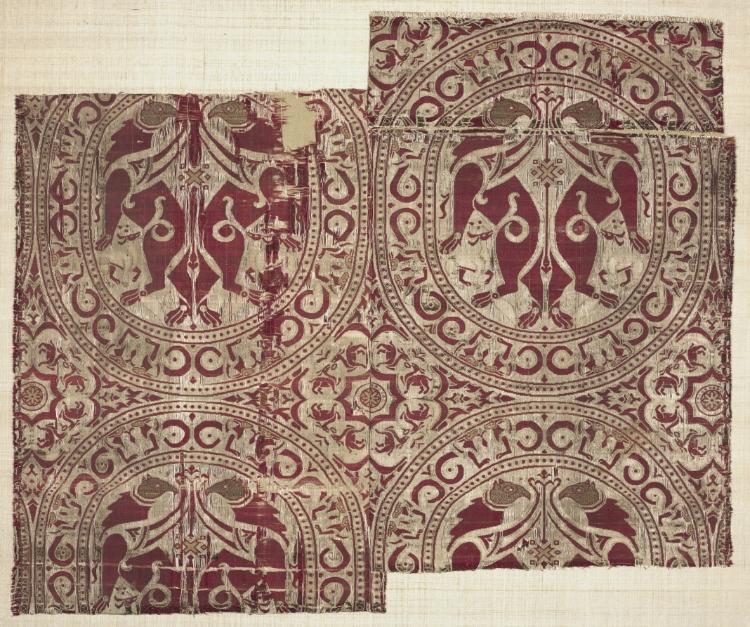
The Lampas with Griffins in Roundels: A Legacy of Imperial Silk Weaving
Introduction: The Artifact as a Testament to Craft
In the hallowed confines of Siguenza Cathedral, Spain, resides a textile of extraordinary historical and material significance: the lampas with griffins in roundels, extracted from the Reliquary of Saint Librada. This silk artifact, woven with precision and artistry, is not merely a decorative fragment but a profound document of imperial ambition, trade, and the enduring legacy of silk weaving that bridged cultures and centuries. As a Senior Heritage Specialist at the Lauren Fashion Heritage Lab, I approach this piece with the discerning eye of a Savile Row tailor—where every thread, weave, and motif speaks to a lineage of mastery that transcends time. The lampas, a compound weave structure characterized by a pattern ground and a supplementary weft for design, exemplifies the technical sophistication of medieval silk production, while its griffin motif anchors it within a broader narrative of power, protection, and cross-cultural exchange.
Materiality: The Silk Thread as a Conduit of History
Silk, the material foundation of this artifact, is a fiber of unparalleled luxury and durability. Originating in China and disseminated along the Silk Road, silk weaving reached its apogee in the Byzantine and Islamic empires, where imperial workshops—such as those in Constantinople, Baghdad, and later Al-Andalus—produced textiles that were both commodities and symbols of sovereignty. The lampas from Siguenza Cathedral is woven from wild or cultivated silk, its fibers exhibiting a natural luster that has survived centuries of veneration and storage. The materiality of this silk is not passive; it is an active participant in the artifact’s story. The warp and weft, meticulously aligned, create a fabric that is at once supple and resilient, capable of draping over reliquaries or adorning the shoulders of royalty. In the context of Savile Row, where cloth is chosen for its drape, weight, and longevity, this silk would be deemed of the highest order—a testament to the weaver’s understanding of fiber behavior under tension and time.
The Weave: Lampas as a Technical Marvel
The term lampas denotes a specific weave structure where a pattern is formed by supplementary wefts that float over the ground weave, creating a raised, often polychrome effect. In this artifact, the ground is likely a tabby or twill weave, while the griffin roundels are executed in a contrasting color—perhaps a deep crimson or gold, indicative of the dyes derived from kermes or saffron. The technical precision required to produce such a lampas is staggering: the weaver must coordinate multiple harnesses and shuttles to maintain pattern integrity across the loom’s width. This is not a fabric for the amateur; it is the product of generations of specialized knowledge, passed down through imperial ateliers. The roundels themselves, each enclosing a griffin, are arranged in a repeating grid, a design convention that originated in Sassanian Persia and was later adopted by Byzantine and Islamic weavers. The symmetry and repetition evoke a sense of order and eternity, appropriate for a reliquary housing a saint’s remains.
Iconography: The Griffin as a Symbol of Imperial and Sacred Power
The griffin, a mythical creature with the body of a lion and the head of an eagle, is a potent symbol across cultures. In the context of this lampas, the griffin represents a fusion of terrestrial and celestial power—the lion’s strength and the eagle’s vision. For the Byzantine Empire, the griffin was an emblem of imperial authority, often associated with the emperor’s role as a protector of Christendom. In Islamic art, the griffin served as a guardian figure, warding off evil and ensuring prosperity. The presence of griffins in roundels on a reliquary textile suggests a deliberate layering of meaning: the saint, through her relics, is protected by these mythical guardians, while the imperial connotations reinforce the Church’s temporal power. The roundel format itself, a circle enclosing the griffin, is a motif derived from silk-weaving traditions of the Silk Road, where such medallions were used to denote status and origin. In the Savile Row tradition, where pattern and motif are chosen with equal care, the griffin roundel would be akin to a house check—a signature of identity and quality.
Context: The Legacy of Imperial Silk Weaving
To fully appreciate this artifact, one must situate it within the legacy of imperial silk weaving. From the 6th to the 13th centuries, silk production was a closely guarded state secret in the Byzantine and Islamic empires. The Imperial Workshops of Constantinople, for example, produced silks exclusively for the court, the Church, and diplomatic gifts. These textiles were not merely functional; they were instruments of soft power, conveying the wealth and sophistication of the empire to foreign dignitaries. The lampas from Siguenza Cathedral likely originated from such a workshop, perhaps in Al-Andalus (Islamic Spain) or even Byzantium, before being transported to the Iberian Peninsula through trade or as a gift. The reliquary itself, housing the remains of Saint Librada, a 4th-century martyr, would have been a focal point of pilgrimage and devotion. The silk covering, therefore, served a dual purpose: it protected the relics and elevated them, visually and symbolically, to a realm of sacred luxury.
Preservation and Legacy: A Call for Continued Stewardship
Today, this lampas fragment is a fragile survivor of centuries of conflict, climate, and neglect. Its preservation requires not only controlled environmental conditions but also a deep understanding of its material and cultural significance. As a heritage specialist, I advocate for the use of non-invasive imaging techniques, such as multispectral analysis, to study the dyes and weave structure without damaging the fibers. The legacy of imperial silk weaving is not merely academic; it informs contemporary luxury textiles, from the silks of Hermès to the bespoke fabrics of Savile Row. The griffin roundel, with its timeless elegance, could inspire a modern pattern for a tailored suit or a ceremonial robe, bridging the gap between ancient craft and modern design.
Conclusion: The Thread That Binds
In the Lampas with Griffins in Roundels, we encounter a convergence of material mastery, iconographic depth, and historical resonance. It is a reminder that silk is not just a fabric but a narrative thread, weaving together empires, faiths, and artisans across millennia. For the Lauren Fashion Heritage Lab, this artifact is a cornerstone of our research into the material culture of luxury, offering insights that inform both conservation and contemporary design. As we continue to study and preserve such treasures, we honor the weavers, the patrons, and the saints who entrusted their stories to silk. In the language of Savile Row, this is a cloth of distinction—one that demands respect, study, and, above all, preservation for generations to come.