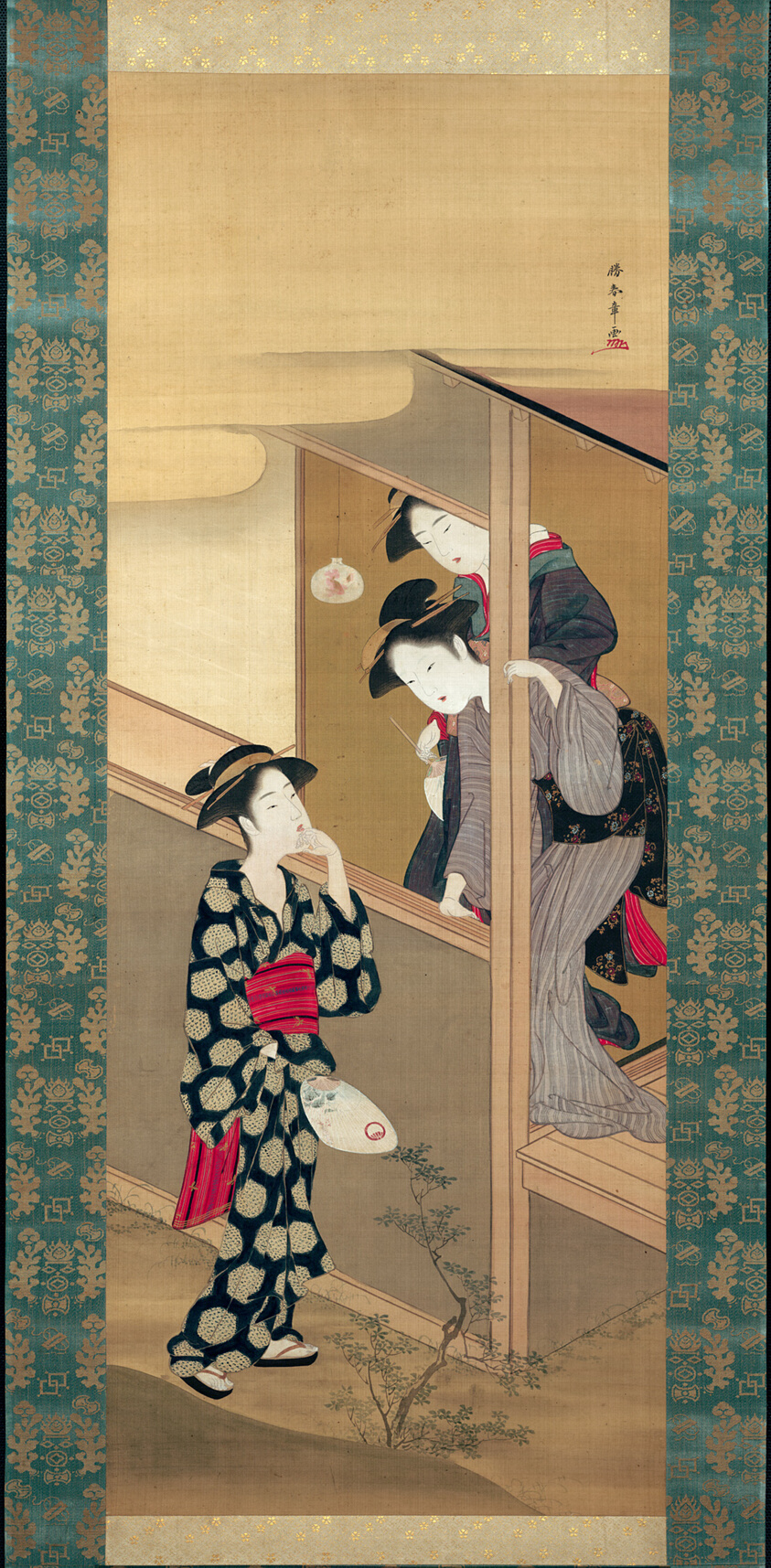
The Artifact as a Testament to Silk’s Narrative Power
In the hallowed corridors of heritage preservation, where the tactile and the visual converge, few artifacts speak with the quiet authority of Three Beauties Chatting by a Veranda. This hanging scroll, executed in ink and colors on silk, is not merely a decorative object; it is a masterclass in material storytelling. As Senior Heritage Specialist for the Lauren Fashion Heritage Lab, I present this analysis with the precision and reverence befitting a Savile Row tailor examining a bolt of finest worsted wool. The silk here is not a passive substrate but an active participant in the narrative—a medium that demands both technical mastery and aesthetic restraint.
Materiality: The Silk as a Living Canvas
The scroll’s foundation is a handwoven silk of exceptional quality, likely produced in the Jiangnan region of China during the late Ming or early Qing dynasty. The warp and weft are so finely balanced that the fabric possesses a fluid elegance—a term that, in the context of Savile Row, evokes the drape of a bespoke suit jacket. Here, the silk’s natural luster is harnessed to create a surface that catches light with the subtlety of a pearl. The ink and mineral pigments—cinnabar for the robes, malachite for the foliage, and lampblack for the outlines—are absorbed into the silk’s fibers, creating a fusion of color and texture that no modern synthetic can replicate.
The scroll’s condition reveals the fragility of this materiality. The silk has yellowed slightly with age, a patina that whispers of centuries of careful unrolling and re-rolling. Yet the colors remain remarkably vibrant, a testament to the artisan’s skill in selecting pigments that bond with the silk’s protein structure. This is not a painting on canvas; it is a dialogue between fiber and pigment, where the silk’s weave dictates the flow of ink, much like the grain of a fine wool determines the cut of a jacket.
Composition: The Veranda as a Stage for Elegance
The scene depicts three women in a garden, their figures arranged around a wooden veranda that recedes into a misty landscape. The composition is deliberately asymmetrical, a hallmark of classical Chinese aesthetics that mirrors the balance of restraint and flourish found in a well-tailored garment. The veranda’s latticework is rendered with precise brushstrokes, each line echoing the discipline of a master cutter’s chalk marks. The women’s robes—flowing silks in shades of coral, jade, and indigo—are painted with a lightness that suggests movement, as if a breeze from the garden has just passed through.
The central figure, seated on a low stool, gestures toward a companion, her sleeve falling in a cascade of folds that mimic the scroll’s own drape. The third woman stands at the veranda’s edge, her gaze directed outward, perhaps toward a lotus pond. This triangular composition creates a dynamic tension, a visual conversation that is both intimate and expansive. The background—a soft wash of ink suggesting distant mountains—fades into the silk’s natural hue, reminding us that the material itself is part of the scene.
Craftsmanship: The Art of the Hanging Scroll
The scroll’s construction is a feat of engineering. The silk is mounted on a paper backing, then attached to a wooden roller with ivory end caps. The top stave, or jiku, is lacquered in dark wood, providing a counterweight that allows the scroll to hang with perfect verticality. This is not merely functional; it is a statement of classic silk craftsmanship, where every element—from the weave to the mounting—is considered with the same rigor as a Savile Row tailor selecting a shoulder pad or a buttonhole twist.
The ink work itself is a study in control. The outlines of the figures are drawn with a brush so fine that the lines are barely perceptible, yet they define the forms with absolute clarity. The colors are applied in thin washes, building depth through layering rather than opacity. This technique, known as gongbi (meticulous painting), requires a steady hand and an intimate understanding of how silk absorbs moisture. A single misplaced stroke would be irreparable, much like a misaligned seam in a bespoke garment.
Cultural Context: Silk as a Symbol of Refinement
In the world from which this scroll emerged, silk was more than a fabric; it was a currency of status and a medium of cultural expression. The three beauties—likely courtesans or noblewomen—are depicted in a moment of leisure, their conversation a metaphor for the refined pursuits of the literati. The veranda, a liminal space between interior and exterior, symbolizes the boundary between the private and the public, much like the silk itself mediates between the artist’s hand and the viewer’s eye.
This artifact also reflects the fluid elegance of the silk trade, which connected China to the world via the Silk Road. The pigments used—imported lapis lazuli from Afghanistan, cinnabar from Spain—speak to a global network of exchange that predates modern globalization. In this sense, the scroll is a microcosm of heritage itself: a fusion of local craftsmanship and international influence, preserved through the resilience of its material.
Preservation and Legacy
For the Lauren Fashion Heritage Lab, this scroll serves as a benchmark for understanding how silk can transcend its utilitarian origins to become a vessel for art. Its preservation requires a controlled environment—low light, stable humidity, and minimal handling—akin to the care given to a vintage Chanel suit in the Lab’s archives. The scroll’s legacy lies not only in its aesthetic beauty but in its demonstration of silk’s capacity to endure, to tell stories across centuries, and to inspire future generations of designers and artisans.
In conclusion, Three Beauties Chatting by a Veranda is a masterwork of materiality and composition. It embodies the classic silk craftsmanship that defines the finest traditions of Chinese art, while its fluid elegance resonates with the principles of bespoke tailoring on Savile Row. As a heritage artifact, it is a reminder that true luxury—whether in silk or in wool—lies in the marriage of material and meaning, a union that this scroll achieves with effortless grace.