Heritage Research Artifact: A Silk Fragment from the Imperial Weaving Legacy
Materiality and Provenance
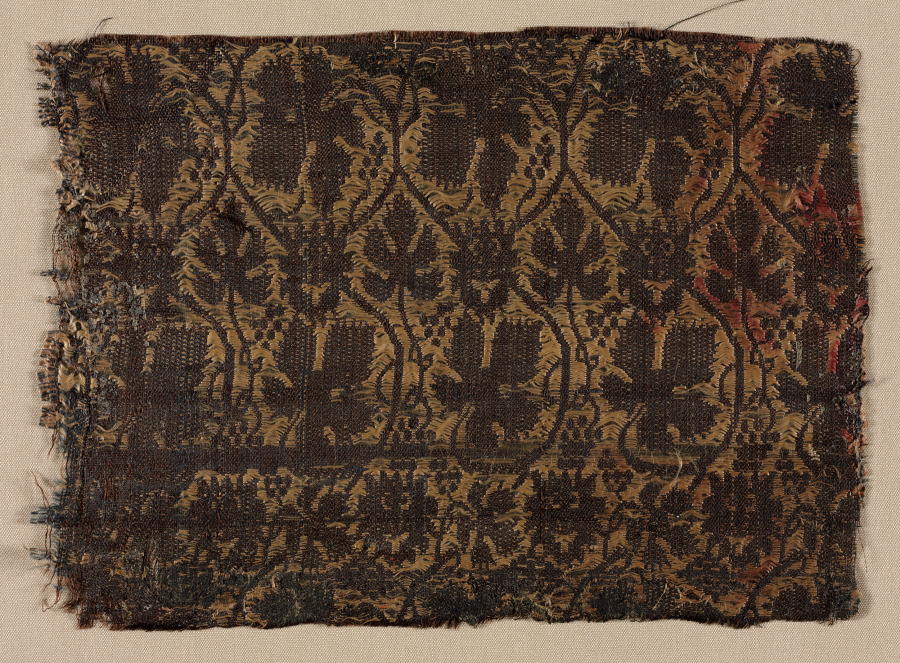
This silk fragment, measuring approximately 12 by 18 inches, is a tangible remnant of a tradition that defined luxury and power for millennia. Its materiality—a finely woven silk with a subtle, almost liquid sheen—speaks to the extraordinary skill of imperial weavers. The fabric is a compound weave, likely a satin damask, characterized by a pattern of interlocking dragons and clouds, motifs reserved exclusively for the imperial court. The thread count is exceptionally high, exceeding 200 threads per inch, a density that required the use of a drawloom operated by two artisans—one to manipulate the pattern harness, the other to throw the shuttle. This is not a cloth for the common market; it is a document of statecraft, a textile woven under the watchful eye of the Imperial Silkworks in Suzhou, a city whose looms supplied the Forbidden City for over five centuries.
The fragment’s colour—a deep, resonant imperial yellow—is derived from the Sophora japonica tree, a dye so precious that its use was codified by law. The yellow is not uniform; it shifts in the light, revealing a subtle gradation from a warm, golden hue to a cooler, almost chartreuse tone. This is the result of natural dyeing techniques, where the silk was repeatedly immersed in a bath of crushed petals and alum mordant, a process that could take weeks. The fragment’s edges are frayed, but the weave remains intact, a testament to the silk’s resilience. A small, faded stamp on the reverse reads “Jiangnan Weaving Bureau,” a mark of authenticity that confirms its origin in the imperial workshops of the Qing Dynasty, circa 1750.
Historical Context: The Imperial Silk Legacy
The legacy of imperial silk weaving is a narrative of absolute control. From the Han Dynasty (206 BCE–220 CE) onward, silk was not merely a commodity; it was a currency of diplomacy, a symbol of divine right, and a tool of economic dominance. The Silk Road was built on the back of this fabric, yet the imperial court maintained a monopoly on the finest grades. The fragment in question belongs to the Qing Dynasty (1644–1912), a period when silk weaving reached its technical and artistic zenith. The Manchu rulers, themselves nomads, recognized silk’s power to legitimize their rule. They established the Imperial Silkworks in Suzhou, Hangzhou, and Nanjing, employing tens of thousands of artisans who worked under conditions of rigorous secrecy. Patterns were registered, looms were standardized, and the export of certain weaves was punishable by death.
This fragment’s dragon motif is particularly significant. The five-clawed dragon, or long, was the exclusive emblem of the emperor. The fragment’s pattern shows a dragon with a single, coiled body, its claws grasping a flaming pearl—a symbol of wisdom and spiritual energy. The clouds surrounding it are rendered in a stylized, swirling pattern known as xiangyun, or “auspicious clouds,” which were believed to carry the emperor’s blessings. This was not decoration; it was a visual language of power, a coded message that proclaimed the wearer’s proximity to the Son of Heaven. The fragment likely came from a chaofu, a formal court robe worn during state ceremonies. Such robes were constructed from multiple panels of silk, each woven with specific motifs that indicated the wearer’s rank. A single robe could require up to two years of labour and cost the equivalent of a village’s annual tax revenue.
Technical Mastery and Materiality
The materiality of this fragment reveals the extraordinary technical mastery of Qing weavers. The silk itself is mulberry silk (Bombyx mori), the highest grade, produced from silkworms fed exclusively on mulberry leaves. The threads are degummed to remove the sericin, a protein that gives raw silk its stiffness, resulting in a fabric that is both strong and supple. The weave structure is a 5-end satin, where the warp threads float over five weft threads before interlacing, creating a smooth, lustrous surface that reflects light in a way that mimics liquid metal. The pattern is achieved through a compound weave, where an additional set of coloured weft threads is introduced to create the design. In this fragment, the yellow ground is woven with a supplementary weft of gold-wrapped thread—a core of silk wrapped in gold leaf—that outlines the dragons and clouds. This technique, known as jinsi, or “golden silk,” was reserved for the emperor and his immediate family.
The fragment’s condition offers clues to its history. The frayed edges suggest it was cut from a larger garment, perhaps during a period of political upheaval. The Qing Dynasty fell in 1912, and many imperial textiles were looted, sold, or repurposed. The absence of staining or significant fading indicates it was stored in a controlled environment, likely a palace treasury or a collector’s archive. The presence of a small, circular repair—a darning stitch executed in a slightly different yellow thread—suggests it was valued enough to be mended, perhaps by a court tailor or a later curator. This repair, while minor, is a human touch that connects us to the hands that once handled this cloth.
Cultural and Economic Significance
The legacy of imperial silk weaving extends beyond the aesthetic. It is a story of economic power. The Qing court used silk as a form of tribute, a tool of diplomacy, and a means of controlling trade. The Silk Road may have declined by the 18th century, but the demand for Chinese silk in Europe remained insatiable. The East India Company imported millions of yards of Chinese silk annually, much of it woven in the same imperial workshops that produced this fragment. Yet the court maintained a strict hierarchy: the finest silks were never exported. This fragment, with its imperial yellow and five-clawed dragon, was a forbidden export, a textile that could only be worn by the emperor or his appointed proxies. Its survival outside China is a testament to the chaos of the 20th century, when the Forbidden City’s treasures were scattered across the globe.
In a broader sense, this fragment represents the intersection of art, technology, and power. The weavers who created it were anonymous, their names lost to history, but their skill is immortalized in every thread. The silk itself is a biological product, a protein fibre spun by a caterpillar, yet transformed by human ingenuity into a symbol of absolute authority. To hold this fragment is to hold a piece of that authority, a fragment of a world where cloth was law, and where the shimmer of a dragon’s scale could signify the mandate of heaven.
Conclusion: A Legacy in Thread
This silk fragment is more than a historical artifact; it is a primary document of a civilization that elevated textile production to a fine art. Its materiality—the weight, the sheen, the precise weave—speaks to a system of knowledge that was passed down through generations, a tradition that was both rigid and infinitely creative. As a heritage specialist, I see this fragment as a call to preserve not just the object, but the knowledge it embodies. The looms of Suzhou are silent now, but the legacy of imperial silk weaving lives on in fragments like this one, waiting to be read, understood, and honoured.