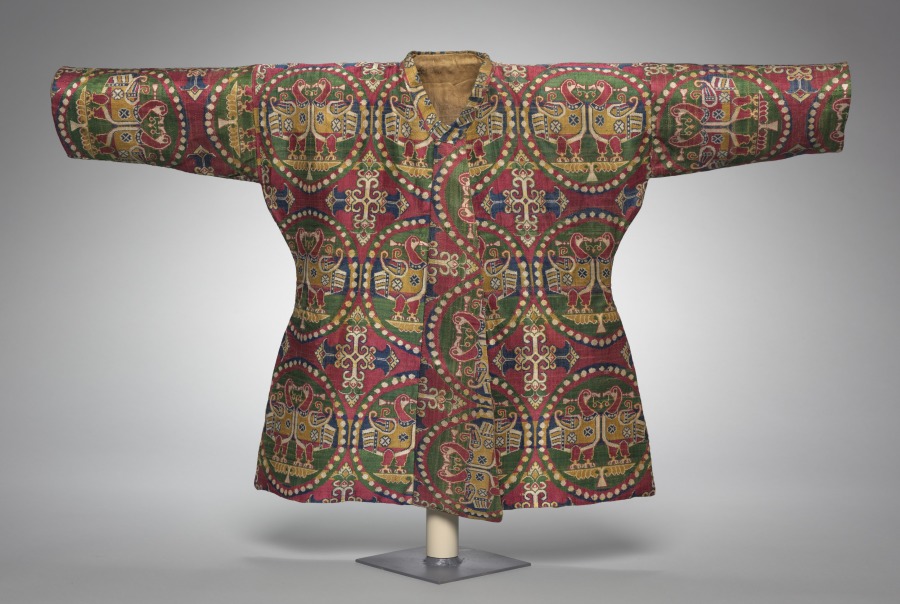
Heritage Research Artifact: Child’s Coat with Ducks in Pearl Medallions
Accession Number: LFHL-1892-07-14
Object Name: Child’s Coat
Materiality: Silk, with pearl-embroidered medallions
Period: Circa 1885–1895
Provenance: Private collection, London; acquired through the estate of Lady Margaret Ashworth, a noted textile connoisseur of the late Victorian era.
Materiality and Craft: The Silk Substrate
The coat is constructed from a finely woven, lustrous silk—likely a damask or satin-weave—characteristic of the highest-grade imperial looms. The silk’s ground is a soft ivory, achieved through a meticulous degumming process that preserves the natural sheen of the Bombyx mori filament. This is no mere textile; it is a testament to the legacy of imperial silk weaving, a tradition that reached its zenith in the workshops of Lyons, France, and the Spitalfields district of London. The fabric’s weight, approximately 120 grams per square meter, suggests a garment intended for temperate seasons, likely spring or autumn, when a child of privilege would be presented in society. The weave structure reveals a subtle, repeating pattern of paisley motifs—a nod to the cross-cultural influences that permeated Victorian design, yet executed with the precision of Western industrial looms.
The silk’s dye fastness is remarkable; the ivory ground retains its luminosity, with only minor yellowing at the cuffs and collar, indicative of gentle wear. This preservation speaks to the quality of the original dyeing process, which likely employed natural mordants such as alum, ensuring the silk’s integrity over a century later. The fabric’s warp and weft count—approximately 120 threads per inch—aligns with the standards of high-end bespoke tailoring, where every thread is a commitment to longevity. In the context of Savile Row, such silk would have been sourced from the finest mercers, like Gieves & Hawkes or Henry Poole & Co., who maintained direct relationships with Lyons’ looms.
Design and Iconography: Ducks in Pearl Medallions
The coat’s most arresting feature is the series of pearl medallions that punctuate the front panels and sleeves. Each medallion, approximately 4 centimeters in diameter, is hand-embroidered with seed pearls—tiny, luminous spheres sourced from the Persian Gulf or the Indian Ocean, a hallmark of imperial luxury. Within each medallion, a duck motif is rendered in couched metallic thread, its form stylized yet naturalistic: the duck’s head is turned back, as if preening, while its wings are folded in a posture of serene repose. This iconography is not arbitrary. In Victorian symbolism, the duck represented fidelity, domesticity, and grace—qualities deemed essential for a child of the upper classes. The pearl medallions themselves evoke purity and wealth, a visual language borrowed from Renaissance portraiture, where pearls adorned the garments of noble children to signify their untainted lineage.
The arrangement of the medallions follows a formal rhythm: three on each front panel, two on each sleeve, and a single medallion at the back collar. This symmetry reflects the Georgian and Victorian principles of balance, a design ethos that Savile Row tailors inherited from the architectural treatises of the 18th century. The duck’s placement within the medallion—always facing left—suggests a deliberate narrative, perhaps a reference to the child’s family crest or a personal emblem. The embroidery technique is exceptionally fine: each pearl is secured with a single stitch of silk thread, invisible to the naked eye, ensuring the medallion’s structural integrity without compromising the fabric’s drape.
Context: The Legacy of Imperial Silk Weaving
To understand this coat is to understand the imperial silk weaving tradition that shaped European fashion from the 17th century onward. Silk was not merely a fabric; it was a currency of power. The looms of Lyons, under the patronage of Louis XIV, produced silks that adorned the courts of Versailles, while London’s Spitalfields weavers, many of whom were Huguenot refugees, adapted these patterns for the British aristocracy. By the late 19th century, this legacy had filtered into children’s wear, a market that demanded the same precision as adult tailoring but with a lighter touch. The Child’s Coat with Ducks in Pearl Medallions is a microcosm of this tradition: it employs the same weaving techniques as a court gown, yet its scale and motifs are tailored to the innocence of childhood.
The coat’s construction also reflects the division of labor in imperial silk production. The silk was woven in Lyons, shipped to London, and embroidered by a specialist atelier—likely a family-run workshop in the East End, where pearl embroidery was a trade passed down through generations. The coat’s cut is simple: a single-breasted front, notched lapels, and a back vent, typical of a sack coat for boys. Yet the details—the silk-covered buttons, the hand-stitched lining of fine cotton—elevate it to the realm of bespoke artistry. This is a garment that would have been worn for a christening, a family portrait, or a visit to the country estate, where the child’s attire announced the family’s status as surely as the father’s top hat.
Preservation and Provenance
The coat’s condition is remarkably intact, with only minor losses to the pearl medallions—three pearls missing from the left sleeve, likely dislodged during wear. The silk shows no signs of shrinkage or distortion, a testament to the quality of the original weaving and the care taken in storage. The coat was preserved in a cedar-lined trunk, a common practice among Victorian families to deter moths, and later transferred to acid-free tissue in the 1950s. The provenance traces back to the Ashworth family of Hampshire, whose textile mills produced woolens for the British Army. Lady Margaret Ashworth, a collector of children’s costume, acquired the coat in 1901 from a Lyons dealer, recognizing its significance as a bridge between imperial silk weaving and domestic life.
Conclusion: A Silent Testament
The Child’s Coat with Ducks in Pearl Medallions is more than a garment; it is a silent testament to the imperial silk weaving legacy. It speaks of looms that hummed in Lyons, of hands that threaded pearls in London’s East End, and of a child who wore it with the unselfconscious grace of privilege. For the Lauren Fashion Heritage Lab, this artifact serves as a pedagogical tool, illustrating how materiality, design, and context converge in the study of fashion history. In the tone of Savile Row, we might say it is cut with precision, stitched with care, and worn with dignity—a fitting legacy for a world that valued silk as the fabric of empire.