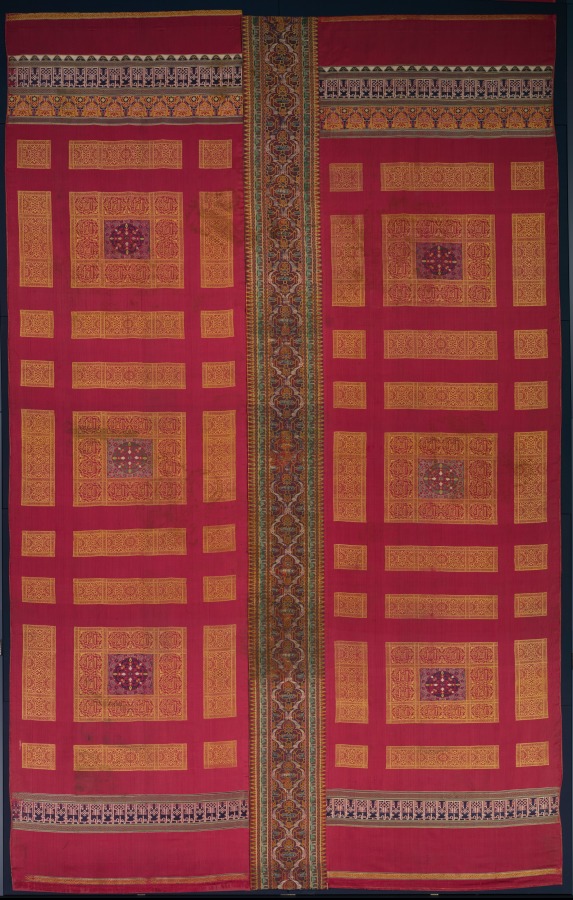
An Examination of a Specimen: The Alhambra Silk Curtain
One must approach this artifact not as a mere decorative textile, but as a definitive statement of power, articulated in the most sophisticated vernacular of its age: woven silk. The subject, a curtain from the Alhambra palace, Granada, represents the apogee of a specific imperial tradition. Its materiality is the entire thesis; silk was not a choice, but the sole acceptable medium for the conveyance of such a message. To understand this piece is to engage with the legacy of imperial silk weaving—a relentless pursuit of technical supremacy and symbolic communication that stretched from the workshops of Byzantium and Baghdad to the very gates of the Alhambra. It is a legacy built not on whimsy, but on a formidable, state-controlled apparatus of production, where the loom was as potent an instrument of statecraft as the sword.
The Imperial Loom: A Machinery of Prestige
The context of imperial silk weaving is one of calculated exclusivity. From its inception, the sericulture complex—the cultivation of the silkworm, the unreeling of the filament, the dyeing with preternaturally expensive pigments, and the operation of the draw-loom—was an enterprise of staggering logistical ambition. It demanded a concentration of capital, expertise, and raw materials that could only be orchestrated by the most formidable of polities. The Byzantine gynaecea, the Abbasid tiraz factories, and later, the Alhambra's own workshops were not ateliers in the romantic sense. They were strategic assets, as guarded as any mint or armoury. The silk they produced was a controlled substance, its distribution a tool of diplomatic favour and a rigid marker of hierarchy. To drape a space in such fabric was to immediately communicate control over this vast, intricate chain of production—a silent, but unequivocal, demonstration of reach and sophistication.
Deciphering the Woven Protocol
Our specific curtain, therefore, operates within this strict protocol. The silk itself, likely a compound weave structure such as a lampas, achieves a density and luminosity that lesser fibres could not approximate. This provided a ground of unparalleled authority upon which the iconographic programme was deployed. The design would not have been the fancy of a single artisan, but a prescribed visual lexicon, vetted by court officials and theologians. One expects to encounter the infinite repeat of geometric arabesques (ataurique), interlace (lacería), and stylised epigraphic bands—the so-called "tapestry of the word."
This is where the material and the message become indivisible. The geometric precision, the flawless, seamless repetition, is a direct function of mastery over the complex draw-loom. The patterns, which appear mathematically infinite, mirror the Islamic conception of the divine as unending and omnipresent. The silk, with its capacity to hold light and colour with a jewel-like intensity, gives physical form to poetic descriptions of paradise. The curtain thus performs a dual function: it is a physical barrier, yes, but more importantly, it is a psychological and spiritual filter. It defines the space it encloses as separate, privileged, and imbued with an order that reflects celestial harmony. It does not merely cover a window; it frames a worldview.
The Alhambra's Particular Statement
Within the broader imperial silk narrative, the Nasrid dynasty of Granada made its own distinct contribution. By the 14th century, when this curtain was likely commissioned, the Nasrids were a power in a delicate position—a client state, yet a bastion of Islamic culture on the Iberian peninsula. Their use of silk was, consequently, an act of profound cultural assertion. The famous Nasrid motto, "Wa la ghalib illa Allah" (And there is no conqueror but God), woven into many of their textiles, is the ultimate case in point. It is a declaration of resilience, woven into the very fabric of the palace.
The Alhambra curtain, then, stands as a culminating synthesis. It employs the established grammar of imperial silk—the costly material, the technically flawless execution, the regimented symbolism—to articulate a specific, defiantly sophisticated identity. It speaks of a kingdom that, though under pressure, maintained the full apparatus and intellectual refinement of a great court. The silk is the carrier of this complex, nuanced confidence.
Enduring Resonance: A Benchmark in Woven Authority
The legacy of this artifact, and the imperial weaving tradition it embodies, is one of setting an uncompromising standard. It established a paradigm where textile production was inseparable from expressions of sovereignty, identity, and philosophical concept. While the methods and motifs evolved, the fundamental principle endured: that the highest form of material culture demands the highest form of technical and artistic discipline, marshalled under coherent vision.
To handle such a piece—even in contemplation—is to recognise a benchmark. It reminds one that true luxury is never merely decorative; it is structural, intellectual, and laden with intent. The silk curtain from the Alhambra does not simply recall a lost splendour. It remains a masterclass in how a civilisation can use the most delicate of filaments to weave the most enduring statements of its authority and aspiration. In its threads, one traces the blueprint of imperial ambition itself.