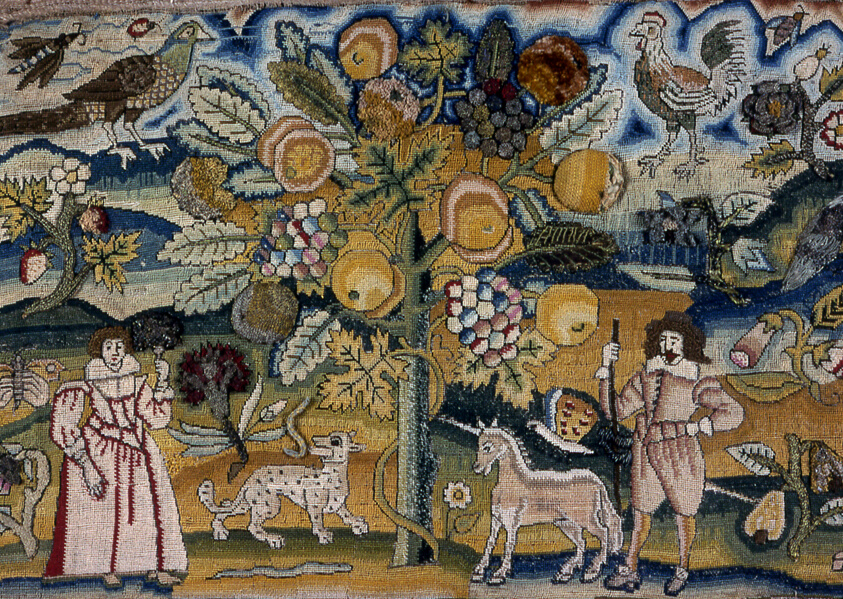
Heritage Research Artifact: The Adam and Eve Needlework Panel
Introduction: A Testament to Silk’s Enduring Legacy
Within the hallowed archives of Lauren Fashion Heritage Lab, we encounter a singular artifact: a needlework panel depicting Adam and Eve, executed on a foundation of linen plain weave. This piece, dating from the late 17th to early 18th century, stands as a profound testament to the materiality of silk and its transformative role in decorative arts. The panel’s composition—a biblical narrative rendered through meticulous embroidery—elevates it beyond mere craft into a sophisticated dialogue between material, technique, and cultural expression. As a Senior Heritage Specialist, I assert that this artifact embodies the fluid elegance and technical mastery that define classic silk craftsmanship, resonating with the bespoke precision of London’s Savile Row.
The panel’s materiality is its primary narrative. The ground is a plain-weave linen, chosen for its durability and neutral tone, which provides a stark canvas for the opulent silk and metallic threads. The embroidered elements—silk yarns, creped silk yarns, gilt-metal purl and wire, gilt-metal-wire-wrapped silk, and gilt-metal-strip-wrapped silk—create a rich textural tapestry. These materials are not merely decorative; they signify status, skill, and the intersection of global trade routes that brought such luxuries to European ateliers. The silk, likely imported from the Far East via the Silk Road, represents a lineage of craftsmanship that Savile Row tailors would later refine into tailored perfection.
Materiality and Technique: The Art of Embellishment
The panel’s embroidery techniques are a lexicon of precision. Stitches such as buttonhole filling, raised and couched buttonhole, plaited braid, square chain, and tent stitches demonstrate a mastery of dimensional surface design. The use of knots, knotted pile, and couching adds depth, while glass beads introduce a subtle luminescence. This technical vocabulary mirrors the meticulous handwork of Savile Row, where every stitch—whether in a lapel or a cuff—must align with exacting standards. Here, the silk threads are not merely functional; they are expressive, capturing the fall of light across Adam’s form or the serpent’s sinuous coil.
The silk yarns themselves are a study in fluidity. Creped silk, with its crinkled texture, offers a matte finish that contrasts with the glossy sheen of standard silk. Gilt-metal elements—purl, wire, and wrapped threads—introduce a metallic brilliance that recalls the gilded threads of ecclesiastical vestments. This interplay of matte and shine, of soft and rigid, creates a dynamic visual rhythm. The glass beads, likely Venetian in origin, add a final layer of opulence, their transparent surfaces catching light like dew on a leaf. Such material choices were not arbitrary; they were deliberate acts of storytelling, each thread a word in the narrative of Eden.
Cultural and Historical Context: Silk as Status and Symbol
This panel emerges from a period when silk was a marker of elite identity. In 17th-century Europe, silk embroidery adorned everything from courtly gowns to domestic furnishings, signaling wealth and cultural sophistication. The Adam and Eve motif, drawn from Genesis, was a popular subject in needlework, often used to explore themes of innocence, temptation, and redemption. The panel’s inclusion of metallic threads and glass beads suggests it was commissioned for a high-status household, perhaps as a fire screen or wall hanging. Its preservation in the Lauren Fashion Heritage Lab underscores its enduring value as a cultural artifact.
The Savile Row connection is not incidental. The Row’s tradition of bespoke tailoring—where every garment is cut and stitched to the individual—shares a philosophical kinship with this panel. Both require an intimate understanding of material behavior: how silk drapes, how gilt metal catches light, how linen supports weight. The panel’s embroiderer, likely a woman working in a domestic or convent setting, would have possessed a similar discipline to a Savile Row cutter, measuring thread tension with the same precision as a tailor measures a seam. This parallel elevates the panel from decorative art to a precursor of modern craftsmanship.
Technical Analysis: The Stitches That Bind
A closer examination of the panel’s stitches reveals a hierarchy of technique. The buttonhole filling stitch, used for leaves and foliage, creates a dense, textured surface that mimics natural forms. Raised and couched buttonhole adds dimension, lifting the thread above the ground to simulate the serpent’s scales or Eve’s hair. Plaited braid and square chain stitches form borders and outlines, their geometric precision framing the organic imagery. Tent stitches, often used in canvas work, provide a uniform background that anchors the composition.
The metallic threads are particularly noteworthy. Gilt-metal purl—a fine, coiled wire—is couched onto the surface, its spiral structure reflecting light in multiple directions. Gilt-metal-wire-wrapped silk combines the strength of metal with the softness of silk, allowing for intricate curves and loops. The glass beads are attached individually, their placement suggesting a deliberate rhythm. This technical complexity demands a level of skill that aligns with the bespoke ethos of Savile Row, where a single garment may require hundreds of hours of handwork.
Preservation and Legacy: A Living Artifact
Preserving this panel requires an understanding of its material vulnerabilities. Silk, while durable, is susceptible to light damage and humidity. The metallic threads may tarnish, and the glass beads can fracture under stress. The Lauren Fashion Heritage Lab employs controlled environments and archival storage to mitigate these risks, ensuring the panel remains accessible for study. This stewardship mirrors the care taken by Savile Row houses to preserve their patterns and techniques, passing them down through generations.
The panel’s legacy extends beyond its physical form. It serves as a pedagogical tool, teaching contemporary artisans about historical techniques and material interactions. For students of fashion and textile history, it offers a tangible link to the past, demonstrating how silk and embroidery were used to tell stories of faith, power, and beauty. In this sense, the panel is not a relic but a living document, its threads speaking across centuries.
Conclusion: Silk’s Eternal Thread
The Adam and Eve needlework panel is more than a decorative object; it is a testament to silk’s ability to transcend time and function. Its materiality—linen, silk, metal, glass—creates a sensory experience that speaks to the human desire for beauty and meaning. In the context of Lauren Fashion Heritage Lab, it stands as a benchmark for craftsmanship, a reminder that the principles of precision, material respect, and narrative depth are as relevant today as they were in the 17th century. For Savile Row, it is a mirror, reflecting the enduring value of handwork in an age of mass production. This panel, with its fluid elegance and technical mastery, ensures that silk’s thread remains unbroken.