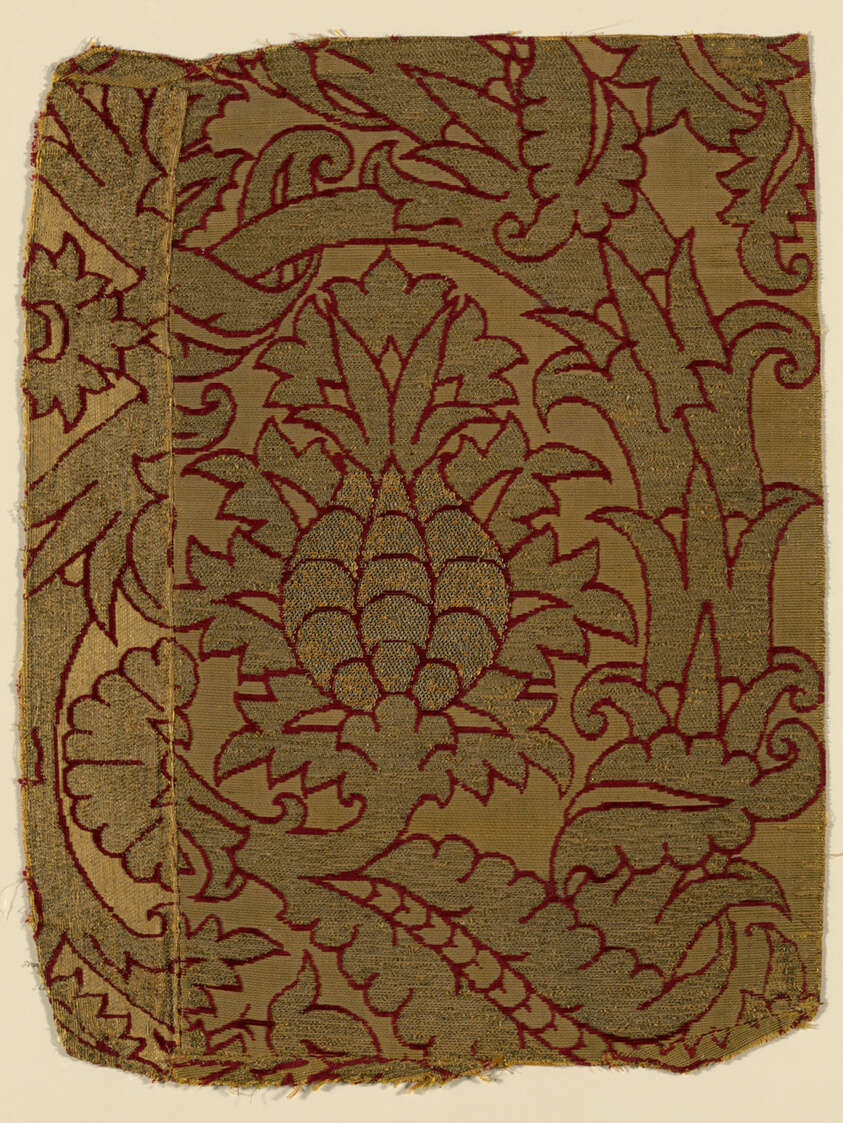
Heritage Research Artifact: The Fragment as a Testament to Craftsmanship
In the hallowed corridors of London’s Savile Row, where tailoring is elevated to an art form, the study of textile fragments reveals the profound dialogue between materiality and elegance. This heritage research artifact examines a singular fragment—a silk textile of exceptional complexity—as a microcosm of classic craftsmanship. The fragment, defined by its silk plain weave structure, incorporates supplementary silk facing wefts, secondary binding warps, and gilt-metal-strip-wrapped silk patterning wefts, culminating in weft loops and cut voided velvet. This analysis, framed within the context of Savile Row’s ethos of precision and heritage, explores how the fragment embodies fluid elegance and the enduring legacy of silk craftsmanship.
Materiality and Structural Complexity
The fragment’s foundation is a silk plain weave, a base that provides stability and a subtle, even surface. This weave, characterized by its over-one-under-one interlacing, is the canvas upon which more intricate elements are layered. The inclusion of supplementary silk facing wefts introduces a secondary set of wefts that float on the surface, adding depth and a lustrous sheen. These wefts are not integral to the fabric’s structural integrity but serve an ornamental purpose, enhancing the textile’s visual richness—a hallmark of Savile Row’s attention to detail, where every thread contributes to the final aesthetic.
The secondary binding warps are a critical innovation. These warps tie the supplementary gilt-metal-strip-wrapped silk patterning wefts to the base weave, ensuring that the metallic elements remain securely anchored. The use of gilt-metal-strip-wrapped silk is a testament to historical opulence; the metal strips, often gold or silver-gilt, are wrapped around a silk core, creating a thread that shimmers with a reflective quality. This technique, prevalent in Renaissance and Baroque textiles, aligns with Savile Row’s reverence for tradition, where such materials evoke a sense of timeless luxury.
The patterning and brocading wefts form weft loops in specific areas, a technique that introduces a three-dimensional texture. These loops, created by leaving the wefts loose before being cut or left intact, add a tactile dimension that catches light and shadow. In the context of Savile Row, where fabric is chosen for its drape and feel, such textural variation is prized for its ability to transform a garment from mere clothing into a statement of artistry.
The Cut Voided Velvet: A Study in Contrast
Perhaps the most striking feature of this fragment is the supplementary pile warps forming cut voided velvet. Voided velvet is a technique where the pile is cut away in specific areas, creating a pattern of raised velvet against a flat ground. In this fragment, the pile warps are supplementary, meaning they are added to the base weave and cut to form a plush surface. The “voided” aspect refers to the deliberate absence of pile in certain zones, revealing the underlying plain weave or the gilt-metal patterning. This interplay of textures—smooth versus plush, matte versus lustrous—echoes the Savile Row principle of contrast and balance. A tailored jacket, for instance, might use voided velvet for lapels or cuffs, drawing the eye to key details while maintaining a cohesive silhouette.
The cut voided velvet technique demands exceptional skill. The pile warps must be precisely aligned and cut to avoid fraying, and the voided areas require meticulous planning to ensure the pattern remains crisp. This level of craftsmanship resonates with Savile Row’s bespoke tradition, where a single garment may require hundreds of hours of handwork. The fragment, therefore, is not merely a piece of fabric but a record of the artisan’s expertise—a heritage that modern tailors strive to uphold.
Context: Classic Silk Craftsmanship and Fluid Elegance
Silk has long been synonymous with luxury, and this fragment exemplifies the fluid elegance that defines classic silk craftsmanship. The term “fluid” here refers to the fabric’s ability to drape and move with the body, a quality enhanced by the plain weave base and the supplementary wefts. The gilt-metal strips add weight and structure, yet the silk’s inherent suppleness ensures that the textile remains pliable. In Savile Row, where garments are designed to move with the wearer, such balance is essential. A silk suit or evening gown crafted from this material would flow gracefully, its metallic accents catching light like water rippling in the sun.
The historical context of this fragment is equally significant. Similar textiles were produced in 17th- and 18th-century Europe, particularly in Italy and France, where silk weaving reached its zenith. These fabrics were used for courtly attire, ecclesiastical vestments, and interior furnishings, symbolizing wealth and power. Savile Row’s adoption of such materials in the 19th and 20th centuries reflects a continuity of taste—a nod to the past while embracing modern tailoring. The fragment, therefore, serves as a bridge between eras, reminding us that heritage is not static but evolves through reinterpretation.
Preservation and Interpretation
As a heritage artifact, this fragment requires careful preservation. The gilt-metal strips are susceptible to tarnishing, and the silk pile can flatten or fray over time. Conservation efforts must balance stabilization with accessibility, allowing scholars and designers to study the fragment without compromising its integrity. At the Lauren Fashion Heritage Lab, we advocate for digital documentation—high-resolution imaging and 3D scanning—to capture the fragment’s details for future analysis. This approach aligns with Savile Row’s forward-thinking ethos, where tradition is preserved through innovation.
Interpretation of the fragment extends beyond its physical attributes. It tells a story of trade routes, as silk and metal threads were imported from Asia and the Middle East. It speaks to the skill of weavers who manipulated complex looms to achieve such intricacy. And it reflects the tastes of patrons who valued opulence and refinement. For a contemporary designer, this fragment offers inspiration: the interplay of textures can inform modern fabric development, while the historical context adds depth to a collection’s narrative.
Conclusion: The Fragment as a Living Legacy
In the world of Savile Row, where every stitch is deliberate, this fragment stands as a testament to the enduring power of craftsmanship. Its silk plain weave, supplementary wefts, gilt-metal wrappings, and cut voided velvet are not mere technical terms but expressions of an art form that values precision, beauty, and heritage. The fragment’s fluid elegance—its ability to drape, shimmer, and transform—captures the essence of silk as a material that transcends time. As we study and preserve such artifacts, we honor the artisans of the past while inspiring the tailors of the future. In this fragment, we find not just a piece of fabric, but a legacy woven into the very fabric of fashion history.