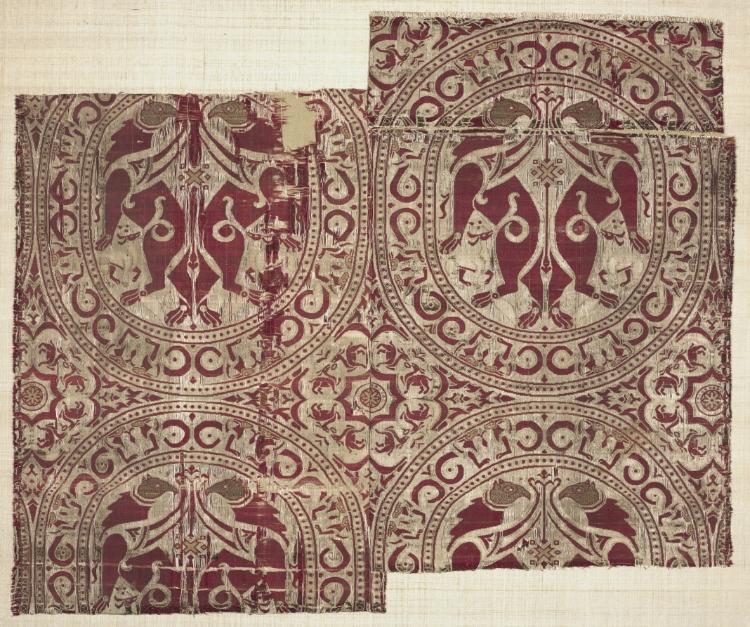
The Lampas with Griffins in Roundels: A Material Testament to Imperial Silk Weaving
In the hallowed archives of textile history, few artifacts command the reverence and analytical scrutiny as the lampas with griffins in roundels, preserved within the Reliquary of Saint Librada at Siguenza Cathedral. As a Senior Heritage Specialist at the Lauren Fashion Heritage Lab, I approach this piece not merely as a decorative fragment but as a profound material document—a silk woven in the crucible of imperial ambition, where threads of commerce, power, and artistry converged. This lampas, dating to the 12th or 13th century, embodies the legacy of imperial silk weaving, a tradition that spanned from Byzantine Constantinople to Islamic Spain, and ultimately shaped the aesthetic lexicon of European luxury.
Materiality and Craft: The Silk of Sovereignty
The materiality of this lampas is its first and most commanding statement. Silk, a fiber once as precious as gold, was the medium of empires. The warp-faced compound weave, known as lampas, allowed for intricate patterns through the introduction of supplementary wefts, creating a ground weave and a pattern weave that interplay with light and shadow. The griffins, mythical beasts with the body of a lion and the head and wings of an eagle, are enclosed within circular roundels—a motif that speaks to the cosmic order and the divine right of rulers. The silk itself, dyed in hues of crimson, gold, and deep indigo, would have been sourced from the sericulture of the East, traded along the Silk Road, and refined in the workshops of Al-Andalus or Sicily.
The technical mastery required to produce such a fabric is staggering. The weaver had to align the pattern repeats with precision, ensuring that the griffins’ symmetry and the roundels’ geometry remained unbroken. This was not a task for the amateur; it demanded generations of tacit knowledge, passed through guilds and royal ateliers. The silk’s lustrous surface, even in its aged state, reflects the light with a depth that synthetic fibers cannot replicate. This is a fabric that was meant to be seen, touched, and revered—a material testament to the weaver’s skill and the patron’s wealth.
Context: The Imperial Silk Weaving Legacy
To understand this lampas, one must situate it within the broader legacy of imperial silk weaving. The tradition began in earnest under the Byzantine Empire, where the state-controlled silk workshops in Constantinople produced fabrics for the court and the church. The griffin motif, a symbol of vigilance and strength, was a favorite of Byzantine emperors, who used it to assert their authority over both earthly and spiritual realms. After the fall of Constantinople, the knowledge and motifs migrated westward, finding fertile ground in Islamic Spain, particularly in the taifa kingdoms and later under the Almohads. The silk workshops of Almería and Murcia became renowned for their lampas weaves, blending Islamic geometric precision with Hellenistic mythological imagery.
The Reliquary of Saint Librada, a 13th-century silver-gilt casket, houses this lampas as a lining or wrapping for the saint’s relics. This context is critical: the silk was not merely decorative but sacred. It served as a barrier between the mortal and the divine, a textile that literally clothed the holy. The choice of griffins—creatures that guard treasures in medieval bestiaries—was deliberate. They symbolized the protection of the saint’s remains, while the roundels evoked eternity, a circle without beginning or end. The silk thus functioned as a material prayer, woven with the hope of salvation.
Stylistic Analysis: The Language of Power and Piety
The stylistic elements of this lampas reveal a syncretic dialogue between cultures. The griffins, with their pronounced beaks and talons, are rendered in a stylized, almost heraldic manner. Their wings are layered with feathers that echo the Islamic arabesque, while their bodies retain a classical naturalism reminiscent of Roman mosaics. The roundels are framed by pearl-like borders, a motif that appears in both Byzantine and Islamic textiles, suggesting a shared visual vocabulary. The background, filled with small floral or geometric patterns, creates a sense of depth and movement, as if the griffins are emerging from a tapestry of celestial gardens.
This fusion is not accidental. The lampas was likely produced in a multicultural workshop, where Christian, Muslim, and Jewish artisans collaborated. The result is a textile that transcends religious boundaries, appealing to a universal sense of majesty. For the Savile Row connoisseur, this piece prefigures the bespoke tradition of blending disparate influences into a cohesive whole. Just as a tailored suit integrates fabric, cut, and lining, this lampas integrates myth, faith, and power into a single, wearable artifact.
Preservation and Legacy: The Fabric of History
The survival of this lampas is a miracle of conservation. Silk is notoriously fragile, susceptible to light, humidity, and handling. Yet, the Reliquary of Saint Librada has protected it for centuries, allowing us to study its weave and pattern with modern tools. At the Lauren Fashion Heritage Lab, we use multispectral imaging and fiber analysis to document its condition, revealing details invisible to the naked eye—such as the original dye sources and the direction of the twist in the silk threads. This research not only preserves the artifact but also informs contemporary silk weaving, offering lessons in sustainability and craftsmanship.
The legacy of this lampas extends beyond the museum. It is a reminder that silk, as a material, carries the weight of empires. From the Byzantine court to the Spanish cathedral, from the Silk Road to Savile Row, the thread of this tradition runs unbroken. Today, luxury fashion houses reference such motifs in their collections, drawing on the same language of power and beauty. The griffin in the roundel, once a symbol of imperial might, now appears on scarves and ties, a subtle nod to the heritage that shapes modern elegance.
Conclusion: A Thread Through Time
The lampas with griffins in roundels from the Reliquary of Saint Librada is more than a textile; it is a narrative woven in silk. Its materiality speaks of the labor and luxury of imperial workshops, its context reveals the sacred and political uses of fabric, and its style embodies the cultural fusion that defines great art. As a heritage specialist, I see in this artifact the blueprint for understanding how materials carry meaning across centuries. For the discerning eye, it is a masterclass in the power of silk—a fiber that, like the griffin itself, guards the treasures of history while inspiring the future of fashion.