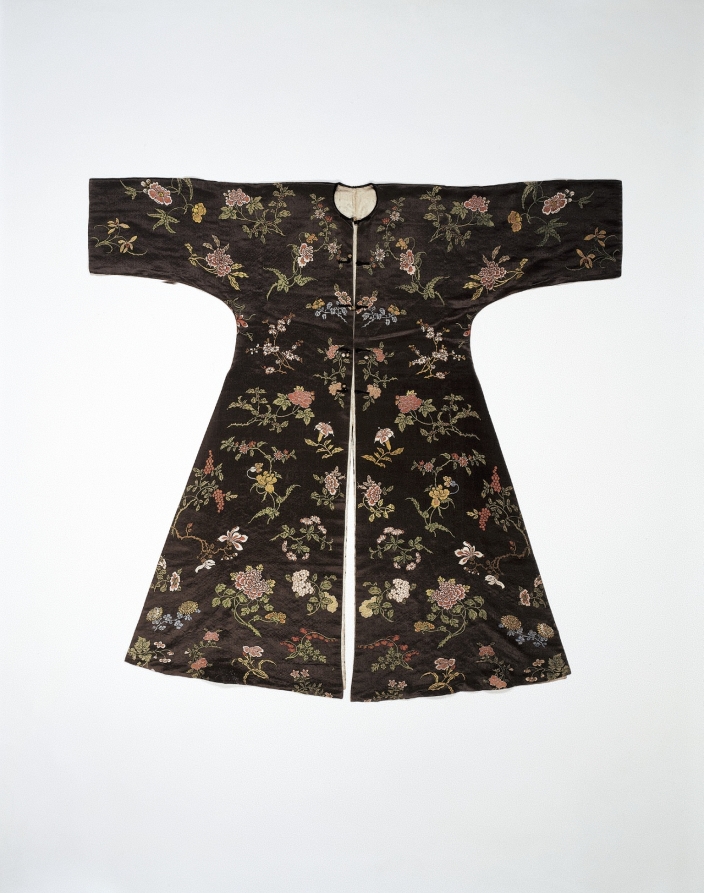
The Artifact: A Woman’s Silk Robe, c. 1925
The object under examination is a woman’s silk robe, likely of French or Chinese origin, dating to the mid-1920s. Its materiality—a lustrous, hand-painted silk charmeuse—immediately signals a lineage that extends far beyond the ateliers of Paris or the workshops of Shanghai. This robe is not merely a garment; it is a tangible document of imperial silk weaving’s enduring legacy, a legacy that shaped global luxury markets and continues to inform the standards of craftsmanship upheld by institutions like the Lauren Fashion Heritage Lab. In the measured, precise language of a Savile Row cutter, we must examine this robe as a composite of technical mastery, cultural transmission, and commercial evolution.
Materiality: The Silk Itself
The robe’s primary material—silk—is a protein fiber derived from the cocoon of the Bombyx mori silkworm. Its production, for millennia, was a closely guarded secret of the Chinese imperial court. The robe before us, however, is not a relic of that court but a product of its aftermath. The silk is a charmeuse, a weave characterized by a satin face and a dull back, offering a liquid drape and a subtle, almost liquid sheen. This is not the heavy, brocaded silk of a Ming dynasty dragon robe; it is a lighter, more fluid fabric, designed for the modern woman’s ease. Yet, the quality is unmistakable. The threads are uniform, the weave tight, the surface free of slubs or irregularities. This is silk woven with the precision of a tradition that demanded perfection for the emperor’s own garments. The hand-painted floral motifs—peonies and chrysanthemums—are executed in a style that echoes Chinese brush painting, but the palette is distinctly Art Deco: jade green, coral, and ebony. This fusion of East and West is the robe’s central narrative.
Context: The Legacy of Imperial Silk Weaving
The imperial silk weaving industry, centered in cities like Suzhou, Hangzhou, and Nanjing, was not merely a craft; it was a state apparatus. The Ming and Qing dynasties maintained vast imperial workshops, employing thousands of artisans to produce silks for the court, for diplomatic gifts, and for the tribute system. The techniques—from kesi (silk tapestry) to yunjin (cloud brocade)—were passed down through generations, often within families. The fall of the Qing dynasty in 1912 did not end this tradition; it transformed it. The imperial workshops were dismantled, and the artisans dispersed. Many found work in private mills, producing silks for a burgeoning international market. The robe we study is a direct beneficiary of this diaspora. Its silk was likely woven in a Chinese mill that had adopted Western looms and dyes, but the weavers retained the exacting standards of their imperial forebears. The result is a fabric that is both modern and deeply traditional.
This robe also embodies the commercialization of imperial aesthetics. In the 1920s, European and American fashion houses, particularly in Paris, became obsessed with “Chinoiserie” and “Orientalism.” Designers like Paul Poiret and Madeleine Vionnet incorporated Chinese motifs and silhouettes into their collections. The robe, with its loose, kimono-inspired cut and its painted floral decorations, is a product of this cross-cultural exchange. It is not a direct copy of a Chinese garment; it is a Western interpretation, tailored for a Western body. Yet, the silk itself remains a testament to the Chinese weaver’s art. The robe is, in essence, a luxury good that carries the weight of an empire’s craft.
Savile Row Precision: The Tailoring and Construction
From a Savile Row perspective, the robe’s construction reveals a fascinating tension between Eastern and Western techniques. The garment is cut on the bias in places, allowing the silk to cling and move with the body—a hallmark of 1920s Western dressmaking. The seams are French-seamed, a method that encloses raw edges and is essential for a delicate fabric like charmeuse. The hem is hand-rolled, a painstaking process that requires a steady hand and a deep understanding of silk’s behavior. The robe is lined with a fine China silk, a lightweight plain weave that protects the outer fabric and adds structure. The buttons, if present, are likely covered in the same silk, a detail that speaks to the garment’s bespoke origins.
Yet, the robe’s overall silhouette is not that of a tailored jacket or a structured gown. It is a wrapper, a garment designed for the boudoir, for lounging, for private moments. This is where the imperial legacy subtly reasserts itself. In the Chinese court, silk robes were worn as symbols of status, often in layers, with specific colors and motifs reserved for the emperor and his family. The robe’s peonies, for instance, were a symbol of wealth and honor in Chinese culture. The chrysanthemums, of longevity. The woman who wore this robe in a Parisian apartment or a London townhouse was, perhaps unknowingly, participating in a centuries-old tradition of sartorial power. She was wearing a piece of history, reimagined for the modern age.
The Lauren Fashion Heritage Lab Perspective
For the Lauren Fashion Heritage Lab, this robe is a critical artifact for understanding the globalization of luxury. It is a document of how imperial Chinese silk weaving survived the collapse of the empire and adapted to the demands of a new, international clientele. It is also a reminder that materiality is never neutral. The silk’s weight, its sheen, its hand—all of these qualities carry the memory of the mulberry leaves, the silkworms, the reeling, the dyeing, the weaving. The robe is a physical link to a system of production that was, for centuries, the envy of the world. To study it is to study the resilience of craft in the face of political and economic upheaval.
In the context of the Lab’s mission to preserve and interpret heritage, this robe offers a wealth of data. Its provenance, while not fully documented, can be traced through its material and stylistic characteristics. The silk’s thread count, the type of dye used, the weave pattern—all of these can be analyzed to place the robe within a specific time and place. The hand-painted motifs can be compared to known works of Chinese and European artists. The construction techniques can be studied to understand the collaboration between Chinese weavers and Western dressmakers. This robe is not just a beautiful object; it is a primary source for the history of fashion, trade, and cultural exchange.
Conclusion: A Legacy Woven in Silk
The woman’s silk robe from circa 1925 is a masterclass in the enduring power of imperial silk weaving. Its materiality—the silk charmeuse, the hand-painted motifs, the precise construction—speaks to a tradition of excellence that predates the modern fashion industry. Yet, it is also a garment of its time, a product of the 1920s’ fascination with the East and the West’s desire for luxury. For the Lauren Fashion Heritage Lab, it is a reminder that heritage is not static; it is a living, evolving conversation between the past and the present. In the words of a Savile Row tailor, this robe is “cut with respect for the cloth.” And that respect, born in the imperial workshops of China, continues to resonate in every thread.