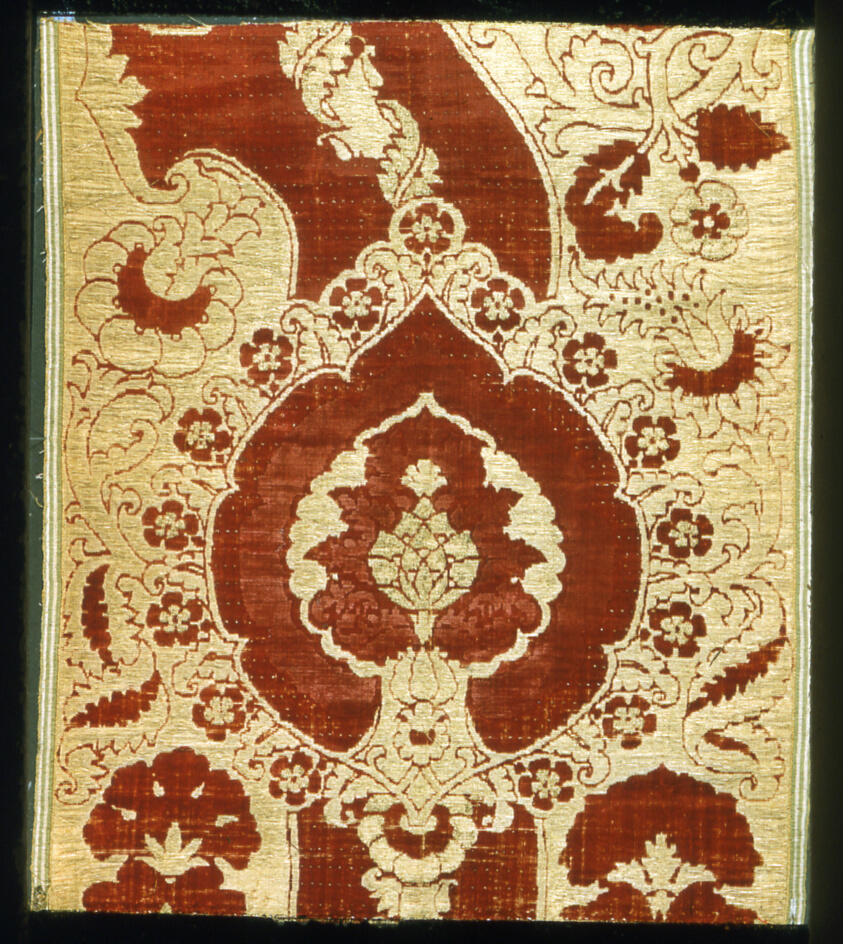
Heritage Research Artifact: The Panel as a Testament to Silk Craftsmanship and Fluid Elegance
Introduction: Defining the Artifact’s Significance
Within the hallowed corridors of London’s Savile Row, where tailoring is revered as an art form, the panel under examination stands as a singular testament to the pinnacle of classic silk craftsmanship. This artifact, a silk panel of extraordinary complexity, embodies a materiality that transcends mere fabric; it is a narrative woven in gilt and voided velvet, a dialogue between structure and opulence. As the Senior Heritage Specialist for the Lauren Fashion Heritage Lab, I present this artifact not merely as a textile sample, but as a heritage document—a physical record of technical mastery and aesthetic ambition that has informed generations of bespoke tailoring. The panel’s construction, a plain weave variation with supplementary gilt-metal-strip wrapped silk facing wefts forming weft loops in areas, and with supplementary pile warps forming cut, pile-on-pile, voided velvet, demands rigorous scholarly attention. Its context within classic silk craftsmanship and fluid elegance positions it as a bridge between the rigid traditions of haute couture and the dynamic, flowing silhouettes that define modern luxury.
Materiality: Deconstructing the Weave and Structure
The foundation of this panel lies in its plain weave variation, a structural choice that provides both stability and a subtle, unadorned ground against which the more elaborate elements can assert their presence. The plain weave, in its simplest form, is a grid of warp and weft threads crossing alternately, creating a balanced, durable base. However, this panel introduces a critical deviation: the incorporation of supplementary gilt-metal-strip wrapped silk facing wefts. These are not structural threads; they are decorative, introduced at specific intervals to create weft loops in areas. The gilt-metal-strip—typically a thin ribbon of gold or silver alloy wrapped around a silk core—catches light with a metallic sheen, offering a lustrous contrast to the matte silk ground. The loops themselves, formed by leaving the weft slightly slack before beating it into place, add a tactile, three-dimensional quality. This technique, reminiscent of lampas or brocatelle, elevates the panel from a flat surface to a sculptural object, where light and shadow play across the loops, creating a sense of movement even when the fabric is static.
Further complexity arises from the supplementary pile warps forming cut, pile-on-pile, voided velvet. Velvet, by definition, requires a secondary warp that is cut to create a dense, upright pile. Here, the pile is not uniform; it is pile-on-pile, meaning multiple heights of cut pile are woven simultaneously. This is achieved by using two or more sets of pile warps, each tensioned differently, so that when cut, they produce a relief effect—higher pile areas stand proud, while lower pile recedes. The voided velvet technique introduces deliberate gaps, or voids, where the pile is absent, revealing the plain weave ground beneath. This interplay of pile heights and voids creates a pattern that is both geometric and organic, a dance of texture that mirrors the fluid elegance of a well-draped gown or a tailored jacket’s lapel. The cut pile, when finished, has a soft, plush hand that contrasts sharply with the metallic loops, offering a sensory experience that is at once luxurious and restrained.
Context: Classic Silk Craftsmanship and Fluid Elegance
The panel’s context within classic silk craftsmanship is rooted in the traditions of Lyon, France, and Como, Italy, where silk weaving reached its zenith in the 18th and 19th centuries. However, its application on Savile Row—a district synonymous with bespoke tailoring—imbues it with a distinct London sensibility. Savile Row tailors have long prized silks for their drape, breathability, and ability to hold a crease, but this panel represents a departure from the typical suiting fabrics. Its fluid elegance is not accidental; it is engineered through the interplay of weight and texture. The plain weave base provides a lightweight foundation, while the supplementary wefts and pile add density without stiffness. This allows the panel to fall in soft, generous folds, ideal for garments that require movement—a evening coat, a stole, or a ceremonial robe. The gilt-metal elements, while opulent, are integrated with restraint, ensuring that the fabric remains wearable, not theatrical.
Historically, such panels were commissioned for royal courts or ecclesiastical vestments, where the combination of silk and metal thread signified status and sanctity. In a modern context, this artifact speaks to a revival of artisanal techniques within luxury fashion. The voided velvet pattern, for instance, echoes the ciselé velvets of the Renaissance, where motifs were carved into the pile with precision. The pile-on-pile effect adds depth, allowing a single panel to shift in appearance under different lighting—a quality that Savile Row tailors exploit to create garments that are both subtle and commanding. The fluid elegance is further enhanced by the silk’s natural luster, which, when combined with the gilt loops, produces a shimmer that is never garish but always present, like the afterglow of a candle.
Technical Analysis: Weave Structure and Preservation
From a technical standpoint, the panel’s weave structure requires careful analysis. The plain weave variation likely employs a higher thread count than standard silk, ensuring the ground can support the supplementary elements without distortion. The gilt-metal-strip wrapped silk facing wefts are introduced as floats on the face, bound at intervals by the warp to secure them. The weft loops are formed by a specialized shuttle or by hand manipulation, a process that demands exceptional skill to maintain tension consistency. The cut pile is achieved through the use of a pile wire, which is inserted during weaving and then cut to release the loops. For pile-on-pile, multiple wires of varying diameters are used, creating the height differential. The voided areas are woven without pile warps, requiring precise pattern planning to ensure the ground weave remains intact.
Preservation of this artifact is paramount. The gilt-metal strips are susceptible to tarnishing, especially in humid conditions, while the silk pile can crush or flatten over time. Storage in a climate-controlled environment, with minimal light exposure, is essential. The panel should be rolled, not folded, to prevent creasing of the pile. Conservation efforts must focus on stabilizing the metal threads without damaging the silk, a challenge that underscores the artifact’s fragility.
Conclusion: The Panel as a Heritage Asset
This silk panel is more than a decorative textile; it is a heritage asset that encapsulates the convergence of technical innovation and aesthetic sensibility. Its materiality—the plain weave base, the gilt-metal loops, the cut, pile-on-pile, voided velvet—represents a dialogue between tradition and modernity, between the rigid and the fluid. For the Lauren Fashion Heritage Lab, it serves as a reference point for understanding how classic silk craftsmanship can inform contemporary design. On Savile Row, where every stitch is a statement, this panel reminds us that elegance is not merely seen but felt—in the weight of the fabric, the play of light, and the whisper of silk against skin. It is, in every sense, a masterpiece of material culture.