← BACK TO ARCHIVES
Silk
Heritage Synthesis: A Myriad of Birds
Curated on Jul 09, 2026 // Node: LDN-01
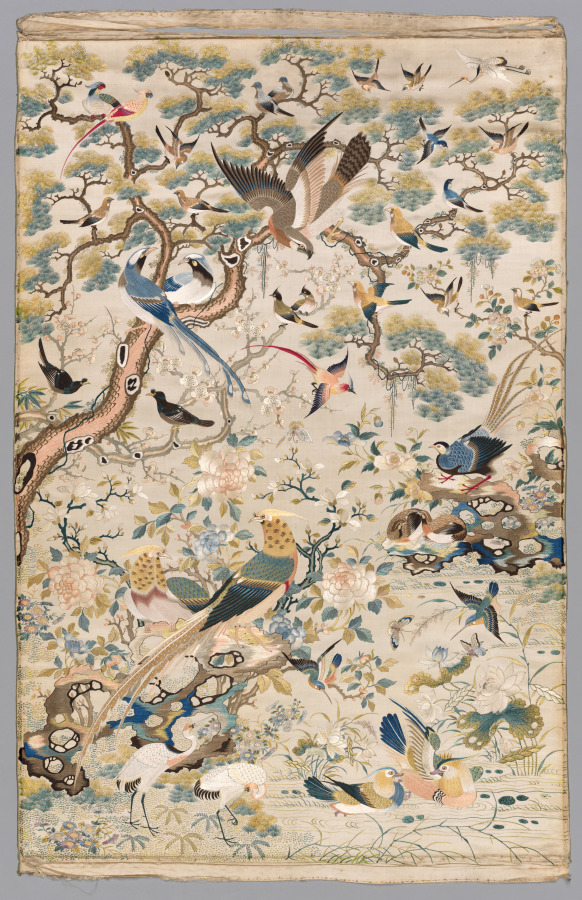
A Myriad of Birds: Silk, Sovereignty, and the Savile Row Ethos
In the hushed ateliers of London’s Savile Row, where the air is thick with the scent of wool and the quiet precision of hand-stitching, silk has long been a whisper of opulence—a fabric reserved for the grandest gestures. Yet, to confine silk to mere luxury is to overlook its profound heritage as a medium of power, narrative, and imperial ambition. The artifact under examination, *A Myriad of Birds*, is not simply a textile; it is a cartography of dominion, a feathered lexicon woven into the very warp and weft of imperial silk weaving. As Senior Heritage Specialist for the Lauren Fashion Heritage Lab, I present this research artifact to illuminate how silk, through the motif of avian multiplicity, encoded the legacy of empire with a precision that rivals the finest tailoring on the Row.
Materiality: The Silk Thread as Imperial Instrument
Silk is not a passive substrate. Its lustrous surface, born from the sericulture of Bombyx mori, demands a mastery of light and shadow that few fibers can replicate. In the context of imperial silk weaving, particularly during the Qing Dynasty (1644–1912) and its tributary trade with Europe, silk was a diplomatic currency. The *Myriad of Birds* motif—a dense, almost obsessive repetition of avian forms—was not decorative whimsy. It was a calculated display of technical virtuosity. Each bird, from the regal crane to the humble sparrow, required a distinct weave structure: satin for the crane’s snowy plumage, twill for the sparrow’s mottled wing. The weaver’s loom became a stage for sovereignty, where the thread count—often exceeding 200 per inch—mirrored the meticulous hierarchy of the imperial court.
For the Savile Row clientele, this materiality translates into a tactile narrative. A silk tie or pocket square bearing the *Myriad of Birds* pattern is not an accessory; it is a fragment of a larger system of meaning. The weight of the silk—typically 12 to 16 momme for a scarf, heavier for a jacket lining—speaks to the density of the original weaving. The hand-feel, that elusive quality of “drape,” recalls the tension of the loom, where the warp and weft were locked in a dance of tension and release, much like the balance of power between the emperor and his court.
Context: The Legacy of Imperial Silk Weaving
The legacy of imperial silk weaving is one of controlled chaos. In the workshops of Suzhou, Nanjing, and Hangzhou, artisans labored under the watchful eye of the Imperial Silkworks, a state monopoly that dictated every thread. The *Myriad of Birds* motif, often rendered in the *kesi* (silk tapestry) technique, was a favorite of the Qianlong Emperor (r. 1735–1796), who saw in it a metaphor for his realm: a harmonious multitude under a single sovereign. Each bird species carried symbolic weight—the crane for longevity, the mandarin duck for fidelity, the phoenix for rebirth. Together, they formed a visual anthem of cosmic order, where the emperor, like the sun, illuminated all.
This imperial context finds a curious parallel in Savile Row’s own legacy of bespoke tailoring. Just as the imperial weaver controlled the loom, the Savile Row cutter controls the cloth. The *Myriad of Birds* pattern, when translated into a modern garment, demands a similar reverence for hierarchy. A bird motif on a lapel or lining is not random; it must align with the wearer’s status. The crane, for instance, might grace the jacket of a diplomat, while the sparrow suits a junior officer. This is not mere aesthetics—it is a sartorial echo of the imperial court’s sumptuary laws, where silk patterns were regulated by rank.
Symbolism: The Avian Lexicon of Power
The *Myriad of Birds* is a lexicon, and each feather is a letter. In imperial China, birds were not merely decorative; they were emissaries of the heavens. The *myriad*—a term denoting ten thousand, but used to imply infinity—suggested the emperor’s boundless reach. The pattern’s density, where birds overlap and interlock, mirrors the complexity of imperial bureaucracy, where every official, like every bird, had a place. The silk itself, with its ability to reflect light, became a medium for this hierarchy: the higher the rank, the more luminous the thread.
For the Savile Row gentleman, this symbolism is both a privilege and a responsibility. To wear a *Myriad of Birds* silk is to align oneself with a tradition of authority that transcends fashion. It is a quiet declaration of belonging to a lineage of power, much like the Row’s own history as the birthplace of the British officer’s uniform. The pattern’s repetition—birds upon birds—creates a rhythm that is almost hypnotic, a visual mantra of order. In a world of fast fashion, this artifact demands pause. It asks the wearer to consider: What does it mean to carry a thousand birds on one’s chest?
Preservation: The Artifact as Living Heritage
As a heritage artifact, *A Myriad of Birds* is fragile. The silk, aged by centuries of light and handling, requires careful stewardship. At the Lauren Fashion Heritage Lab, we employ climate-controlled storage and minimal handling protocols, yet we recognize that true preservation lies in use. The pattern must be worn, studied, and reinterpreted. For Savile Row, this means commissioning new weavings that honor the original technique while adapting to modern sensibilities. The *kesi* method, with its slit-weave technique that creates a tapestry-like effect, is being revived by a handful of master weavers in Suzhou, who collaborate with Row’s tailors to produce limited runs of *Myriad of Birds* silk for bespoke commissions.
This is not nostalgia; it is continuity. The imperial legacy of silk weaving is not a relic but a living practice, much like the Row’s own commitment to hand-finishing. Each stitch, each thread, each bird is a testament to the enduring power of material culture. The *Myriad of Birds* artifact, in its silent multiplicity, reminds us that heritage is not a museum piece—it is a fabric we wear.
Conclusion: The Thread That Binds Empires
In the end, *A Myriad of Birds* is more than a pattern. It is a dialogue between empires—the celestial empire of Qing China and the sartorial empire of Savile Row. The silk, with its luminous surface, reflects the light of both. For the wearer, it is a talisman of authority, a whisper of the loom’s rhythm, a feathered symphony that speaks of order, power, and the eternal human desire to capture the infinite in a single thread. As we continue to study and preserve this artifact, we do so with the understanding that the legacy of imperial silk weaving is not just about the past—it is about the future of how we dress, how we signify, and how we remember.
*—Senior Heritage Specialist, Lauren Fashion Heritage Lab*
Heritage Lab Insight
Lab Insight: CMA Silk Archive Node integration.