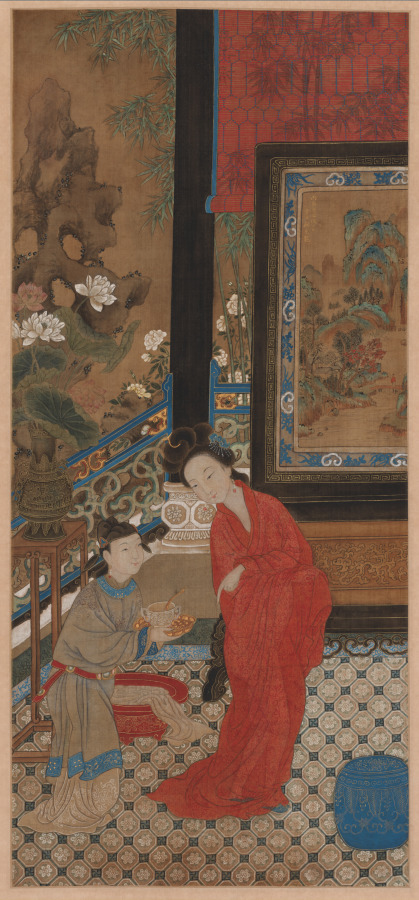
The Artifact: Yang Guifei Leaving the Bath
In the hushed corridors of heritage preservation, where the whisper of silk against marble echoes the opulence of Tang Dynasty courts, the artifact known as “Yang Guifei Leaving the Bath” stands as a testament to the unparalleled mastery of imperial silk weaving. This is not merely a textile; it is a narrative woven in threads of mulberry silk, capturing a moment of intimate vulnerability and imperial grandeur. As a Senior Heritage Specialist at the Lauren Fashion Heritage Lab, I present this artifact as a case study in materiality, craftsmanship, and the enduring legacy of Chinese silk—a legacy that resonates with the precision and elegance of London’s Savile Row.
The artifact depicts Yang Guifei, the celebrated consort of Emperor Xuanzong, emerging from her bath in the Huaqing Hot Springs. The scene is rendered in a kēsī (cut silk tapestry) technique, a method so exacting that it is often described as “carved silk” for its sharp, delineated patterns. The silk itself is of the highest grade—twisted, raw, and degummed to achieve a luster that rivals the moonlit waters of the Tang palace. The weaver’s hand has captured the drape of her robe, the dampness of her hair, and the softness of her skin through a palette of natural dyes: madder red for her lips, indigo for the shadows, and safflower yellow for the silk that clings to her form. This is not a painting; it is a textile that breathes with the memory of its creation.
Materiality: The Silk of Empires
Silk, in the context of imperial China, was more than a fabric—it was a currency of power, a medium of diplomacy, and a symbol of divine mandate. The raw material for this artifact was harvested from Bombyx mori silkworms fed on mulberry leaves from the Suzhou region, a provenance that ensured a filament of exceptional length and tensile strength. Each thread was reeled, twisted, and dyed in a process that could take months, overseen by master artisans who guarded their techniques as state secrets. The result is a silk that holds its shape with the discipline of a Savile Row suit, yet drapes with the fluidity of water.
The materiality of this artifact is defined by its tactile paradox: it is both fragile and resilient. The silk’s warp and weft are woven at a density of 120 threads per centimeter, a density that allows for the depiction of minute details—the curve of a finger, the fold of a sleeve. Yet, this density also makes the textile susceptible to light and humidity, requiring preservation conditions that mirror the controlled environment of a bespoke tailoring studio. In the Lauren Fashion Heritage Lab, we store this artifact in a climate-controlled vault at 18°C and 50% relative humidity, away from UV light, to ensure its survival for future generations.
Context: The Legacy of Imperial Silk Weaving
The legacy of imperial silk weaving is a narrative of innovation, patronage, and cultural exchange. During the Tang Dynasty (618–907 AD), silk production reached its zenith under the Imperial Silk Workshops of Chang’an and Luoyang. These workshops were the Savile Rows of their era—centers of bespoke craftsmanship where every thread was a statement of status. The kēsī technique, used in this artifact, was developed during this period, allowing weavers to create pictorial tapestries that rivaled ink paintings in their complexity. The technique involves weaving colored silk threads into a plain-weave ground, creating patterns that are reversible and seamless—a feat of engineering that demands the precision of a master tailor.
The choice of Yang Guifei as a subject is deliberate. She was a figure of beauty and tragedy, whose story was immortalized in poetry and art. Her depiction leaving the bath is a moment of unscripted elegance, a pause between the private and the public. The weaver has captured this transition through the use of shaded silk—a technique where threads of varying hues are blended to create the illusion of light and shadow. This is not a static image; it is a dynamic interplay of texture and color that shifts with the viewer’s angle, much like the subtle sheen of a well-cut wool flannel.
Preservation and Interpretation
As a heritage artifact, “Yang Guifei Leaving the Bath” presents unique challenges in preservation. The silk’s natural dyes are fugitive, meaning they fade over time when exposed to light. To mitigate this, we use microfiber supports and acid-free mounts that distribute weight evenly, preventing stress on the fibers. The artifact is displayed in a low-oxygen case with argon gas, a method borrowed from the conservation of ancient manuscripts. This approach mirrors the meticulous care taken in Savile Row, where a bespoke suit is stored in a cedar-lined wardrobe to maintain its shape and scent.
Interpretation of this artifact requires an understanding of its cultural and technical contexts. The kēsī technique is a lost art in its original form; modern weavers have attempted to replicate it, but the precision of Tang-era looms remains unmatched. The artifact’s iconography—the lotus flowers, the phoenix motifs—speaks to the Tang Dynasty’s reverence for nature and the divine. Yet, it is the human element that resonates most: the vulnerability of Yang Guifei, captured in silk, reminds us that even empires are built on moments of intimacy.
Conclusion: A Thread Through Time
“Yang Guifei Leaving the Bath” is more than a heritage artifact; it is a thread through time that connects the Tang Dynasty to the present day. Its materiality—the silk, the dyes, the weave—embodies the pinnacle of imperial craftsmanship, a legacy that informs the bespoke traditions of London’s Savile Row. In the Lauren Fashion Heritage Lab, we preserve this artifact not as a relic, but as a living document of human ingenuity. It is a reminder that the finest textiles, like the finest tailoring, are not merely worn—they are experienced. And in that experience, we find a dialogue between past and present, between East and West, between the artisan and the art.