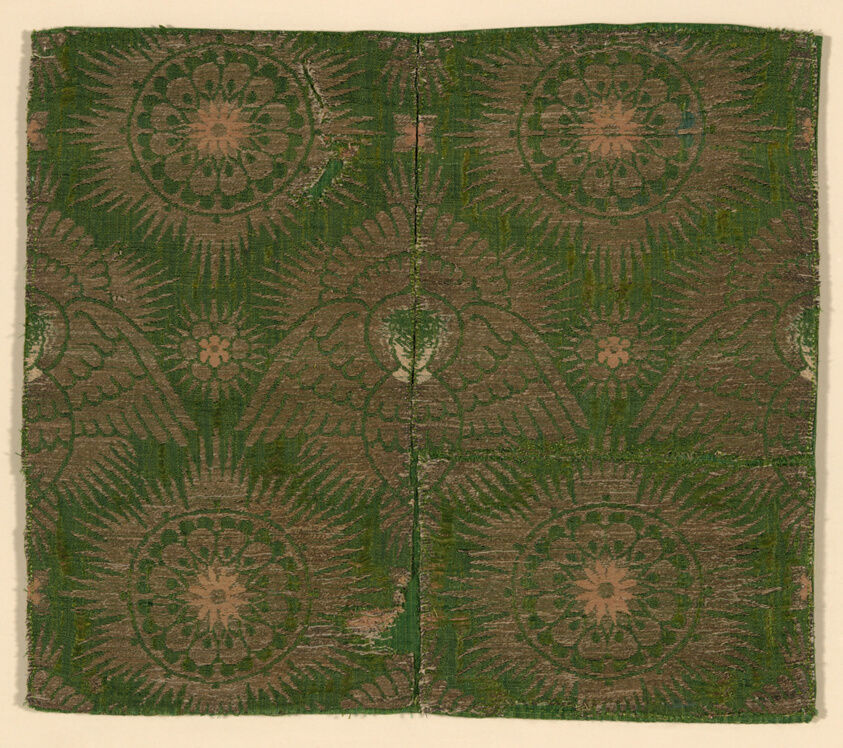
A Fragment: On the Persistence of Excellence
In the considered estimation of this house, true heritage is rarely presented as a complete narrative. It is, rather, encountered in fragments—a whisper of technique, a glimpse of a hand’s movement, a singular, enduring material truth. The artifact under examination, a fragment of silk and gilt-animal-substrate-wrapped linen, presents not as a relic of a finished garment, but as a foundational statement. It is a manifesto in miniature, asserting principles of material integrity, structural intelligence, and fluid elegance that remain the non-negotiable tenets of classic craftsmanship.
Material Provenance: The Foundation of Character
Let us first address the matter of materiality, for here lies the unassailable core of any serious endeavour. The primary substrate is silk, the undisputed sovereign of textile fibres. Its selection is the first and most critical decision, akin to the choice of a bespoke cloth from the limited editions of a Huddersfield mill. This silk possesses a specific gravity and a native lustre that speaks of superior breeding—the result of impeccable sericulture and conscientious throwing. It provides the ground upon which all else is built, offering a surface that accepts dye with profound depth and a handle that promises, even in this static fragment, a sensation of weightless drape.
More esoteric, yet equally significant, is the detail of the gilt-animal-substrate-wrapped linen. This is not mere decoration; it is alchemy. A slender strand of linen, itself a fibre of noble humility and great strength, is meticulously enveloped in a substrate derived from animal membrane, upon which a stratum of gold is applied. The result is a supplementary yarn of immense symbolic and tactile value. The linen provides tensile fortitude, the animal substrate offers adhesion and a pliant bed, the gold confers an immortal radiance. This composite thread is a testament to the pre-industrial pursuit of enhancement through combination—seeking not to disguise the inherent nature of materials, but to elevate them through judicious alliance.
Structural Intelligence: The Architecture of Fluidity
The construction of the fragment reveals a mind of considerable technical ambition. The twill weave is the chosen architecture. Unlike the plain, egalitarian over-under of tabby, twill is a diagonal progression—a subtle, rhythmic ascent that inherently affords greater pliability and a softer, more refined face. It is the weave of cavalry twill and fine gabardine; a structure that implies movement and resilience.
However, the artisan has not been content with a simple twill. The specification notes twill interlacings of secondary binding warps and supplementary patterning wefts. This is where the quiet genius of the piece resides. The primary structure, the body of the cloth, is established. Upon this, a secondary binding warp is introduced—a structural reinforcement, a hidden skeleton ensuring integrity. Then come the supplementary patterning wefts: the gilt-wrapped threads, carried across the surface not as a mere appliqué, but woven into the very matrix of the cloth. They are integral yet distinct, following their own disciplined path across the twill ground to create a pattern—likely a subtle stripe, a crest, or a geometric motif—that is born from the fabric, not imposed upon it.
This is the sartorial equivalent of a Savile Row coat’s internal construction. The luxurious surface—the exquisite silken face—is supported by an unseen, complex armature of canvas, haircloth, and stitch work that gives it form, memory, and longevity. The gilt thread is the pick-stitching on a lapel: decorative, yes, but only because it is first and foremost functional, securing the roll with immutable precision.
Context and Bearing: Fluid Elegance as a Permanent Ideal
The fragment’s stated context is Classic silk craftsmanship and fluid elegance. This is not a mere stylistic note; it is the conclusive argument of the piece. Classic craftsmanship is here evidenced in the relentless pursuit of appropriate materials and the mastery of complex, interlocking techniques. There is no shortcut, no compromise in the interlacement. Each element is given a role suited to its nature, and each role is fulfilled with technical rigour.
The fluid elegance is the inevitable result of this rigour. Elegance is too often misconstrued as mere appearance. True elegance, as understood in the finest ateliers, is a consequence of perfect function. The fluidity is born from the diagonal give of the twill, from the inherent drape of the weighted silk, from the supple strength of the composite gilt thread that moves with the ground cloth, not against it. This fragment, for all its static fragility, captures the principle of kinetic grace. It was designed to fall, to flow, to respond to the human form and its motion with a silent, gleaming compliance.
In conclusion, this fragment stands as a definitive benchmark. It articulates a philosophy where luxury is defined by integrity, where beauty is a by-product of structural truth, and where ornamentation is the celebration of function. It reminds us that in an age of fleeting impressions, the most powerful statement is often a fragment—a perfectly resolved detail that implies, with absolute authority, the character of the whole. It is not a relic of a forgotten past, but a permanent standard, patiently awaiting rediscovery by those who understand that the foundation of enduring style is, and will always be, immutable principles executed with uncompromising craft.