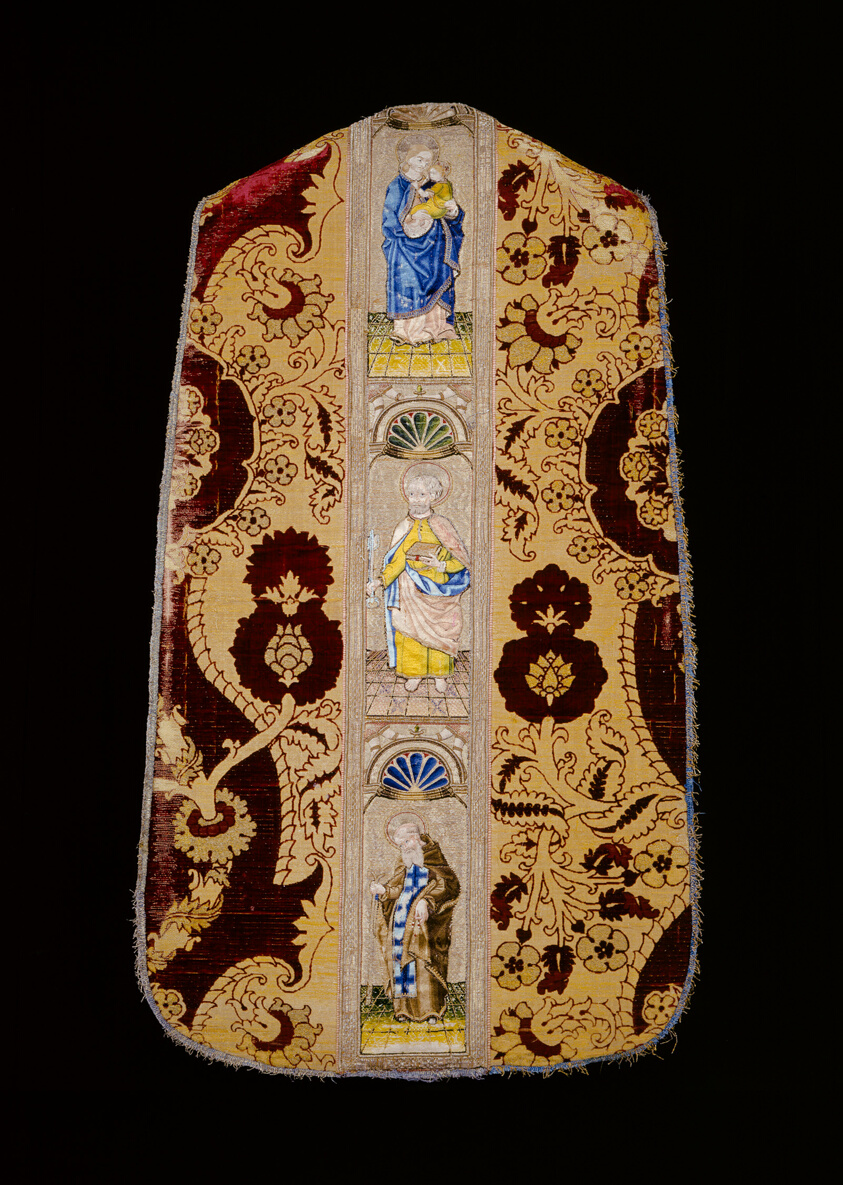
Heritage Artifact Analysis: The Chasuble with Orphrey Band
Introduction: A Confluence of Craft and Devotion
Within the hallowed archives of the Lauren Fashion Heritage Lab, we encounter an artifact of profound material and historical significance: a chasuble adorned with an orphrey band. This garment, a vestment of liturgical purpose, transcends its functional origins to become a testament to the pinnacle of European silk craftsmanship and the fluid elegance that defines the most rarefied textile traditions. As a Senior Heritage Specialist, I approach this piece not merely as a relic of religious ceremony, but as a sophisticated document of material culture, one that speaks to the interplay of technical mastery, aesthetic ambition, and the immutable values of quality that resonate deeply with the ethos of London’s Savile Row. The chasuble’s construction, from its sumptuous voided velvet to its intricately embroidered band, represents a dialogue between the weaver’s loom and the embroiderer’s needle—a dialogue that yields a garment of extraordinary presence and grace.
Materiality: The Silk Foundation
The chasuble itself is a masterclass in textile engineering. Its foundation is a silk, plain weave, a structure that provides both stability and a subtle, unassuming ground. Yet, this is no ordinary silk. The fabric is elevated by silk facing wefts and twill interlacings of secondary binding warps, a technical complexity that introduces a nuanced texture and a play of light across the surface. The true virtuosity, however, lies in the gilt-metal-strip-wrapped silk facing wefts. These wefts, composed of silk threads meticulously wrapped in strips of gilt metal, are not merely decorative; they are structural. They form weft loops on cut and uncut, pile-on-pile voided velvet. This technique, known as ciselé velvet, creates a three-dimensional landscape of lustrous, raised patterns. The contrast between the cut loops, which produce a dense, reflective pile, and the uncut loops, which offer a softer, more diffuse shimmer, generates a dynamic interplay of light and shadow. The voided areas—where the velvet pile is absent—reveal the underlying plain weave, providing a visual and tactile respite. This is not a fabric that simply covers; it is a fabric that performs. The fluid elegance of the chasuble’s drape, its ability to move with the body while maintaining its sculptural form, is a direct result of this sophisticated construction. The silk, with its inherent tensile strength and luster, combined with the weight and flexibility of the metal-wrapped threads, creates a garment that is both opulent and surprisingly wearable.
The Orphrey Band: Embroidered Narrative
Running vertically down the center of the chasuble is the orphrey band, a panel of linen, plain weave, that serves as the canvas for an extraordinary embroidery. The choice of linen is deliberate: its stability and absorbency provide an ideal ground for the dense, intricate stitching. The embroidery employs a lexicon of stitches—fishbone, herringbone, satin, split, and stem stitches—each chosen for its specific textural and visual effect. The laid work and couching techniques, where threads are laid flat and secured with small stitches, create broad areas of color and metallic sheen. The padded couching introduces a subtle relief, giving the figures and motifs a sculptural presence. The materials are as refined as the techniques: silk, linen, and gilt-metal-strip-wrapped silk. The silk threads provide vibrant, saturated hues; the linen offers a matte, grounding contrast; and the gilt metal strips catch the light, echoing the shimmer of the chasuble’s velvet. The band is edged with a woven fringe, a finishing touch that frames the embroidery and adds a final note of precision. This is not mere decoration; it is a narrative woven in thread. The orphrey band transforms the chasuble from a garment of status into a garment of meaning, its iconography—likely depicting saints or biblical scenes—serving as a visual sermon.
Context: The Savile Row Ethos of Craft
To understand this chasuble is to understand the principles that underpin the finest tailoring traditions of London’s Savile Row. The garment embodies a philosophy of material integrity, technical mastery, and enduring elegance. The silk velvet, with its pile-on-pile construction, is a direct analogue to the bespoke suit’s reliance on superlative cloth. Just as a Savile Row cutter selects a woolen cloth for its hand, drape, and longevity, the medieval weaver selected silk and metal threads for their ability to hold a form and reflect light. The orphrey band, with its meticulous embroidery, mirrors the hand-stitching that distinguishes a bespoke garment from its mass-produced counterpart. The fishbone and herringbone stitches, for instance, are not merely decorative; they are structural, providing strength and flexibility. This attention to detail, this refusal to compromise on technique, is the very essence of Savile Row. The chasuble’s fluid elegance—its ability to fall in graceful folds while maintaining its architectural integrity—is a quality that every tailor aspires to achieve. It is a reminder that true luxury is not about ostentation, but about the quiet confidence of impeccable construction.
Conclusion: A Legacy of Thread and Time
This chasuble with orphrey band is more than a historical artifact; it is a masterclass in the art of making. Its materiality—the silk, the gilt metal, the linen, the intricate stitches—tells a story of human ingenuity and aesthetic ambition. It speaks to a time when the creation of a garment was a collaborative act of devotion, involving weavers, embroiderers, and patrons who understood that beauty is a form of reverence. For the Lauren Fashion Heritage Lab, this piece serves as a benchmark of excellence. It reminds us that the principles of craft—the choice of materials, the precision of technique, the pursuit of elegance—are timeless. In the context of Savile Row, where the bespoke suit is a symbol of enduring quality, the chasuble stands as a parallel testament: a garment that, though born of a different purpose, shares the same DNA of meticulous craftsmanship. It is a heritage artifact that continues to teach, inspire, and elevate our understanding of what a garment can be.