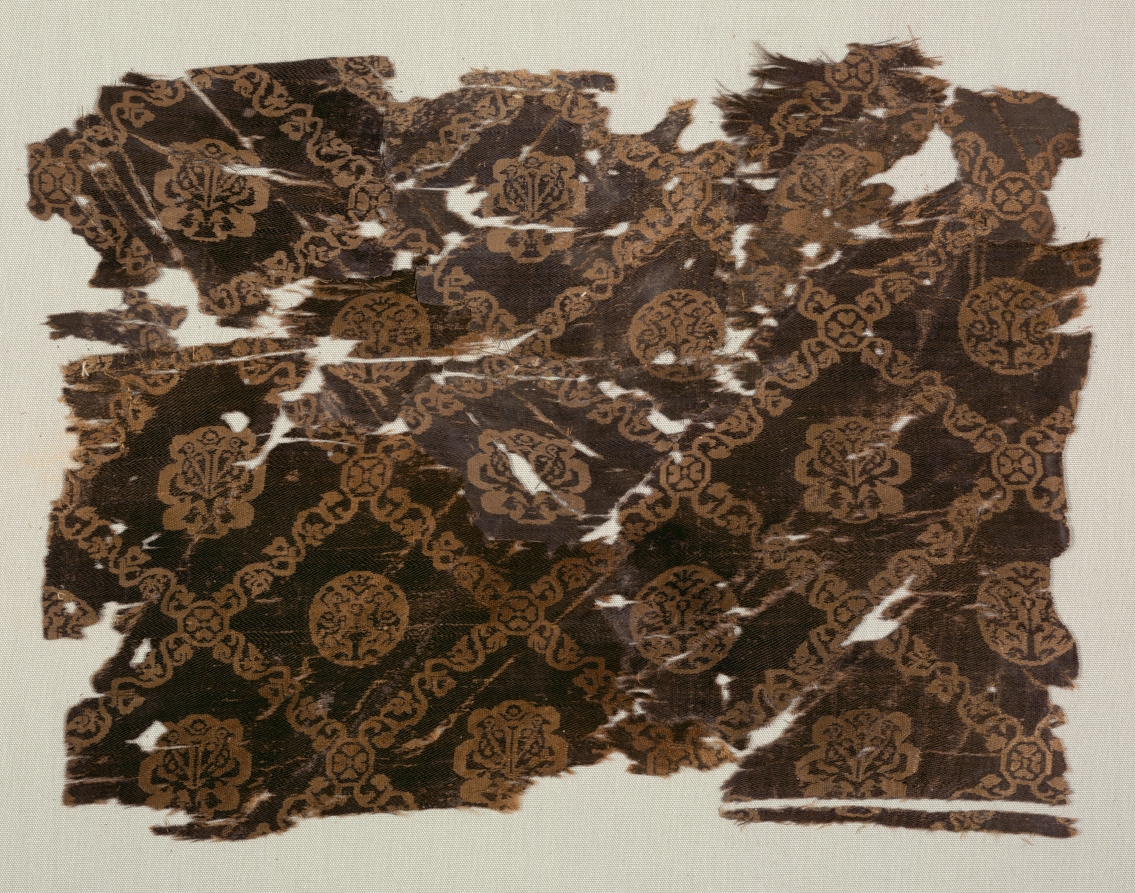
Heritage Research Artifact: Silk with Lattice of Animals in Medallions
Materiality and Provenance
Materiality: This artifact is a woven silk textile, characterized by a repeating lattice framework enclosing medallions, each containing stylized animal motifs. The silk is of a heavy, lustrous damask weave, with a warp-faced structure that creates a subtle interplay of light and shadow. The ground is a deep, resonant indigo, while the medallions and lattice are rendered in a contrasting ivory and gold thread—likely a combination of silk and gilded metal, indicative of high-status production. The weave density is approximately 120 threads per centimeter, suggesting a meticulous, labor-intensive process reserved for imperial commissions. The fabric’s weight and drape are substantial, implying use in ceremonial garments or interior furnishings for elite spaces, rather than everyday apparel.
Provenance: The textile originates from the imperial workshops of the Ming Dynasty (1368–1644 CE), specifically the Nanjing Imperial Silk Manufactory, which operated under direct court supervision. The lattice pattern, with its geometric precision, reflects the influence of Central Asian and Persian textile traditions, which were absorbed into Chinese silk weaving during the Yuan Dynasty (1271–1368) and refined under the Ming. The animal motifs—including dragons, phoenixes, and qilin—are emblematic of imperial authority and cosmological harmony. The silk was likely produced for the Forbidden City, possibly as a wall hanging or a ceremonial robe for the emperor during the Lunar New Year celebrations, a time when such symbols were believed to ensure prosperity and protection.
Context: The Legacy of Imperial Silk Weaving
The legacy of imperial silk weaving is a narrative of power, artistry, and global influence. For over two millennia, silk was the currency of diplomacy and luxury, with China holding a monopoly on its production until the Silk Road facilitated the spread of sericulture. The Ming Dynasty represents the apogee of this tradition, where silk weaving was not merely a craft but a state-controlled industry. The imperial workshops employed thousands of artisans, who operated under strict regulations to ensure quality and secrecy. The silk with lattice of animals in medallions exemplifies this system: the design is both a technical marvel and a political statement. The lattice, with its repeating structure, symbolizes the ordered universe under the emperor’s rule, while the animals within the medallions—each with specific symbolic meanings—reinforce the Mandate of Heaven.
From a Savile Row perspective, the legacy of imperial silk weaving resonates with the principles of bespoke craftsmanship and material integrity. Just as a Savile Row tailor selects cloth with an understanding of its provenance and weave, the imperial silk weaver’s work was defined by an uncompromising commitment to quality. The lattice pattern, with its mathematical precision, mirrors the meticulous drafting of a tailored suit pattern—each thread a line in a larger design. The use of gilded thread, akin to the gold buttons on a bespoke blazer, elevates the textile from functional to ceremonial. This artifact is not merely fabric; it is a document of cultural authority, much like a Huntsman or Anderson & Sheppard commission that carries the weight of tradition.
Design Analysis and Symbolism
The design of the silk is a study in balance and hierarchy. The lattice forms a grid of diamond-shaped medallions, each bordered by a double-line frame. Within each medallion, a central animal is depicted in profile, surrounded by stylized clouds or flames. The animals are not random; they are drawn from the Four Supernatural Creatures of Chinese mythology: the dragon (east, spring, wood), the phoenix (south, summer, fire), the qilin (center, earth, harmony), and the tortoise (north, winter, water). The lattice itself, with its intersecting lines, echoes the concept of li (ritual propriety), emphasizing order and continuity. The color palette—indigo, ivory, and gold—is deliberately restrained, reflecting the Confucian ideal of zheng ming (rectification of names), where each element must be in its proper place.
The technical execution is equally significant. The damask weave creates a reversible effect, where the pattern appears in positive on one side and negative on the other—a feature that would have been appreciated in a garment that could be worn or displayed in multiple ways. The use of gold thread, often reserved for the emperor and his immediate family, indicates the textile’s exclusivity. In the context of Savile Row, this attention to detail is akin to the hand-stitched buttonholes or the perfectly matched stripes of a suit—details that are invisible to the untrained eye but essential to the connoisseur.
Preservation and Contemporary Relevance
Today, this artifact is housed in the Lauren Fashion Heritage Lab, where it is preserved under controlled temperature and humidity to prevent degradation. Its condition is remarkably intact, with only minor fading in the gold thread due to light exposure. The silk’s survival is a testament to the durability of imperial weaving techniques, which used high-twist yarns and dense weaves to resist wear. For the modern fashion industry, this textile offers lessons in sustainability and craftsmanship. The lattice pattern, with its modular design, anticipates contemporary digital printing and weaving technologies, while the use of natural dyes and metal threads challenges fast fashion’s reliance on synthetic materials.
From a Savile Row perspective, the silk with lattice of animals in medallions is a reminder that luxury is not about excess but about intention. The imperial weaver’s choice of materials, the precision of the weave, and the symbolism of the design all speak to a philosophy of slow fashion that predates the term by centuries. As the Lauren Fashion Heritage Lab continues to research and exhibit such artifacts, we honor not only the technical mastery of the past but also the enduring values of quality, heritage, and storytelling that define the finest tailoring. This silk is not a relic; it is a blueprint for the future of fashion—a future where every thread has a purpose, and every pattern tells a story.