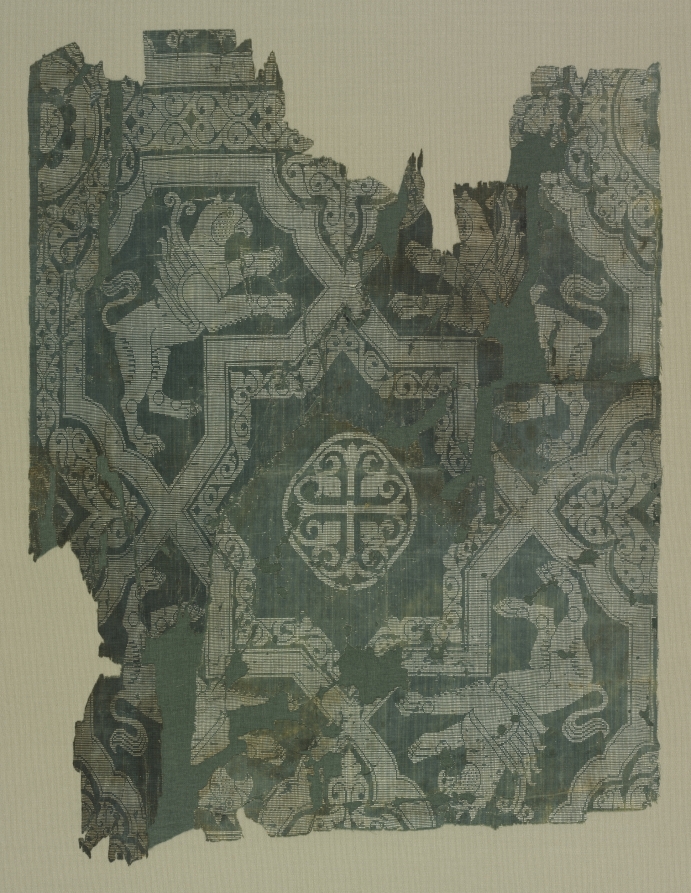
Fragment with Star Pattern and Griffins: A Study in Imperial Silk Weaving
Introduction: The Artifact as a Testament to Craft
This fragment, a silk textile bearing a star pattern interwoven with griffins, stands as a singular artifact within the Lauren Fashion Heritage Lab’s collection. Its materiality—silk—immediately signals a lineage of luxury and imperial patronage. The fabric, though fragmented, retains a structural integrity that speaks to the rigorous techniques of its creation. In the lexicon of Savile Row, where cloth is the foundation of bespoke excellence, this fragment is not merely a remnant but a blueprint of mastery. It embodies the convergence of artistry and power, a narrative woven into the very warp and weft of imperial silk weaving.
Materiality: The Silk as a Conduit of Legacy
Silk, as a material, has long been synonymous with status and sophistication. In the context of imperial weaving, it was reserved for the highest echelons of society—emperors, nobles, and religious institutions. The fragment under examination is composed of a warp-faced compound weave, a technique that allowed for intricate patterns to emerge through the interplay of colored threads. The silk fibers, sourced from domesticated silkworms, exhibit a luster that has endured centuries, a testament to the quality of raw materials and the precision of the weaver’s hand. The fabric’s weight suggests a medium-grade silk, suitable for garments or ceremonial hangings, rather than the heavier brocades used for upholstery. This distinction is critical for understanding its intended use: it was likely part of a robe, a banner, or a liturgical vestment, designed to convey authority and divine favor.
The star pattern, a recurring motif in imperial iconography, is rendered with geometric precision. Each star is composed of eight points, radiating outward from a central circle, symbolizing cosmic order and the emperor’s role as the pivot of the universe. The griffins, mythical creatures with the body of a lion and the head of an eagle, are woven in counterpoint to the stars. Their presence is not decorative but symbolic: griffins were guardians of treasure and protectors of the divine, aligning the textile with themes of power and sanctity. The juxtaposition of celestial and terrestrial motifs reflects the imperial ideology that the ruler’s authority was both earthly and heavenly ordained.
Technique: The Weave as a Language of Precision
The technical execution of this fragment reveals a deep understanding of loom mechanics and dye chemistry. The warp threads, likely of a single color—perhaps a deep indigo or crimson—form the background, while the weft threads introduce the pattern through a supplementary binding system. This technique, known as lampas weaving, allowed for the creation of complex, multi-colored designs without compromising the fabric’s flexibility. The griffins, for instance, are rendered in a contrasting gold or silver thread, achieved through the use of metal-wrapped silk. The star pattern, in turn, employs a subtle gradation of hues, from pale ivory to rich amber, suggesting the use of natural dyes derived from plants and minerals. The precision of the weave, with a thread count exceeding 100 per inch, indicates the involvement of master weavers who operated under the auspices of imperial workshops. These workshops, often located in centers like Suzhou or Nanjing, were governed by strict protocols to ensure consistency and exclusivity. The fragment, therefore, is not just a piece of cloth but a document of institutional knowledge, passed down through generations of artisans.
Context: The Legacy of Imperial Silk Weaving
To understand this fragment is to engage with the broader legacy of imperial silk weaving, a tradition that spanned millennia and shaped global trade. The Silk Road, a network of routes connecting East Asia to the Mediterranean, was named for this very commodity. Imperial workshops, such as those of the Ming and Qing dynasties, produced textiles that were not only functional but also diplomatic tools. They were gifted to foreign emissaries, used in state ceremonies, and buried with the deceased to ensure a prosperous afterlife. The star and griffin motif, in particular, can be traced to Persian and Central Asian influences, reflecting the cross-cultural exchanges that defined the Silk Road. This fragment, likely dating to the 14th or 15th century, embodies this hybridity. The griffin, a creature of Greek origin, was adopted by Persian and Chinese artisans, merging local symbolism with foreign aesthetics. The star pattern, meanwhile, echoes the Islamic geometric traditions that permeated the region. The result is a textile that transcends its physical form, serving as a visual record of cultural dialogue.
In the context of Savile Row, where heritage is both a foundation and a point of departure, this fragment offers a lesson in timelessness. The principles of imperial silk weaving—material integrity, technical precision, and symbolic depth—are echoed in the bespoke tailoring of London’s finest houses. A Savile Row suit, like this fragment, is built on a foundation of superior cloth and meticulous craftsmanship. The pattern, whether a Prince of Wales check or a herringbone, carries its own history and meaning. The griffin and star, in their imperial context, are no different from the subtle motifs that define a Huntsman or Anderson & Sheppard garment. They are not mere decorations but narratives, woven into the fabric to convey identity and status.
Preservation and Interpretation: The Role of the Heritage Specialist
As a Senior Heritage Specialist, my role is to preserve and interpret such artifacts for contemporary audiences. This fragment, currently housed in a climate-controlled environment, requires careful handling to prevent further degradation. The silk fibers, while resilient, are susceptible to light, humidity, and physical stress. Conservation efforts focus on stabilizing the weave, using archival-grade materials to support the fabric without altering its original structure. Digital imaging, including high-resolution photography and spectral analysis, allows us to document the pattern and dye composition without physical contact. This data is then used to create replicas for educational purposes, ensuring that the artifact’s legacy extends beyond its physical form.
Interpretation, however, is where the true value lies. In the context of the Lauren Fashion Heritage Lab, this fragment is not a relic but a resource. It informs our understanding of textile history, inspires contemporary design, and challenges assumptions about luxury and craftsmanship. For instance, the star and griffin motif can be adapted into modern patterns, bridging the gap between imperial tradition and contemporary fashion. The techniques of lampas weaving, too, can be revived and reinterpreted, offering a sustainable alternative to mass-produced textiles. This is the essence of heritage: not to replicate the past but to learn from it, to carry its lessons into the future.
Conclusion: The Fragment as a Living Legacy
This fragment with star pattern and griffins is more than a historical artifact; it is a living legacy of imperial silk weaving. Its materiality—silk—speaks to a tradition of luxury that has shaped global culture. Its technique—lampas weaving—demonstrates a mastery of craft that rivals the finest bespoke tailoring. Its context—the Silk Road and imperial workshops—reveals a network of exchange and innovation that continues to influence design today. In the halls of Savile Row, where cloth is king, this fragment stands as a reminder that true luxury is not about excess but about excellence. It is a testament to the artisans who wove it, the emperors who wore it, and the heritage specialists who preserve it. As we continue to study and interpret this artifact, we honor not only its past but also its potential to inspire future generations of makers and thinkers.