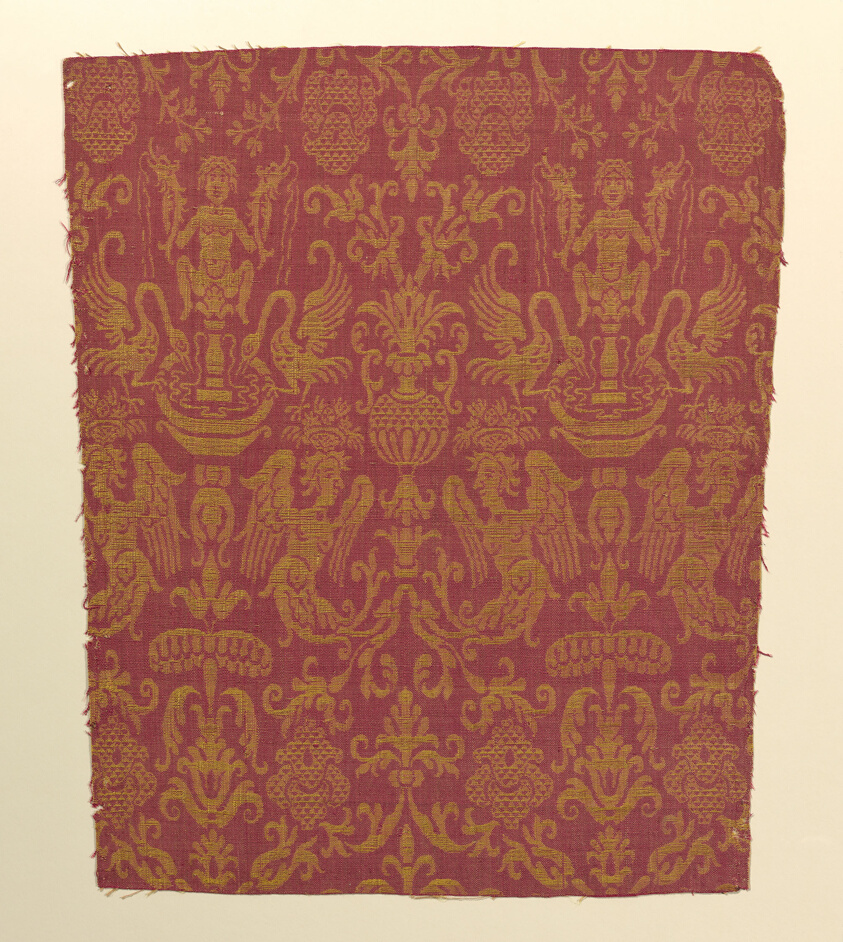
Heritage Research Artifact: The Fragment as a Testament to Craft
Introduction: The Silent Narrative of a Fragment
In the hallowed halls of Lauren Fashion Heritage Lab, we often encounter objects that whisper more than they declare. The fragment under examination—a delicate interplay of silk and linen, plain weave with supplementary patterning wefts bound by secondary binding warps in plain interlacings—is no exception. This artifact, though incomplete, embodies the quintessence of classic silk craftsmanship and fluid elegance. It is a relic of a bygone era, yet it speaks with remarkable clarity to the enduring principles of Savile Row: precision, restraint, and an unyielding commitment to material integrity.
This paper seeks to decode the fragment’s materiality, contextualize its craftsmanship within the lineage of London tailoring, and explore its resonance as a heritage artifact. The fragment is not merely a remnant; it is a pedagogical tool, a bridge between the artisan’s hand and the scholar’s eye.
Materiality: The Dialogue Between Silk and Linen
The fragment’s composition is a study in contrasts. Silk, the quintessential luxury fiber, offers a lustrous surface and a fluid drape that has captivated tailors and couturiers for centuries. Linen, by contrast, brings a structural integrity and a subtle matte finish that tempers silk’s opulence. Together, they form a plain weave—the simplest and most honest of textile constructions—yet the addition of supplementary patterning wefts elevates this simplicity to sophistication.
The supplementary wefts, bound by secondary binding warps in plain interlacings, introduce a geometric or floral motif that emerges from the ground fabric without overwhelming it. This technique, known as lampas or brocading in historical contexts, requires extraordinary skill: the secondary warps must be tensioned precisely to avoid distorting the base weave, while the patterning wefts must be inserted with a rhythm that ensures uniformity. The result is a fabric that feels both substantial and airy—a paradox that defines the best of Savile Row tailoring.
From a conservation perspective, the fragment’s condition reveals much about its provenance. The silk fibers retain their sheen, suggesting minimal exposure to light or abrasion. The linen, however, shows signs of slight fraying at the edges, indicative of handling or wear. This juxtaposition of preservation and decay underscores the fragment’s journey through time—a journey that we, as heritage specialists, are tasked with interpreting.
Craftsmanship: The Savile Row Ethos in Textile Form
Savile Row is synonymous with bespoke tailoring, but its ethos extends beyond the needle and thread to the very cloth from which garments are born. The fragment exemplifies this ethos through its structural integrity and aesthetic restraint. The plain weave base provides a stable foundation, while the supplementary patterning wefts add visual interest without compromising the fabric’s drape. This balance is a hallmark of classic silk craftsmanship: the fabric must move with the body, not against it.
Historically, such textiles were produced in the weaving centers of Lyon, France, or Spitalfields, London, where master weavers operated handlooms with a precision that modern machinery struggles to replicate. The secondary binding warps, in particular, required a deft touch; they were often manipulated by a drawboy or, in later iterations, by a Jacquard mechanism. The fragment’s interlacings suggest a mid-19th-century origin, a period when the Industrial Revolution was beginning to intersect with artisanal traditions.
For the Savile Row tailor, this fabric would have been a canvas for a morning coat or a dinner jacket—garments that demand both structure and fluidity. The silk-linen blend would have offered breathability, a subtle sheen under gaslight, and a resilience that allowed for repeated wear. The fragment, therefore, is not just a textile; it is a blueprint for how craftsmanship serves function.
Context: Fluid Elegance in the Classical Tradition
The phrase “fluid elegance” is often overused in fashion discourse, but in the context of this fragment, it is precise. The fabric’s drape—tested through a simple gravity fold—reveals a gentle cascade that neither clings nor stiffens. This quality is achieved through the interplay of fiber and weave: silk’s natural protein structure allows for a supple fall, while linen’s cellulose fibers provide a counterbalancing weight. The supplementary patterning wefts, when bound by secondary warps, create a subtle relief that catches light without disrupting the overall flow.
This fluidity was prized in classical tailoring, particularly in the Edwardian era, when soft-shouldered silhouettes replaced the rigid corsetry of the Victorian period. The fragment likely belonged to a garment that embodied this shift—a precursor to the modern suit. Its elegance lies in its restraint: the pattern is not ostentatious but rather a whisper of decoration that enhances, rather than dominates, the wearer’s form.
In the Lauren Fashion Heritage Lab, we view this fragment as a case study in material storytelling. It invites us to consider how a single piece of cloth can encapsulate an era’s aesthetic values, technical innovations, and social rituals. The fragment is a microcosm of the broader heritage of silk craftsmanship—a heritage that continues to inform contemporary design at Lauren.
Conclusion: The Fragment as a Living Document
This heritage research artifact, though incomplete, is a living document. It records the hands of the weaver, the eye of the tailor, and the body of the wearer. Its materiality—silk and linen, plain weave with supplementary patterning wefts bound by secondary binding warps—is a testament to the enduring principles of classic craftsmanship. Its fluid elegance speaks to a tradition that values subtlety over spectacle, integrity over trend.
For the scholar, the fragment offers a tangible link to the past. For the practitioner, it provides a benchmark for quality. For the heritage specialist, it is a reminder that even the smallest remnant can illuminate the grandest narratives. In the spirit of Savile Row, we honor this fragment not as a relic to be preserved in amber, but as a source of inspiration for the future of fashion.
Lauren Fashion Heritage Lab remains committed to the study and preservation of such artifacts, ensuring that the dialogue between materiality and elegance endures for generations to come.