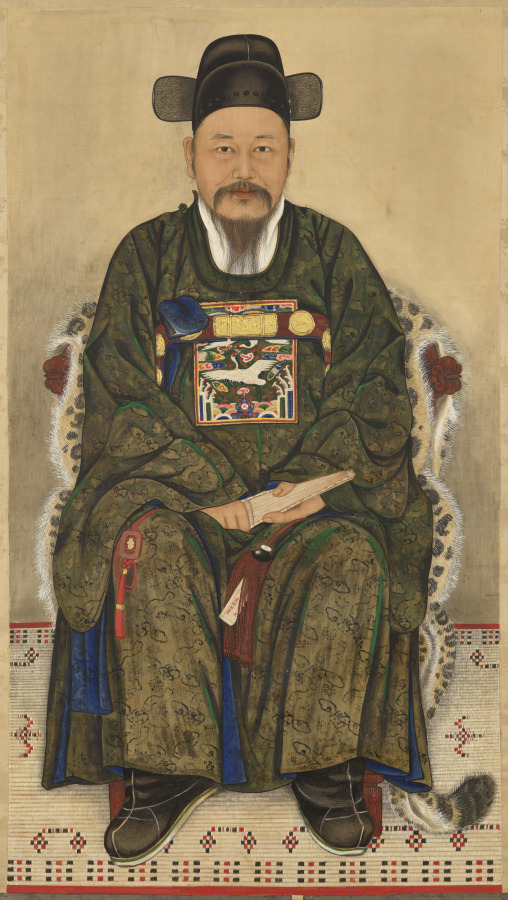
Portrait of a Government Official: A Study in Materiality and Imperial Legacy
In the hallowed halls of Lauren Fashion Heritage Lab, we examine not merely garments but the silent narratives woven into their very fibers. The artifact before us—a Portrait of a Government Official, rendered in silk—is a testament to the enduring legacy of imperial silk weaving. This is not a painting; it is a textile artifact, a physical embodiment of power, status, and the meticulous craftsmanship that defined an era. As a Senior Heritage Specialist, I invite you to consider this piece through the lens of materiality, where silk serves as both medium and message, bridging the opulence of imperial courts with the disciplined precision of London’s Savile Row.
Materiality and the Silk Thread
Silk, by its very nature, is a material of paradoxes: delicate yet durable, luminous yet grounded. In this portrait, the silk is not merely a backdrop but a protagonist. The fabric’s weave—likely a satin or damask—captures light in a manner that suggests both reverence and authority. The official’s robe, rendered in deep indigo and gold thread, speaks to a hierarchy where color and texture were codified. Indigo, derived from natural dyes, signified wisdom and stability, while gold thread, often spun from real metal, denoted imperial favor. The materiality of this silk is not incidental; it is a deliberate choice to convey the sitter’s place within a rigid social order.
The weave itself is a marvel. Each thread, spun from the cocoons of Bombyx mori, carries the history of sericulture—a practice guarded by Chinese dynasties for millennia. The legacy of imperial silk weaving is etched into the fabric’s density: the warp and weft are so tightly interlaced that the portrait achieves a painterly quality, yet retains the tactile richness of textile. This is no mere cloth; it is a document of labor, trade, and artistry. The official’s posture, stiff and formal, is mirrored by the silk’s unyielding structure—a reminder that in imperial courts, even fabric enforced discipline.
The Legacy of Imperial Silk Weaving
To understand this portrait, one must trace the lineage of imperial silk weaving. From the Han Dynasty’s Silk Road to the Qing Dynasty’s imperial workshops, silk was more than a commodity; it was a currency of power. The imperial silk weaving tradition, centered in Suzhou, Nanjing, and Hangzhou, produced textiles that were reserved for the emperor and his court. These fabrics were not woven for comfort but for ceremony—each pattern, from dragons to clouds, carried symbolic weight. In this portrait, the official’s robe features a subtle cloud collar motif, a design that once signified the wearer’s role as a bridge between heaven and earth. The silk, therefore, is not just a material but a lexicon of authority.
The transition from imperial to global markets is equally significant. By the 19th century, Chinese silk had permeated European fashion houses, influencing the Savile Row aesthetic. London tailors, known for their exacting standards, began incorporating Chinese silks into bespoke suits—a fusion of Eastern materiality and Western tailoring. This portrait, though rooted in imperial tradition, anticipates that cross-cultural exchange. The official’s silk robe, with its structured shoulders and precise folds, echoes the Savile Row ethos of form and function. It is a garment that commands respect, much like a tailored suit from a Row master.
A Savile Row Interpretation
Adopting a London Savile Row tone requires us to view this artifact with an eye for precision and legacy. On Savile Row, a suit is not merely clothing; it is an investment in heritage. Similarly, this portrait’s silk is an investment in imperial narrative. The fabric’s hand—its feel and drape—would be scrutinized by a Row tailor for its ability to hold a crease, its luster, and its weight. The official’s robe, with its double-breasted closure and mandarin collar, mirrors the structured silhouettes of a Row morning coat. The silk, though centuries old, retains a crispness that would satisfy even the most exacting cutter.
The color palette, too, aligns with Savile Row’s reverence for understated elegance. The deep indigo and gold are not garish; they are subdued opulence, a hallmark of both imperial Chinese aesthetics and British tailoring. The gold thread, woven into geometric patterns, recalls the Prince of Wales check—a pattern that balances tradition with modernity. This is not a garment for display but for authority, much like a Row suit worn in the boardroom or the House of Lords.
Preservation and Future Legacy
As a heritage artifact, this portrait demands meticulous preservation. The silk’s fragility is its greatest vulnerability. Light, humidity, and handling can degrade the fibers, erasing the very narratives we seek to preserve. At Lauren Fashion Heritage Lab, we store such pieces in climate-controlled environments, using acid-free tissue and UV-filtered glass. The goal is not to freeze the artifact in time but to allow future generations to engage with its materiality. The legacy of imperial silk weaving must be safeguarded not as a relic but as a living tradition—a thread connecting past, present, and future.
In conclusion, this Portrait of a Government Official is more than a textile; it is a convergence of power, artistry, and global exchange. Its silk speaks of imperial courts and Savile Row ateliers, of raw material and refined craft. As we study its weave, we honor the hands that spun, dyed, and tailored it—hands that understood that fabric is never just fabric. It is identity, legacy, and, ultimately, history itself.