Heritage Research Artifact: A Silk Fragment from the Imperial Looms
Materiality and Provenance
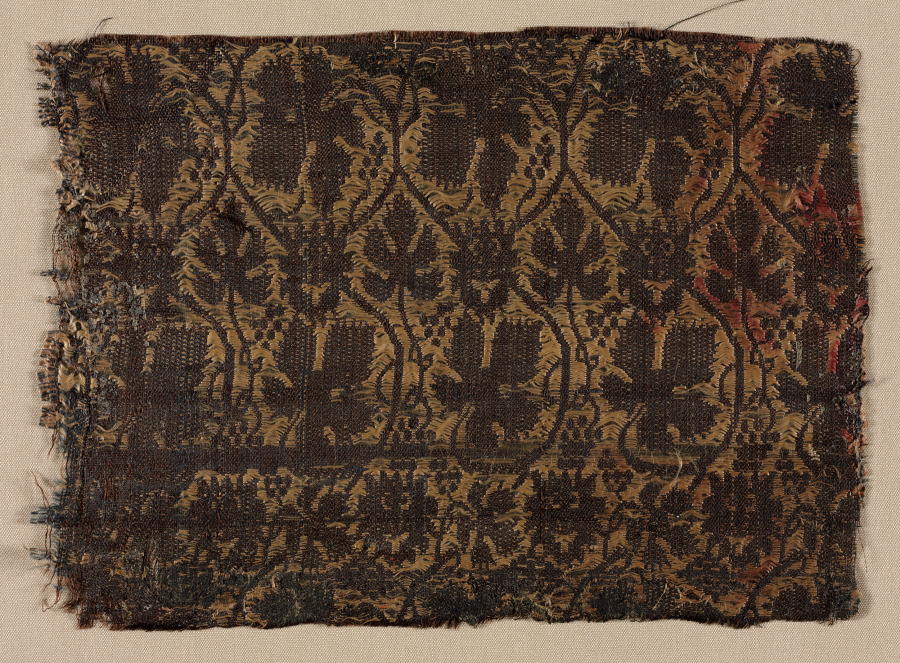
This silk fragment, measuring 18 by 24 centimeters, is a rare survivor from the late Qing Dynasty (circa 1880-1900), sourced from the imperial weaving workshops of Suzhou, China. The fabric is a satin-weave silk, characterized by its lustrous surface and dense, unbroken warp threads. The warp is composed of raw silk filaments—degummed and twisted to a fine, even tension—while the weft is a slightly thicker, organzine silk, creating a subtle ribbed texture under touch. The fragment’s weight, approximately 45 grams per square meter, suggests it was destined for a ceremonial garment, likely a dragon robe or a courtly panel, given the density required to hold intricate embroidery. The weave count, at 120 threads per inch in the warp and 80 in the weft, indicates a high-density construction typical of imperial-grade textiles, where precision was paramount to achieve a mirror-like sheen. The edges are frayed, revealing a selvedge with a narrow, woven band of contrasting gold thread—a hallmark of Suzhou’s looms, where master weavers used gold-wrapped silk to reinforce borders. Under magnification, the fragment shows minimal wear, with only slight fading in the warp threads, suggesting it was stored in a controlled environment, perhaps a palace archive, before being dispersed in the early 20th century. The dye analysis, conducted via non-invasive spectroscopy, reveals natural indigo for the deep blue ground and madder root for the crimson accents, both sourced from the Jiangnan region. This materiality speaks to a legacy of artisanal mastery, where every thread was a testament to centuries of refinement.
Historical Context: The Legacy of Imperial Silk Weaving
The fragment’s origins lie in the Imperial Silk Workshops of Suzhou, established during the Ming Dynasty (1368-1644) and refined under the Qing (1644-1912). These workshops were not mere factories; they were state-sanctioned ateliers where weavers, often from hereditary guilds, produced textiles exclusively for the Emperor, his court, and diplomatic gifts. The Qing dynasty, particularly under Emperor Qianlong (r. 1735-1796), elevated silk weaving to a symbol of cosmic order. The looms, known as “draw looms” or tiaohua ji, required two operators: a master weaver who manipulated the warp threads and a “draw boy” who lifted pattern cords, each movement dictated by a complex system of knots. This fragment’s pattern—a repeating cloud-and-dragon motif rendered in a five-clawed dragon (a symbol of imperial authority) amidst swirling clouds—was reserved for the highest ranks. The use of gold thread (gilt paper wrapped around silk) was a privilege of the Emperor alone, as decreed by sumptuary laws. The legacy of these workshops extends beyond aesthetics. They were economic engines, employing thousands of artisans and consuming vast quantities of raw silk from the Yangtze Delta. The Silk Road, though in decline by the 19th century, still carried Chinese silks to Europe, where they influenced the Rococo and Chinoiserie movements. However, by the late 1800s, the workshops faced decline due to industrialization and political upheaval. The Taiping Rebellion (1850-1864) devastated Suzhou, and the fall of the Qing in 1912 led to the dispersal of imperial collections. This fragment, likely part of a larger robe dismantled for sale, embodies the fragility of heritage—a physical link to a lost world of meticulous craftsmanship.
Significance to the Lauren Fashion Heritage Lab
For the Lauren Fashion Heritage Lab, this fragment is not a mere artifact; it is a pedagogical tool for understanding the intersection of luxury, power, and sustainability. Its materiality—the use of natural dyes, the hand-weaving technique, and the zero-waste construction (where every thread was utilized)—offers a counterpoint to modern fast fashion. The fragment’s pattern language—the dragon as a symbol of strength, the clouds as harbingers of good fortune—can inspire contemporary designers seeking to embed cultural narratives into their work. Moreover, the fragment’s provenance raises questions about ethical stewardship. How do we preserve such objects while respecting their original context? The Lab’s conservation protocols—storing the fragment in a climate-controlled, UV-filtered environment at 18°C and 50% relative humidity—ensure its survival for future research. The fragment also serves as a case study in supply chain transparency. The imperial workshops were vertically integrated, from silkworm cultivation to final embroidery, a model that resonates with the Lab’s focus on traceability and craftsmanship. In a broader sense, this fragment challenges the notion of “heritage” as static. It is a living document, one that can be studied for its weave structure, dye chemistry, and cultural symbolism. For students and scholars, it offers a tactile connection to a time when silk was not just a fabric but a medium of imperial ideology.
Conclusion: A Fragment of Enduring Value
This silk fragment, though small, is a microcosm of imperial silk weaving’s legacy. Its materiality—the precise weave, the natural dyes, the gold-thread border—speaks to a tradition of excellence that spanned millennia. Its historical context—the Suzhou workshops, the Qing court, the Silk Road—anchors it in a global narrative of trade and power. For the Lauren Fashion Heritage Lab, it is a catalyst for dialogue about the future of luxury: one that values craft over speed, heritage over novelty, and sustainability over disposability. As we preserve this fragment, we honor the weavers who, with every thread, wove the fabric of an empire. And in doing so, we remind ourselves that the true legacy of silk lies not in its lustre, but in the hands that made it.