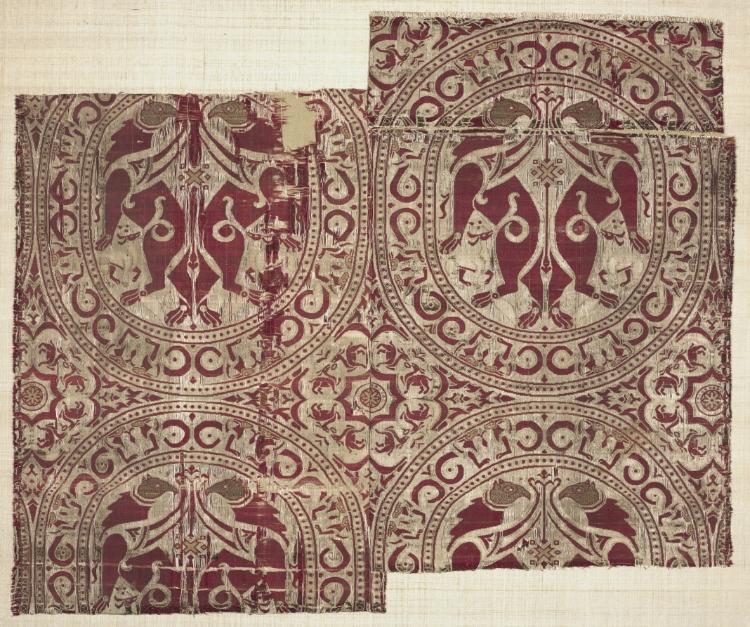
The Lampas with Griffins in Roundels: A Study in Materiality and Imperial Legacy
In the hallowed archives of textile history, few artifacts command the reverence and analytical depth as the Lampas with Griffins in Roundels, preserved within the Reliquary of Saint Librada at Siguenza Cathedral. As a Senior Heritage Specialist at the Lauren Fashion Heritage Lab, I approach this piece not merely as a relic of ecclesiastical devotion, but as a profound testament to the enduring legacy of imperial silk weaving—a legacy that informs the very fabric of luxury and craftsmanship we uphold today. This silk lampas, dating from the 12th to 13th centuries, embodies a confluence of material mastery, cultural transmission, and symbolic power that resonates with the precision and exclusivity of a Savile Row commission.
Materiality: The Silk Thread as a Conduit of Empire
The materiality of this lampas is its first and most compelling narrative. Silk, in the medieval world, was not a mere textile; it was a currency of empire, a marker of sovereignty, and a medium of artistic exchange. The silk used in this lampas originates from the Byzantine and Islamic weaving traditions, where sericulture was a closely guarded imperial monopoly. The fibers themselves—lustrous, resilient, and capable of absorbing the most vibrant dyes—were imported along the Silk Road, a network that connected the courts of Constantinople, Baghdad, and Al-Andalus. For the reliquary of Saint Librada, a patron saint of Siguenza, the choice of silk was deliberate: it elevated the sacred object from the mundane to the transcendent, wrapping the relics in a material that mirrored the heavenly light and earthly power of the Church.
The weave structure—a lampas—is a sophisticated compound weave that combines a ground fabric with a pattern weft, allowing for intricate, multicolored designs. In this artifact, the ground is a rich, deep crimson, likely derived from kermes or cochineal, while the griffins and roundels are rendered in gold and silver-gilt threads. The technical precision required to produce such a fabric was immense, demanding specialized looms and skilled artisans who were often part of imperial workshops. This level of craftsmanship aligns with the Savile Row ethos: a commitment to bespoke excellence, where every thread is placed with intention, and the final product is a harmonious balance of form and function.
Iconography: The Griffin as a Symbol of Imperial and Sacred Authority
The griffins in roundels are the focal point of the design, and their iconography is a rich tapestry of meaning. The griffin—a mythical creature with the body of a lion and the head and wings of an eagle—was a potent symbol in both Byzantine and Islamic art. In the Byzantine context, the griffin represented divine power and protection, often guarding sacred spaces or imperial regalia. In Islamic art, it symbolized strength and vigilance, frequently appearing on textiles and metalwork for caliphal courts. The roundels, or medallions, that frame the griffins are a hallmark of Sassanian and later Islamic design, where they served as a motif of cosmic order and eternal recurrence. For the reliquary of Saint Librada, this iconography was repurposed: the griffins became guardians of the saint’s relics, their fierce yet noble forms warding off evil and asserting the sanctity of the Church.
The repetition of the griffin roundels across the fabric creates a rhythmic pattern that is both decorative and symbolic. This repetition echoes the liturgical cycles of the Church, where the eternal is made manifest through ritual repetition. The gold threads, which catch the light in a cathedral’s candlelit interior, would have evoked the divine radiance of heaven, transforming the reliquary into a microcosm of the celestial Jerusalem. For the modern observer, this pattern speaks to the timeless appeal of structured, repeat motifs—a principle that informs the design of tailored suits, where lapels, pockets, and stripes create a visual rhythm that is both elegant and authoritative.
Context: The Legacy of Imperial Silk Weaving
The context of this lampas is inseparable from the legacy of imperial silk weaving, a tradition that spanned continents and centuries. The Byzantine Empire, with its state-run silk workshops in Constantinople, set the standard for luxury textiles, producing silks that were gifted to foreign rulers and used in the highest ecclesiastical ceremonies. After the fall of Constantinople in 1204, the knowledge and techniques of silk weaving migrated westward, finding fertile ground in Islamic Spain, particularly in Al-Andalus. The taifa kingdoms and later the Nasrid dynasty of Granada became centers of silk production, where weavers synthesized Byzantine, Persian, and Arab motifs into a distinct Hispano-Islamic style. The Lampas with Griffins in Roundels is a product of this synthesis: its griffins bear the stylized features of Islamic art, while the roundels and color palette reflect Byzantine influences.
This legacy is not merely historical; it is a living tradition that informs the luxury textile industry today. The silk mills of Como, the ateliers of Lyon, and the bespoke fabric houses of London’s Savile Row all trace their lineage to these imperial workshops. The principles of quality, exclusivity, and artistic integrity that defined Byzantine and Islamic silk weaving are the same principles that guide the creation of a Huntsman or Anderson & Sheppard suit. The lampas, with its compound weave and metallic threads, is a direct ancestor of the brocades and damasks used in high-end tailoring, where fabric is not just a covering but a statement of identity and status.
Preservation and Interpretation: A Heritage Artifact for the Modern Era
As a heritage artifact, the Lampas with Griffins in Roundels presents unique challenges and opportunities for preservation. The silk fibers, while durable, are susceptible to light, humidity, and handling. The metallic threads, often made of silver-gilt over silk, can tarnish and become brittle. At the Lauren Fashion Heritage Lab, we employ a multidisciplinary approach to conservation, combining textile science with art historical analysis. This includes non-invasive imaging techniques, such as multispectral photography, to reveal faded patterns and dye compositions, as well as climate-controlled storage to slow degradation. The goal is not to freeze the artifact in time, but to ensure its survival for future generations, who will continue to draw inspiration from its beauty and craftsmanship.
Interpretation is equally critical. The lampas must be understood not as a static object, but as a dynamic participant in the cultural and economic networks of its time. It is a document of trade routes, of artistic exchange, and of the human desire to create objects of enduring value. For the fashion industry, this artifact serves as a reminder that luxury is not a recent invention; it is a tradition rooted in the pursuit of perfection, a pursuit that transcends centuries and civilizations.
Conclusion: The Enduring Thread of Excellence
In the Lampas with Griffins in Roundels, we find a microcosm of the imperial silk legacy—a legacy that continues to shape the way we understand and produce luxury textiles. From the Byzantine workshops to the reliquary of Saint Librada, from the silk roads to Savile Row, the thread of excellence remains unbroken. As heritage specialists, we are custodians of this thread, tasked with preserving its integrity and communicating its significance. The griffins may no longer guard the relics of a saint, but they still guard a tradition of craftsmanship that is as relevant today as it was in the 13th century. In every stitch, every weave, every pattern, we see the enduring power of silk—a material that, like the griffin itself, is both earthly and divine.