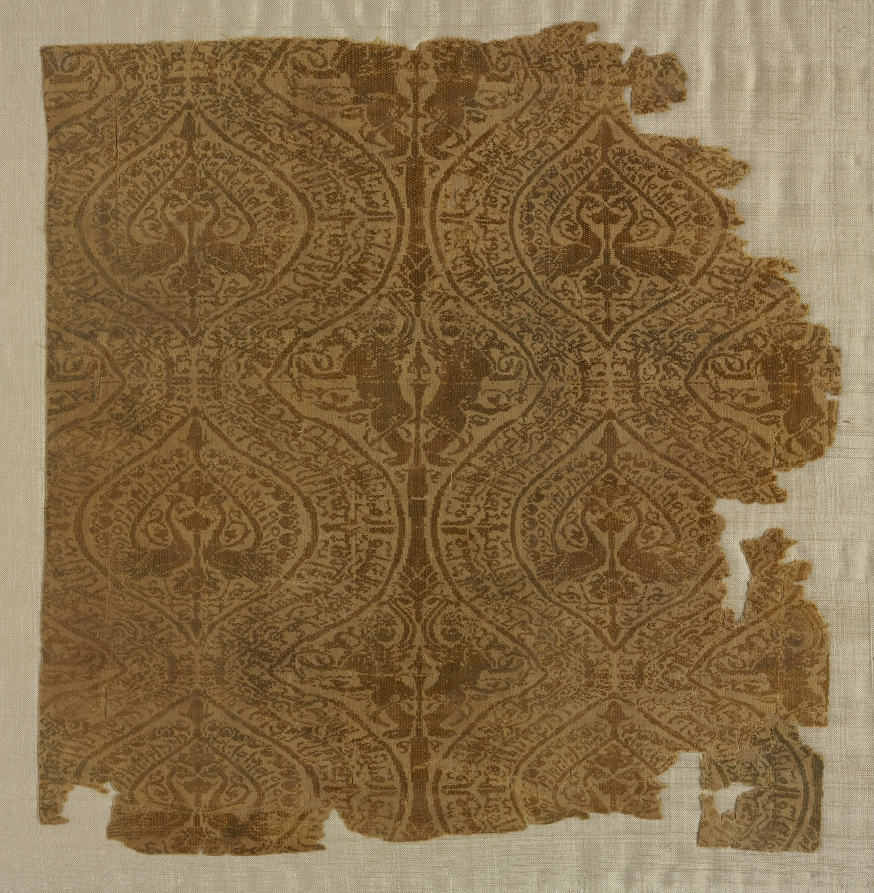
The Fragment with Peacocks in Ogival Pattern: A Study in Imperial Silk Weaving and Its Enduring Legacy
Introduction: The Artifact as a Testament to Craft
As a Senior Heritage Specialist at the Lauren Fashion Heritage Lab, I am privileged to present a detailed analysis of a singular artifact: a silk fragment bearing a design of peacocks within an ogival pattern. This piece, though modest in size, is a profound testament to the pinnacle of imperial silk weaving—a tradition that has shaped not only the material culture of dynastic courts but also the very fabric of Western luxury tailoring. In the lexicon of London’s Savile Row, where precision and heritage are paramount, this fragment speaks to the unbroken thread of artistry that connects the looms of ancient empires to the bespoke ateliers of today.
The artifact’s materiality—silk—is its first and most telling attribute. Silk, derived from the cocoon of the Bombyx mori silkworm, has been revered for millennia as a fiber of unparalleled luster, strength, and drape. In the context of imperial silk weaving, particularly within the Ming and Qing dynasties of China, silk was not merely a textile but a medium of state power, religious symbolism, and artistic expression. The fragment’s survival, likely as a remnant from a larger garment or ceremonial hanging, offers a rare window into the technical and aesthetic sophistication of its creators.
Materiality and Technique: The Silk as a Canvas
The fragment’s silk base is woven in a compound structure, likely a satin weave with supplementary wefts for the pattern. This technique, known as kesi (cut silk) in its most refined form, or more commonly as jin (brocade) in imperial contexts, allowed for the precise rendering of intricate motifs. The ogival pattern—a repeating, pointed arch shape—is a hallmark of Persian and Central Asian influence, which was absorbed and reimagined by Chinese weavers during the Yuan dynasty (1271–1368) and perfected in subsequent centuries. The ogive frames the peacocks, which are rendered in vibrant hues of azure, emerald, and gold, achieved through the use of natural dyes such as indigo, madder, and orpiment (a mineral pigment for yellow). The gold threads, likely silk wrapped in gilded paper or metal, add a luminous quality that catches the light, a deliberate choice to signify imperial opulence.
The peacock itself is a symbol of profound significance. In Chinese iconography, the peacock represents dignity, beauty, and the watchful eye of the divine. Its plumage, with its “eyes,” is associated with the starry heavens and the concept of ming (brightness or enlightenment). In Buddhist contexts, the peacock is a protector, often depicted consuming venomous creatures to symbolize the transformation of evil into wisdom. The pairing of peacocks within an ogival pattern suggests a harmonious duality—perhaps representing yin and yang, or the union of earthly and celestial realms. This iconographic density elevates the fragment beyond mere decoration; it is a narrative woven in silk.
Context: The Legacy of Imperial Silk Weaving
To fully appreciate this fragment, one must situate it within the broader legacy of imperial silk weaving. The imperial workshops, such as the Nanjing Silk Bureau and the Suzhou Imperial Textile Factory, were state-controlled enterprises that produced textiles exclusively for the emperor, his court, and diplomatic gifts. These workshops employed master weavers who trained for decades, passing down techniques through guilds and families. The production of a single robe could take months, requiring thousands of silk threads and meticulous attention to pattern alignment. The ogival pattern, with its repeating curves, demanded exceptional skill to maintain symmetry across the loom’s width—a feat achieved through the use of drawlooms, which allowed for the lifting of individual warp threads to create complex designs.
The legacy of this tradition extends far beyond China’s borders. By the 17th and 18th centuries, Chinese silks were coveted by European aristocracies, influencing the chinoiserie aesthetic that permeated Rococo design. Savile Row tailors, though primarily known for woolen suiting, have long recognized the value of silk for linings, waistcoats, and evening wear. The precision of imperial weaving—the evenness of the weave, the clarity of the pattern—set a standard that Western mills, such as those in Lyon and Spitalfields, sought to emulate. Today, the fragment serves as a benchmark for quality: a reminder that true luxury is not in novelty but in the mastery of enduring techniques.
Conservation and Interpretation: A Fragile Legacy
As a heritage artifact, this fragment requires careful conservation. Silk is a protein fiber, susceptible to light, humidity, and mechanical stress. The fragment’s colors, though still vibrant, show evidence of fading and dye migration, indicating exposure to light over centuries. The gold threads are brittle, and the weave has relaxed in areas, creating a subtle distortion of the ogival pattern. At the Lauren Fashion Heritage Lab, we employ passive conservation methods—storing the fragment in a climate-controlled environment with UV-filtered lighting and minimal handling. Digital imaging, including multispectral photography, allows us to document the pattern without physical contact, revealing details invisible to the naked eye, such as the direction of the weave and the sequence of weft insertions.
Interpretation of this artifact also requires a multidisciplinary approach. Art historians analyze the iconography; textile scientists study the dye composition; and historians of technology reconstruct the loom mechanisms. For the Savile Row practitioner, the fragment offers lessons in proportion and repetition. The ogival pattern, with its rhythmic arches, is a study in balance—a principle that underpins the cut of a jacket or the drape of a trouser. The peacocks, with their proud stances, remind us that clothing is not merely functional but a statement of identity and status.
Conclusion: The Fragment as a Living Document
In conclusion, the fragment with peacocks in an ogival pattern is far more than a decorative textile. It is a living document of imperial silk weaving, a tradition that embodies the intersection of art, technology, and power. Its materiality—silk—connects it to a global history of trade and cultural exchange. Its pattern speaks to the universal human desire for order and beauty. And its legacy, preserved in the hushed archives of heritage labs and the bespoke workshops of Savile Row, continues to inspire a reverence for craft that transcends time.
At the Lauren Fashion Heritage Lab, we are committed to ensuring that such artifacts are not merely studied but experienced—through exhibitions, digital reconstructions, and collaborations with contemporary artisans. For in the fragment’s silk threads, we find the warp and weft of our own sartorial heritage: a fabric that, like the peacock’s plumage, remains ever vibrant, ever watchful, and ever enduring.