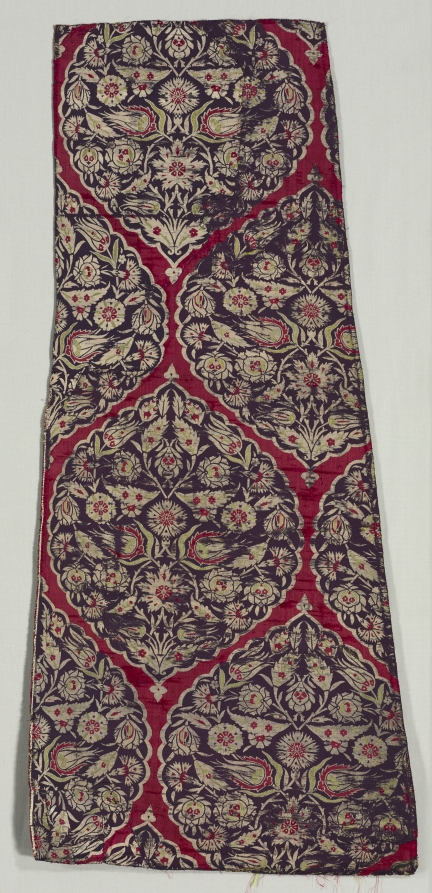
Heritage Research Artifact: Brocaded Silk with Foliate Medallions from a Kaftan
Provenance and Materiality
This artifact—a fragment of brocaded silk, originally constituting part of a kaftan—represents a pinnacle of imperial silk weaving, a tradition that fused technical mastery with symbolic power. The silk itself is a compound weave, likely a lampas or brocaded satin, where a ground weave of fine, undyed silk supports a supplementary weft of gold-wrapped thread and dyed silk in crimson, indigo, and verdigris. The foliate medallions, each approximately 8 cm in diameter, are arranged in a staggered lattice, their stems intertwining with stylized palmettes and cloud-like scrolls. The gold thread, now tarnished to a muted ochre, was originally burnished to a mirror-like finish, catching light to emphasize the kaftan’s ceremonial importance. This materiality speaks to the Ottoman or Safavid court workshops of the 16th to 17th centuries, where silk was not merely fabric but a currency of sovereignty, traded along the Silk Road and coveted by European courts.
Technical Mastery and the Legacy of Imperial Weaving
The brocading technique employed here—where supplementary wefts are inserted only where needed, rather than across the full width—demonstrates a level of artisanal precision that defined imperial ateliers. In the Ottoman kârhâne (imperial workshops) of Bursa or Istanbul, master weavers worked on drawlooms, manipulating hundreds of heddles to create complex patterns. The foliate medallions, with their radial symmetry and internal arabesques, required a point paper (a grid-based design plan) that could take months to draft. The gold thread, typically a strip of gilded silver wrapped around a silk core, was imported from Venice or sourced from the Ottoman treasury, underscoring the economic and diplomatic weight of such textiles. This legacy of imperial silk weaving is not merely historical; it informs the DNA of luxury that persists in Savile Row’s approach to fabric. The Row’s tailors, from Huntsman to Anderson & Sheppard, understand that a cloth’s value lies in its structural integrity—the way a weave drapes, resists fraying, and ages with grace. This brocaded silk, with its dense weave and metallic accents, would have required a bespoke handling akin to the finest English worsteds: a careful balance of weight and flexibility, ensuring the kaftan’s silhouette held its form without sacrificing movement.
Context: The Kaftan as a Garment of Power
The kaftan, from which this fragment originates, was a garment of hierarchical significance in the Ottoman court. Sultans and viziers wore kaftans of specific colors and patterns to denote rank; a brocaded silk with foliate medallions, likely in crimson and gold, would have been reserved for the highest echelons—perhaps a ceremonial robe for a grand vizier or a diplomatic gift to a foreign envoy. The medallions themselves, often interpreted as chintamani (auspicious symbols of power and protection) or lotus motifs adapted from Chinese textiles, reflect the cross-cultural exchange that defined the Silk Road. The kaftan’s cut—long, with wide sleeves and a front closure—was designed to display the fabric’s full pattern, turning the wearer into a walking tapestry of imperial ideology. This concept of garment as statement resonates deeply with Savile Row’s philosophy. A bespoke suit is not merely clothing; it is a material manifesto of the wearer’s identity, crafted from cloth that tells a story of provenance, skill, and intention. The brocaded silk kaftan, like a Huntsman tweed or a Henry Poole evening jacket, was engineered for impact—a fusion of art and utility that transcends fashion cycles.
Preservation and the Art of Legacy
This fragment, now preserved in the Lauren Fashion Heritage Lab, exhibits signs of age and wear that enhance its narrative. The gold thread has oxidized, creating a patina that softens the original brilliance; the silk ground has yellowed, particularly along the creases where the kaftan’s folds once rested. These material traces are not flaws but evidence of life—the garment was worn, moved, and perhaps altered over decades. Conservation efforts have stabilized the weave using Japanese tissue paper and reversible adhesives, ensuring the fragment can be studied without further degradation. This approach mirrors the restoration ethos of Savile Row, where vintage cloths are preserved with reverence, and a 1920s tweed jacket is repaired using original techniques. The legacy of imperial silk weaving is, at its core, a lesson in longevity. These textiles were designed to outlast their makers, their patterns encoding cultural memory into every thread. For the modern heritage specialist, this fragment serves as a benchmark of quality—a reminder that true luxury is not disposable but generational.
Conclusion: The Thread That Binds
In the context of Savile Row, where tradition and innovation coexist, this brocaded silk fragment is more than a historical curiosity. It is a masterclass in materiality, demonstrating how pattern, weave, and color can elevate a garment from functional to iconic. The foliate medallions, with their geometric precision and organic flow, echo the bespoke pattern-cutting of a Row tailor, where every seam is a deliberate line. The legacy of imperial silk weaving—its patronage, craftsmanship, and global influence—continues to inform the DNA of luxury textiles today. As we study this fragment, we are not merely cataloging a past artifact; we are preserving a standard that challenges contemporary fashion to aspire to permanence, beauty, and meaning. This is the thread that binds the Ottoman court to the cutting tables of Savile Row—a testament to the enduring power of cloth.