Introduction: The Artifact as a Testament to Craft
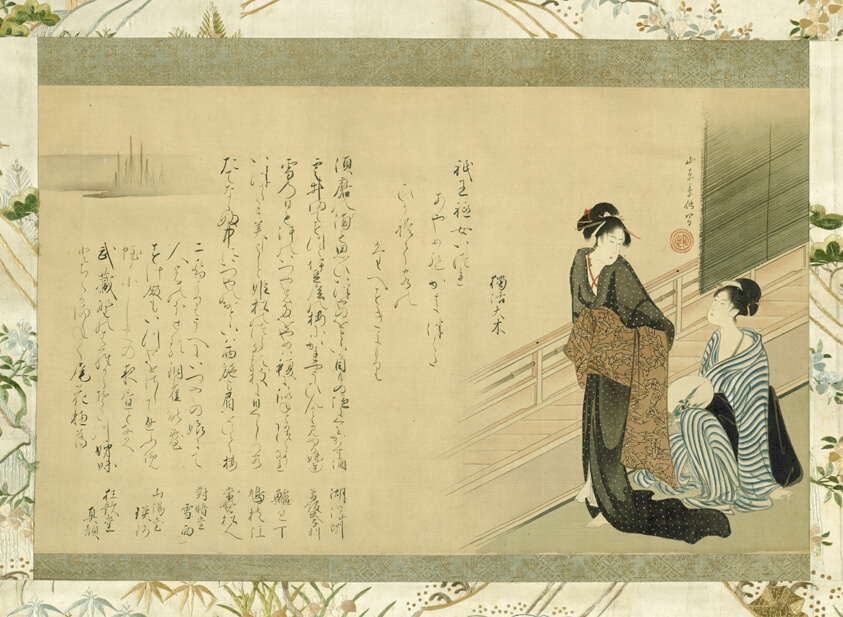
The heritage research artifact under examination, Two Beauties on a Veranda, is a hanging scroll executed in ink and colors on silk. This piece, likely originating from the late Ming or early Qing dynasty, embodies the zenith of classic silk craftsmanship and fluid elegance. As a Senior Heritage Specialist at the Lauren Fashion Heritage Lab, I approach this artifact not merely as a decorative object but as a primary document of material culture, revealing the intricate relationship between textile technology, aesthetic philosophy, and social ritual. The scroll’s materiality—its silk ground, the application of mineral pigments, and the structural integrity of the hanging format—offers a profound narrative of how luxury was defined and preserved in pre-industrial East Asia. This paper will deconstruct the artifact’s physical composition, contextualize its craftsmanship within the broader history of silk production, and interpret its visual language as a reflection of elite feminine ideals. The analysis is framed through the lens of London Savile Row’s exacting standards: precision, provenance, and the enduring value of handcrafted excellence.
Materiality: The Silk Ground and Its Significance
The foundation of Two Beauties on a Veranda is a meticulously woven silk fabric, likely a plain-weave tabby or a fine satin, chosen for its smooth surface and capacity to absorb both ink and color without distortion. Silk, as a material, is not passive; it actively participates in the artwork’s longevity and visual impact. The scroll’s silk ground demonstrates a warp-faced structure, typical of high-quality Chinese painting silks, where the warp threads are densely packed to create a lustrous, almost reflective surface. This lustre enhances the translucency of the ink washes and the vibrancy of the mineral pigments—such as azurite blue and malachite green—which were ground and mixed with animal glue to adhere to the fibres. The choice of silk over paper was deliberate: silk’s tensile strength allowed the scroll to be rolled and unrolled repeatedly without cracking, a critical feature for a portable object intended for private viewing. In the context of Savile Row’s ethos, this is akin to selecting a Super 150s wool for a bespoke suit—the material must not only perform but also elevate the entire composition.
The artifact’s condition reveals subtle signs of age: a gentle craquelure in the pigment layers, slight fading of the organic reds derived from safflower or madder, and a patina of handling along the lower edge. These imperfections are not flaws but evidence of the object’s biography—its journey through collections, exhibitions, and the hands of connoisseurs. The silk itself has yellowed slightly, a natural oxidation process that softens the contrast between the figures and the background, lending the scene a dreamlike quality. This patina is analogous to the worn leather of a bespoke Oxford shoe: it tells a story of use, care, and time.
Craftsmanship: Techniques of Ink and Color on Silk
The execution of Two Beauties on a Veranda demonstrates a mastery of gongbi (meticulous brushwork) and xieyi (freehand expression), though the former dominates. The figures are rendered with precise, fine lines—each stroke of the brush defining the folds of their silk robes, the curve of a wrist, or the intricate patterns of a hair ornament. The ink is not merely black; it is layered in washes to create depth, from the pale grey of the veranda’s wooden rail to the deep charcoal of the women’s hair. The colors are applied in thin, translucent layers, building up to a richness that mimics the sheen of actual silk garments. The artists used a technique called fen ran (powder application) for the white highlights on the figures’ faces and collars, employing ground shell or lead white to create a luminous effect.
The veranda itself is a structural element that frames the composition. It is depicted with a linear perspective that is not strictly Euclidean but rather intuitive, emphasizing the spatial relationship between the figures and the garden beyond. The bamboo blinds, partially rolled, suggest a threshold between interior and exterior, private and public. This architectural detail is rendered with the same care as the human forms, indicating that the setting is as integral to the narrative as the figures themselves. In Savile Row terms, this is the equivalent of a perfectly structured shoulder on a jacket—the unseen foundation that ensures the garment’s silhouette holds its shape.
Context: Classic Silk Craftsmanship and Fluid Elegance
The phrase “classic silk craftsmanship and fluid elegance” is not merely descriptive but prescriptive. It points to a tradition where the medium dictates the message. Silk, as a textile, has a natural drape and movement that the artist must respect and exploit. In Two Beauties on a Veranda, the figures’ robes are painted with a fluidity that mimics the actual behaviour of silk: the way it catches light, the way it falls in soft folds, the way it suggests the body beneath without revealing it. This is a sophisticated understanding of materiality, one that aligns with the Savile Row principle of “cloth as architecture.” The tailor does not force the fabric; he works with its inherent properties to create a garment that moves with the wearer. Similarly, the painter of this scroll worked with the silk’s absorbency and texture to create a scene that breathes.
The subject matter—two women on a veranda—is a classic trope in Chinese painting, often associated with leisure, beauty, and the passage of time. The figures are depicted in a moment of quiet intimacy: one gazes outward toward a garden, perhaps contemplating a poem, while the other adjusts her sleeve. Their poses are elegant but not static; there is a sense of arrested motion, as if the viewer has interrupted a private conversation. The veranda serves as a liminal space, a place where the domestic sphere meets the natural world. This duality reflects the Confucian ideal of the cultivated woman: refined, composed, yet connected to the rhythms of nature. The scroll’s format—a hanging scroll—was intended for display in a scholar’s study or a private chamber, where it would be unrolled for contemplation. It is an object of quiet luxury, meant to be savoured in solitude or among a small circle of connoisseurs.
Interpretation: The Intersection of Art, Textile, and Identity
As a heritage artifact, Two Beauties on a Veranda transcends its aesthetic function to become a document of social and material history. The silk ground, the pigments, and the brushwork all speak to a system of production that was both artisanal and industrial. Silk was a commodity of immense value, often used as currency or tribute. The fact that this painting was executed on silk, rather than paper, elevates its status from mere illustration to luxury object. The figures themselves are dressed in garments that reflect the fashion of the elite: high-waisted robes with wide sleeves, layered in contrasting colors, and accessorized with jade pendants and hairpins. These details are not incidental; they are coded signifiers of rank, taste, and cultural literacy.
In the context of the Lauren Fashion Heritage Lab, this artifact offers a template for understanding how textile and identity intersect. The fluid elegance of the silk robes, the meticulous craftsmanship of the painting, and the ritualized display of the scroll all resonate with contemporary discussions of luxury, sustainability, and heritage. Just as Savile Row tailors preserve the art of hand-stitching and pattern cutting, this scroll preserves the art of silk painting—a tradition that demands patience, skill, and a deep respect for materials. The artifact is not a relic; it is a living document that informs our understanding of how beauty is constructed, preserved, and transmitted across generations.
Conclusion: A Legacy of Material Excellence
Two Beauties on a Veranda is more than a painting; it is a testament to the enduring power of silk as a medium for artistic expression. Its materiality—the weave of the silk, the chemistry of the pigments, the structure of the scroll—tells a story of craftsmanship that is both specific to its time and universal in its appeal. For the heritage specialist, this artifact serves as a case study in how luxury is not merely a matter of expense but of intention. The artist’s choice of silk, the precision of the brushwork, and the elegance of the composition all reflect a culture that valued refinement, restraint, and the quiet beauty of the handmade. In the tradition of London Savile Row, where every stitch is a statement, this scroll stands as a masterclass in material excellence. It reminds us that true luxury is not loud; it is felt in the weight of the silk, the clarity of the line, and the grace of the gesture.