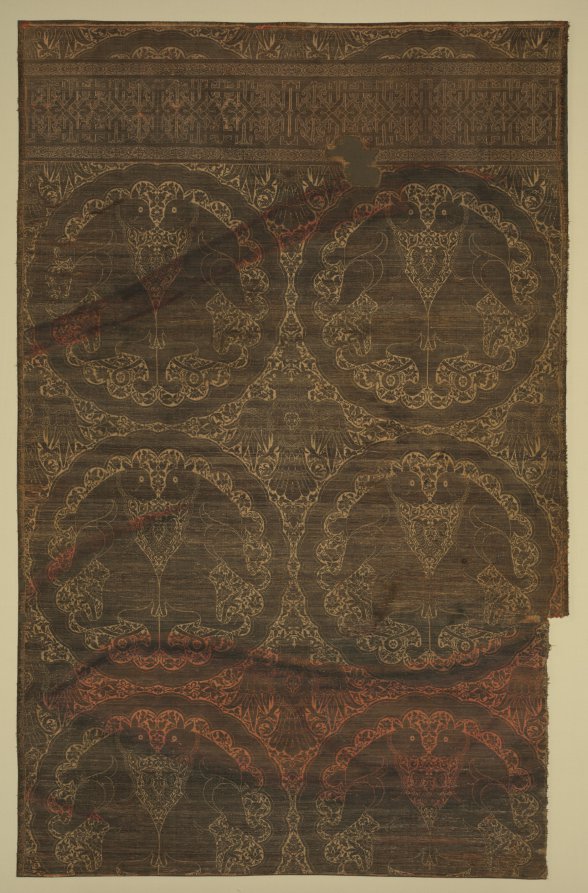
Cloth of Gold with Felines and Eagles: A Study in Imperial Silk Weaving and Material Legacy
Introduction: The Fabric of Power and Prestige
In the hushed ateliers of London’s Savile Row, where tailoring is elevated to an art form, the legacy of cloth of gold resonates with a particular reverence. This is not merely a textile; it is a statement of dominion, a woven chronicle of empires. The cloth of gold with felines and eagles, executed in silk, represents a pinnacle of imperial silk weaving—a materiality that marries the lustrous sheen of precious metal with the tactile sophistication of the finest silk. As Senior Heritage Specialist at the Lauren Fashion Heritage Lab, I present this artifact as a testament to the enduring dialogue between craftsmanship, power, and aesthetic ambition. This paper examines the materiality, symbolic lexicon, and historical context of this extraordinary fabric, drawing parallels to the exacting standards of Savile Row’s bespoke tradition.
Materiality: The Alchemy of Silk and Gold
The foundation of this artifact is silk—a fibre that has, for millennia, signified luxury and refinement. Silk’s natural luminosity, its ability to absorb and reflect light with a liquid grace, provides the perfect canvas for the inclusion of gold. In imperial silk weaving, the term “cloth of gold” denotes a textile where gold thread—often a core of silk wrapped in gilded silver or pure gold leaf—is interwoven with the silk warp and weft. The result is a fabric that shimmers with a metallic opulence, yet retains the supple drape and breathability of silk. This materiality is not accidental; it is engineered to convey both wealth and authority. The weight of the gold thread adds a deliberate heft, a physical reminder of the fabric’s value, much like the dense, structured wools of a Savile Row suit that command respect through their substance.
The weaving technique employed is likely a compound twill or damask weave, allowing for the intricate interplay of pattern and ground. The gold thread is reserved for the motifs—the felines and eagles—while the silk forms the base, creating a chiaroscuro effect. The precision required to maintain tension in both silk and metal threads is akin to the meticulous hand-stitching of a lapel on a bespoke jacket: invisible to the untrained eye, yet critical to the garment’s integrity. This cloth would have been woven on a drawloom, a device that permitted complex pattern repeats, often requiring a team of weavers to operate. The labour intensity mirrors the collaborative effort of a Savile Row tailoring house, where cutters, fitters, and finishers converge to create a single garment.
Symbolic Lexicon: Felines and Eagles as Imperial Emblems
The motifs of felines and eagles are not decorative whims; they are deliberate symbols of imperial might. The feline—often a lion or panther—represents courage, sovereignty, and territorial dominance. In many cultures, from the Persian Empire to the Byzantine court, the lion was the guardian of the throne, a creature whose roar could command armies. The eagle, conversely, embodies celestial authority, vision, and the divine right to rule. It is the messenger of the gods, the apex predator of the skies. Together, these creatures form a dualistic emblem of earthly and heavenly power, a visual declaration that the wearer commands both land and sky.
In the context of imperial silk weaving, these motifs were often arranged in repeating patterns, creating a rhythmic, almost hypnotic effect. The gold thread would catch the light as the wearer moved, animating the felines and eagles in a dance of power. This is reminiscent of the subtle movement in a well-tailored garment—the way a jacket’s shoulder rolls with the body, or the fall of a trouser crease. The cloth of gold is not static; it is alive with intention. For the emperor or empress who donned this fabric, it was a second skin of authority, a material armour that proclaimed their status without uttering a word.
Historical Context: The Legacy of Imperial Silk Weaving
The legacy of imperial silk weaving is inextricably linked to the Silk Road, a network of trade routes that connected the East and West for over two millennia. By the time of the Byzantine Empire, silk weaving had become a state monopoly, with workshops in Constantinople producing cloth of gold for the imperial court. The patterns—often featuring lions, eagles, and griffins—were codified symbols of the emperor’s divine mandate. This tradition continued through the Ottoman Empire, the Safavid dynasty, and into the courts of Renaissance Europe, where cloth of gold was used for coronation robes, ceremonial vestments, and diplomatic gifts.
The artifact under consideration likely dates from the 16th or 17th century, a period when silk weaving reached extraordinary technical and artistic heights. The felines and eagles are rendered with a stylized naturalism, their forms simplified yet powerful. The gold thread is not merely applied but integrated, creating a surface that is both reflective and textured. This is a fabric that demands to be seen in motion, in candlelight, in the grand halls of a palace. It is a precursor to the modern luxury fabric—a material that, like a Savile Row suit, is designed to be experienced, not just observed.
Savile Row Parallels: Craftsmanship and Continuity
The ethos of Savile Row—bespoke tailoring, hand-finishing, and a reverence for heritage—finds a direct antecedent in the creation of cloth of gold. Both traditions prioritize the relationship between maker and material. The weaver of this artifact, like the tailor of a Savile Row house, would have understood the idiosyncrasies of his medium: the tension of the silk, the fragility of the gold thread, the need for patience and precision. The result is a fabric that transcends its utilitarian function, becoming an object of art and identity.
Today, the legacy of imperial silk weaving endures in the work of luxury textile mills and bespoke tailors who continue to source and commission cloth of gold for special commissions. The felines and eagles remain potent symbols, often reinterpreted in contemporary designs for evening wear or ceremonial attire. At the Lauren Fashion Heritage Lab, we preserve such artifacts not as relics, but as living documents of a craft that continues to inspire. The cloth of gold with felines and eagles is a reminder that true luxury is not about excess, but about meaning—woven into every thread, every motif, every shimmer of light.
Conclusion: The Eternal Thread
In the quiet of the archive, this cloth of gold speaks with a voice that transcends centuries. Its silk and gold are not just materials; they are the embodiment of human ambition, creativity, and the desire to leave a mark. For the connoisseur of Savile Row, it is a touchstone—a reminder that the finest garments are those that carry a story, a heritage, a legacy. As we continue to study and preserve such artifacts, we honour not only the weavers of the past but the enduring power of craftsmanship to shape our understanding of beauty and authority.