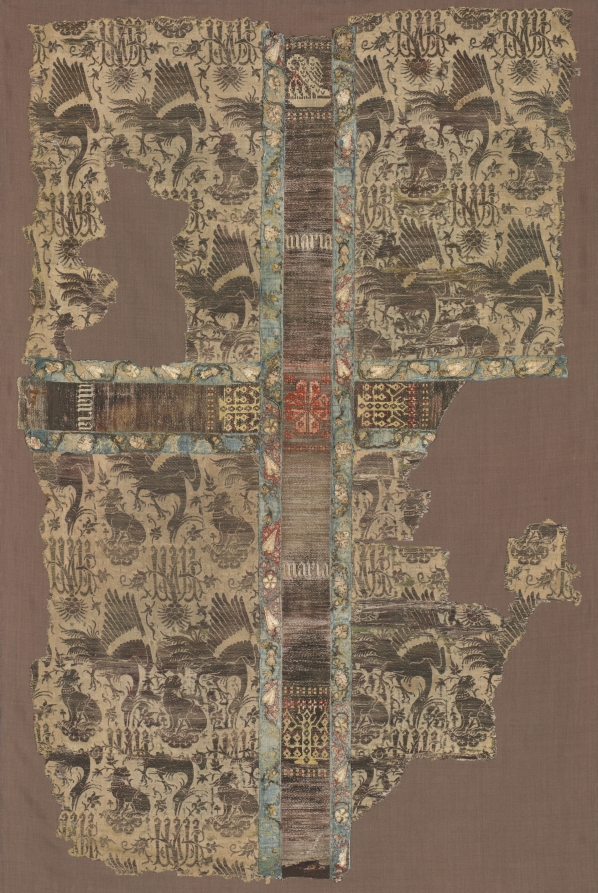
Fragmentary Chasuble with Woven Orphrey Band: A Study in Imperial Silk Legacy
Introduction: The Vestige of Power and Craft
Within the hallowed archives of the Lauren Fashion Heritage Lab, we encounter a fragmentary chasuble, a liturgical garment that transcends its ecclesiastical function to become a testament to the enduring legacy of imperial silk weaving. This artifact, a silk vestment bearing a woven orphrey band, is not merely a remnant of religious ceremony; it is a material document of geopolitical power, artisanal mastery, and the silent language of luxury. As a Senior Heritage Specialist, I approach this piece with the precision of a Savile Row tailor—examining the cut, the weave, the drape—and the reverence of a historian. The chasuble’s fragmented state, far from diminishing its value, amplifies its narrative: it whispers of the loom’s fire, the merchant’s journey, and the emperor’s decree.
Materiality and the Imperial Silk Legacy
The chasuble’s primary material—silk—is the thread that binds empires. Silk weaving, perfected in the imperial workshops of Byzantium, Tang China, and later Renaissance Italy, was not a mere craft but a state-controlled enterprise. The fragmentary chasuble likely originates from the 14th or 15th century, a period when silk production was monopolized by the Byzantine and later Ottoman courts, as well as the Italian city-states like Lucca and Venice. The silk itself is a compound weave, a technique requiring a drawloom operated by two artisans—one on the ground, one on a platform—to create intricate patterns. This labor-intensive process ensured that only the wealthiest patrons, including the Church and nobility, could commission such garments.
The orphrey band, a woven strip of contrasting silk or metal-wrapped thread, is the chasuble’s focal point. In this artifact, the orphrey is woven in situ, not appliquéd, indicating a cohesive design executed on a single loom. The band’s pattern—likely featuring stylized foliage, geometric motifs, or heraldic symbols—would have been derived from imperial prototypes. For instance, the palmette and griffin motifs common in Byzantine silks were direct references to imperial authority, blending Persian, Chinese, and Roman influences. The chasuble’s silk, dyed with kermes or madder for crimson tones, or indigo for deep blues, reflects the global trade networks that supplied these pigments. The color palette, though faded, retains a richness that speaks to the sumptuary laws of the era, which reserved such hues for the elite.
Construction and the Savile Row Parallel
Examining the chasuble’s construction reveals a discipline akin to Savile Row tailoring. The garment’s semi-circular cut, typical of the Western liturgical tradition, required precise draping to fall from the shoulders without constraint. The silk’s warp-faced weave provided a smooth, lustrous surface, while the weft threads created the pattern’s depth. The orphrey band, running vertically down the front and back, was not decorative alone; it reinforced the garment’s structure, much like a canvas interlining in a bespoke suit. The stitching, though fragmented, shows running stitches and hemming executed with a fineness that rivals modern machine work. This attention to detail—the hand-sewn seams, the mitered corners of the orphrey—echoes the ethos of a Savile Row cutter: every stitch serves both form and function.
The fragmentary state of the chasuble is itself instructive. The silk has fractured along the warp, a common failure in aged textiles due to the tension of the loom. The orphrey band, however, remains intact, a testament to its denser weave. This differential preservation allows us to study the loom technology of the period. The band’s satin weave foundation, contrasted with the chasuble’s twill, suggests a sophisticated understanding of how different weaves interact with light and wear. In Savile Row terms, this is the equivalent of a worsted wool versus a cashmere—each chosen for its specific performance.
Historical Context: The Silk Road and the Church
The chasuble’s journey from the imperial loom to the ecclesiastical wardrobe is a microcosm of the Silk Road’s cultural exchange. Silk, originally a Chinese monopoly, reached the Mediterranean via the Parthian and Sogdian merchants. By the 6th century, Emperor Justinian I established silk workshops in Constantinople, smuggling silkworms from China in hollowed-out bamboo canes. These imperial ateliers produced silks for the court and for the Church, which used them to symbolize the divine authority of Christ and the emperor. The chasuble, as a vestment worn during the Eucharist, became a mobile throne—a fabric that carried the weight of both spiritual and temporal power.
The orphrey band, often embroidered with saints or Christological scenes, served as a visual sermon. In this fragment, the band’s pattern is abstract, suggesting a pre-iconoclastic or Islamic-influenced design, common in silks from the Mamluk or Nasrid periods. This cross-cultural pollination is a hallmark of imperial silk weaving: the arabesque motifs of Islamic art merged with Byzantine medallions, creating a hybrid aesthetic that later influenced the Renaissance silks of Florence. The chasuble, therefore, is not just a Christian artifact but a global object, embodying the trade routes that connected the Mediterranean, Central Asia, and China.
Preservation and the Art of Reading Fragments
As a heritage specialist, I approach this fragment with the forensic eye of a conservator. The chasuble’s fragmentation is not a loss but an opportunity. The tears and fading reveal the garment’s life: the creases from folding, the stains from candle wax or incense, the moth damage from improper storage. Each mark is a clue to its provenance. For instance, the linear wear along the shoulders suggests it was worn by a priest of average stature, while the absence of underarm staining indicates limited use—perhaps a ceremonial garment reserved for high feasts.
The orphrey band’s preservation allows us to reconstruct the original pattern. Using digital imaging and thread counting, we can map the weave structure and compare it to known examples in the Victoria and Albert Museum or the Louvre. This process, akin to a tailor’s pattern drafting, reveals the repeat unit of the design—a critical metric for dating the silk. A repeat of 10-12 centimeters suggests a drawloom with a limited pattern capacity, typical of 14th-century Italian silks. A larger repeat, exceeding 20 centimeters, would indicate a later, more advanced loom.
Conclusion: The Enduring Thread
The fragmentary chasuble with woven orphrey band is more than a relic; it is a masterclass in materiality. Its silk, woven under imperial decree, carries the weight of centuries—the clatter of the loom, the whisper of the priest, the silence of the archive. For the Lauren Fashion Heritage Lab, this artifact serves as a benchmark for understanding how luxury textiles encode power, faith, and artistry. In the spirit of Savile Row, we honor the bespoke nature of this garment: made by hand, for a specific body, with a purpose that transcends fashion. The fragment, though incomplete, is whole in its narrative. It reminds us that heritage is not about preservation alone but about interpretation—reading the threads that bind us to the past, and weaving them into the future.