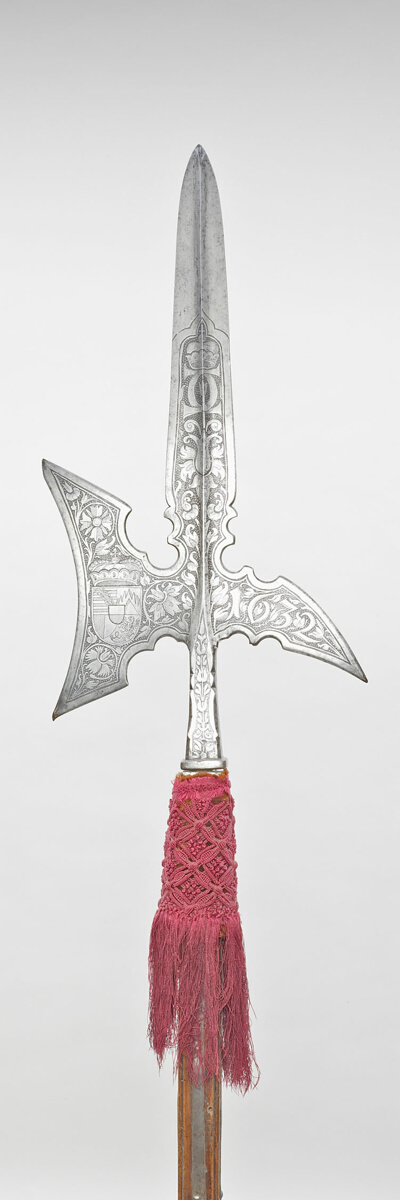
An Instrument of Ceremony: The Halberd as Sartorial Statement
To the untutored eye, a halberd presents as a mere tool of martial function; a compounded assembly of steel, iron, and wood engineered for the grim arithmetic of the battlefield. Yet, to consider the halberd commissioned for the Bodyguard of His Serene Highness Karl Eusebius, Prince of Liechtenstein, in such purely utilitarian terms is to profoundly misapprehend its essence. This artifact, a symphony of steel, gilding, ash, and—most critically—silk, transcends its typological classification. It is not merely a weapon carried by a guard. It is the foundational element of a uniform, the rigid exoskeleton upon which the soft power of a court is draped. Its existence speaks not to the chaos of combat, but to the meticulously ordered theatre of princely authority. In this rarefied context, the halberd ceases to be an implement of war and becomes, unequivocally, an instrument of ceremony. Its presence articulates a boundary more psychological than physical, its polished blade reflecting not an enemy, but the exalted status of the figure it protects.
Material Grammar: The Dialogue Between Rigour and Fluidity
The material composition of this halberd constitutes a deliberate and sophisticated grammar. The core—the formidable blade, the sturdy langets, the robust socket—is of steel and iron, materials speaking the ancient language of strength, permanence, and lethal capability. This is the bone structure. Upon this foundation lies the gilding, a transformative veneer that alchemizes hardened steel into a symbol of solar radiance and divine-right authority. It catches the candlelight in a chamber of state, a moving point of brilliance that draws the eye and announces presence. The shaft, of turned ash, provides the crucial connection between man and metal; its organic warmth and inherent resilience a testament to balanced, reliable service.
And yet, these elements, for all their solemnity, remain incomplete. They are the canvas. The silk is the masterpiece. The silk cord, meticulously wrapped and knotted, and the silk tassel or textile banner affixed beneath the blade, introduce a narrative of fluid elegance and consummate craftsmanship into an object of inherent rigidity. This is the pivotal dialogue. The silk does not soften the halberd’s purpose; it elevates its meaning. Its deep, likely proprietary dye—a crimson, a princely blue, or a gold to match the gilding—is a burst of curated colour against metallic monochrome. The fineness of its weave, the sheen that plays subtly with light differently than the hard gleam of gilt, speaks of looms, of expertise, of a luxury industry far removed from the forge. The silk is the sartorial link, the material echo of the guard’s own coat, his waist sash, the linings of his attire. It binds the weapon to the wearer, creating a cohesive visual identity where the martial and the courtly are seamlessly integrated.
Context: The Savile Row of Central Europe & The Prince’s Eye
To understand the imperative for such an artifact, one must appreciate the court of Karl Eusebius (1611-1684). A prince of formidable intellect and refined taste, he was less a warrior-king and more a consummate patron and collector, a man who dedicated his life and considerable resources to the aggrandizement of his house through art, architecture, and the cultivation of impeccable style. His bodyguard was, therefore, never intended as a frontline combat unit. It was a permanent feature of his retinue, a living, breathing component of his public iconography. These men were as much decorative as they were defensive, extensions of the prince’s own aura.
In this light, their equipment demanded the highest standards of what one might term, in a modern vernacular, bespoke commissioning. The procurement of these halberds would have been a cross-disciplinary endeavour. The finest armourer in Prague or Vienna would be engaged for the blade and metalwork—a specialist in his field, much like a master cutter on Savile Row is a sculptor of cloth. Concurrently, a master silk merchant, with access to the finest damasks or velvets from Italian or Ottoman markets, would be consulted for the textiles. The final assembly, the fitting of the silk to the steel, required a coordination of crafts akin to the fitting of a military tailcoat, where the drape of the wool must honour the structure of the underlying padding. The result is a piece of applied art. Every element, from the temper of the steel to the twist of the silk cord, is executed to a standard that would meet the exacting scrutiny of the prince himself, a known perfectionist in matters of aesthetic harmony.
The Silken Code: Non-Verbal Communication of Power
The function of the silk, therefore, operates on multiple frequencies. Practically, it provides a grip, but this is merely its most pedestrian duty. Symbolically, it is a badge of office, its colour and quality instantly identifying the bearer as belonging to the Liechtenstein household and no other. Aesthetically, it provides the essential element of fluid movement. In the static, upright position of the guard at ease, the silk tassel hangs with a graceful weight. As the halberd is moved to the present arms, the tassel sways, catching the light, its motion animating the entire form, lending a vital, human elegance to the mechanical precision of the drill. This kinetic elegance is paramount. It transforms a potentially clumsy manoeuvre into a balletic display of disciplined grace.
Ultimately, this halberd, through its incorporation of silk, communicates a profound political and social truth. It declares that the power of Karl Eusebius is so secure, so absolute, that the very instruments of his physical defence can be lavishly adorned. The threat of violence is sublimated into the spectacle of authority. The silk signifies that this prince is protected not only by steel, but by tradition, by wealth, by an entire ecosystem of craftsmanship dedicated to the manifestation of his sovereignty. The bodyguard, thus equipped, becomes a mobile monument. He and his halberd are a unified ensemble, a walking proclamation that here, in this court, even power dresses for the occasion. The silk is the final, indispensable stitch in this construction—the touch of fluid elegance that assures us this is not an object from the arsenal, but a heritage artifact from the atelier of statecraft.