← BACK TO ARCHIVES
Silk
Heritage Synthesis: Fragment (From an Orphrey Band)
Curated on Jul 11, 2026 // Node: LDN-01
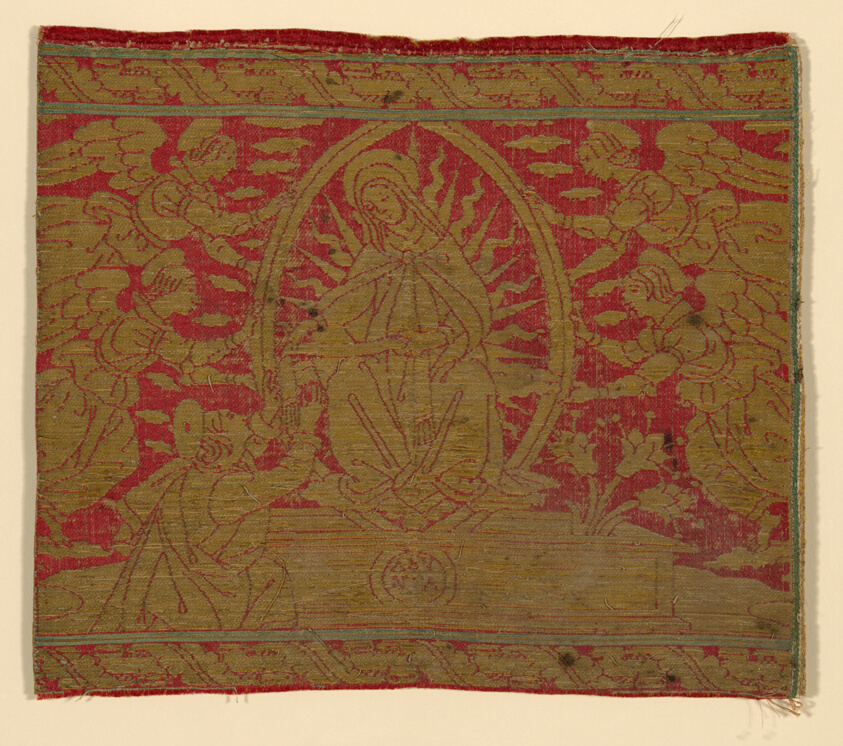
The Fragment as a Testament to Craft: Deconstructing an Orphrey Band
In the rarefied world of heritage textiles, few artifacts speak with the quiet authority of a fragment from an orphrey band. This piece, a silk and gilt-animal-substrate-wrapped linen composition, is not merely a remnant of ecclesiastical or ceremonial dress; it is a ledger of technical mastery, economic ambition, and aesthetic restraint. As a Senior Heritage Specialist at the Lauren Fashion Heritage Lab, I approach this object with the same precision one would apply to a bespoke Savile Row suit—where every stitch, every weave, and every material choice tells a story of provenance, purpose, and perfection. The fragment’s materiality—warp-float faced satin weave with twill interlacings of secondary binding warps and supplementary patterning wefts—elevates it beyond decoration into the realm of engineering. This paper will dissect its construction, contextualize its craftsmanship, and argue for its enduring relevance in the study of luxury textiles.
Materiality: The Anatomy of Opulence
The fragment’s foundation lies in its silk warp and weft, a fiber synonymous with luxury since antiquity. Silk’s natural luster, tensile strength, and ability to absorb dyes with unparalleled depth made it the preferred medium for high-status textiles across Europe and Asia. Here, the silk is woven into a warp-float faced satin weave, a structure that prioritizes the surface over the interior. In satin weaves, the warp threads “float” over multiple weft threads before interlacing, creating a smooth, reflective surface that catches light like still water. This technique, perfected in Byzantine and Italian workshops, required meticulous tension control and a deep understanding of fiber behavior. The secondary binding warps, interlaced in a twill pattern, serve as a structural counterpoint. Twill’s diagonal ribbing provides durability and flexibility, preventing the satin from distorting under strain. This dual-system weave—satin for aesthetic brilliance, twill for structural integrity—mirrors the philosophy of a Savile Row tailor who balances a soft, draped shoulder with a reinforced canvas chest piece.
The most arresting element, however, is the gilt-animal-substrate-wrapped linen. This phrase describes a thread where a thin strip of animal membrane (often goldbeater’s skin, derived from ox intestine) is gilded with gold or silver leaf, then spirally wrapped around a linen core. The result is a metallic thread that is both lightweight and resilient, capable of withstanding the rigors of weaving without cracking or tarnishing. The use of animal substrate, rather than pure metal wire, indicates a sophisticated understanding of material economy: gilding on membrane reduced weight and cost while maintaining visual impact. In the orphrey band—a decorative strip adorning ecclesiastical vestments—these threads were used as supplementary patterning wefts, introduced selectively to create intricate motifs. The contrast between the matte silk satin and the luminous metallic threads would have been breathtaking, a play of light and shadow that evoked the divine.
Context: The Orphrey Band in Ecclesiastical and Secular Fashion
Orphrey bands, originating in the 12th century, were integral to liturgical vestments such as chasubles, copes, and dalmatics. They served both functional and symbolic roles: structurally reinforcing the garment’s edges while visually demarcating sacred space. The fragment’s design—likely a repeating pattern of floral or geometric motifs—reflects the Gothic and Renaissance preference for naturalistic forms rendered with geometric precision. The warp-float faced satin weave allowed for sharp, clean lines in the metallic threads, while the twill interlacings provided a subtle textural backdrop. This was not mere decoration; it was a form of visual theology, where gold symbolized divine light and silk represented purity.
Yet the orphrey band’s influence extended beyond the church. By the 14th century, secular elites adopted similar techniques for courtly garments, including surcoats, hoods, and ceremonial robes. The fragment’s materiality—silk and gilt thread—was a marker of status, accessible only to those with access to long-distance trade networks and skilled workshops. The use of animal-substrate-wrapped linen, rather than solid gold thread, suggests a pragmatic approach to luxury: the illusion of opulence achieved through technical innovation. This echoes the ethos of Savile Row, where a bespoke suit’s value lies not in raw material cost alone but in the mastery of construction—the invisible seams, the hand-stitched buttonholes, the careful pattern matching.
Craftsmanship: The Unseen Labor
To fully appreciate this fragment, one must consider the labor embedded in its creation. The warp-float faced satin weave required a loom with multiple harnesses, each controlling a set of warp threads. The weaver would have to lift specific harnesses in precise sequences to create the satin floats, while simultaneously managing the secondary binding warps for the twill interlacings. The supplementary patterning wefts, including the gilt threads, were introduced via a separate mechanism, often a drawloom operated by a second artisan. This division of labor—the weaver managing the ground weave, the drawboy pulling cords to lift pattern threads—was a hallmark of medieval textile production, where a single orphrey band could take months to complete.
The gilt-animal-substrate-wrapped linen thread itself required specialized preparation. Goldbeaters would hammer gold into thin leaves, then apply it to animal membrane using a binder such as gum arabic. The membrane was then cut into narrow strips and wound around a linen core, a process that demanded steady hands and a keen eye for uniformity. Any imperfection in the wrapping would cause the thread to break during weaving, ruining the entire piece. This level of precision—where each thread is a composite of multiple materials and skills—mirrors the bespoke tailor’s approach to a suit: the canvas interlining, the horsehair chest piece, the silk lining, all working in concert to create a garment that is both beautiful and functional.
Preservation and Legacy
Today, this fragment serves as a pedagogical tool for understanding the intersection of art, technology, and commerce. Its survival—likely as a cut piece from a larger vestment—offers a window into the recycling practices of historical textile economies. Orphrey bands were often removed from worn-out garments and repurposed for new vestments, a practice that speaks to the value placed on such craftsmanship. In the Lauren Fashion Heritage Lab, we study this fragment not as a relic but as a blueprint. The warp-float faced satin weave, the twill interlacings, the gilt-animal-substrate-wrapped linen—these techniques inform contemporary luxury textile design, from high-end fashion to interior furnishings. The fragment reminds us that true luxury is not about ostentation but about the invisible labor, the material intelligence, and the quiet elegance of a well-made thing.
In conclusion, this orphrey band fragment is a masterclass in materiality and craft. Its silk and gilt-animal-substrate-wrapped linen, woven into a warp-float faced satin weave with twill interlacings, embodies the principles of classic silk craftsmanship: fluid elegance, structural integrity, and a reverence for detail. As we continue to explore the heritage of textiles, we must remember that each fragment is a conversation—between artisan and material, between past and present, between the sacred and the secular. And like a Savile Row suit, it is a conversation that never goes out of style.
Heritage Lab Insight
Lab Insight: AIC Silk Archive Node #1873.